


19th Century Leather Sofa
These pieces bring a rich sense of history to a room, offering deep comfort combined with the distinct character of nineteenth-century craftsmanship.
19th Century Leather Sofa
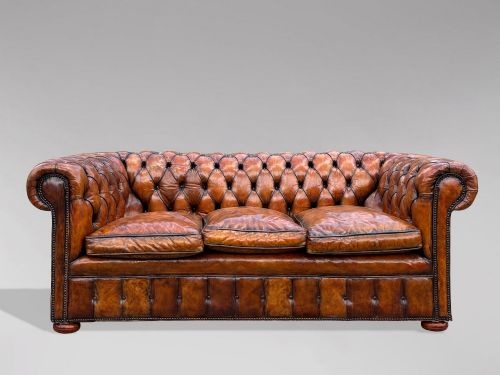
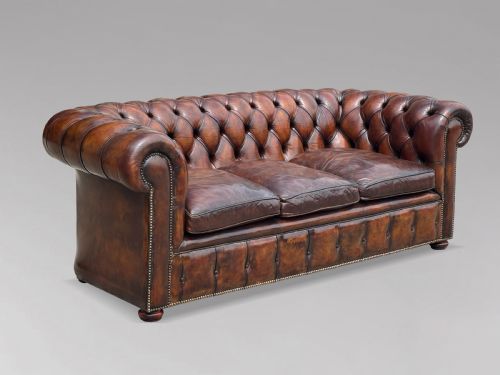
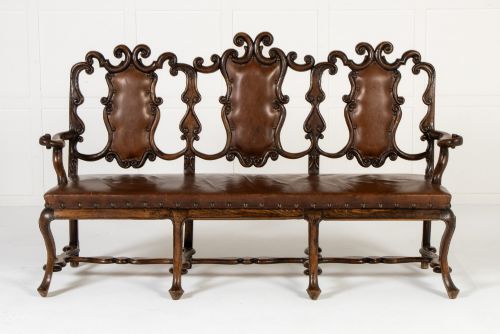
A 19th century leather sofa encompasses substantial button-backed Chesterfields, scroll-end settees, and open-arm seating upholstered in cattle hide.
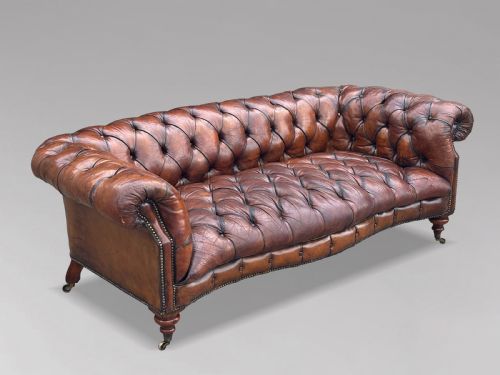
The version most commonly encountered on this page is the Victorian brown leather Chesterfield, often featuring deep tufting and hand-dyed finishes.
Makers and workshops of the period also produced structural frames in walnut, mahogany, and oak, pairing sturdy timbers with supple hides for daily use.
How they were made
Frames are constructed from dense hardwoods such as mahogany, walnut, rosewood, and oak, providing a rigid structural skeleton that supports heavy upholstery.
Upholstery relies on natural leather hides, secured with brass studs and stuffed to achieve deep buttoning and resilient cushioning.
Many historic Chesterfields still retain decades of patina from quiet Victorian drawing rooms.
What varies in quality
The integrity of the internal wooden frame and the depth of the hand-carved details dictate the foundational standard of the piece.
The grade, thickness, and historical preservation of the leather surface, alongside the precision of the button tufting, separate standard examples from exceptional ones.
Howard And Sons·Hampton And Sons·Gillows
The 19th Century Leather Sofa Glossary
- Chesterfield
- A large upholstered sofa characterised by deep button tufting and rolled arms of the same height as the back.
- Goncalo Alves
- A dense exotic hardwood used in nineteenth-century furniture framing, noted for its rich figuring and durability.
- Settee
- A medium-sized upholstered seat with a back and arms, designed to accommodate multiple people.
- Scroll end
- A furniture arm or frame termination that curves outward in a spiral or scroll shape.
- Show frame
- A wooden structural framework left exposed around the upholstered elements to display the carved timber.
19th Century Leather Sofa: Frequently Asked Questions
How do I care for old leather?
Maintenance requires regular dusting with a soft cloth and the application of appropriate leather balms to prevent drying and cracking.
Keeping the piece away from direct sunlight and heat sources preserves the natural oils within the hide.
Are these sofas comfortable for daily use?
These seating options were built with robust internal springing and firm padding designed to support upright posture over long periods.
While firmer than modern foam cushions, their traditional construction offers durable ergonomic support.
How do I identify a Victorian piece?
Identification relies on observing stylistic markers such as heavy walnut show frames, deep buttoning, and specific revival design motifs.
Documentation, timber selection, and traditional joinery methods further confirm the nineteenth-century origin.
Can I place these near radiators?
Placing antique leather furniture close to direct heat sources causes the hide to dry out, warp, and eventually split.
Maintaining a stable room temperature protects both the leather upholstery and the underlying hardwood frame.