
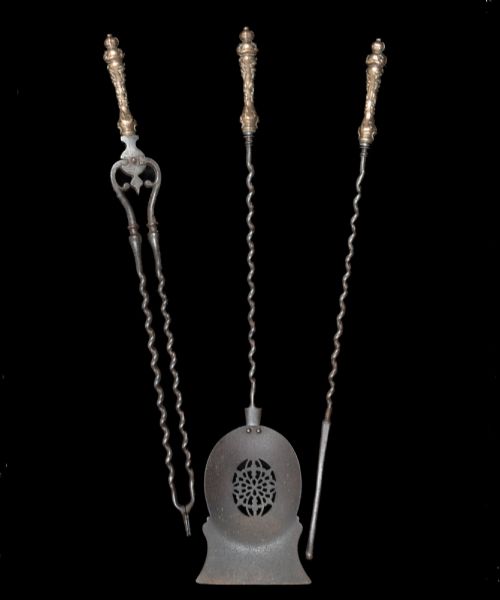
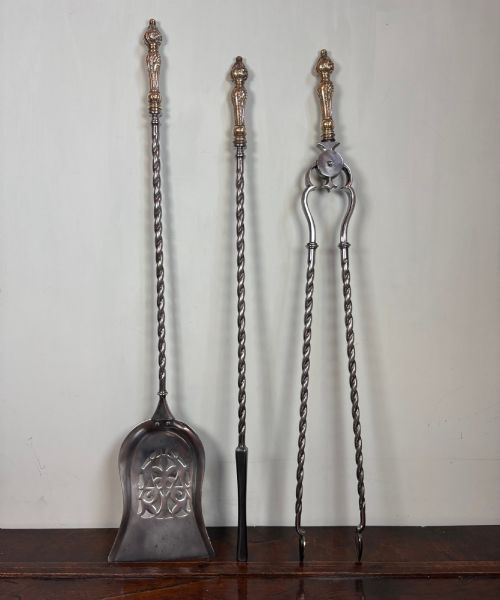


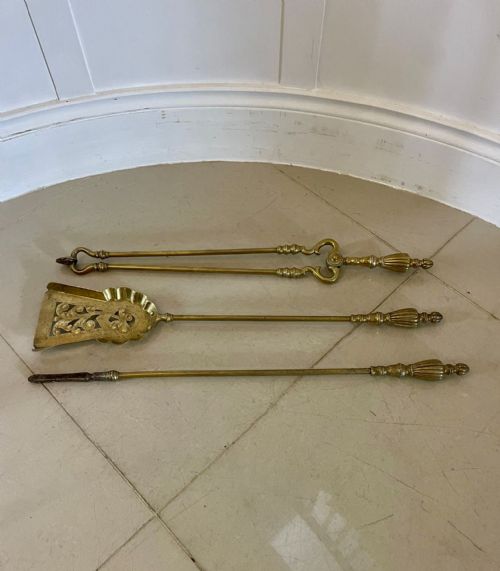


19th Century Hearth Tools
These 19th century hearth tools bring genuine period utility and character to an open fire, combining practical metalwork with the robust designs of the era.
19th Century Hearth Tools
When you search for 19th century hearth tools, you encounter functional equipment designed to manage an active fire in the home. These pieces span the 19th century, incorporating Victorian, Georgian, and Arts & Crafts styles alongside regional examples like Scottish vernacular and French country designs.
The selection on this page centres primarily on matched or assembled sets of fire irons, including shovels, tongs, and pokers. Alongside these traditional tools, the listings include andirons, fire dogs, log grabbers, and kitchen utensils intended for hearth use.
Most pieces date from the broader Victorian period, with specific pieces attributed to decades such as the 1860s, 1870s, and 1880s, as well as the early 19th century. Buyers will find that brass and steel dominate the material palette, often paired together within a single set.
How they were made
Smiths and metalworkers utilised solid brass, wrought iron, and steel to forge these hardworking implements. Techniques included hand-forging for iron and wrought iron pieces, which created durable, utilitarian items suited to daily use.
Steel surfaces frequently received a polished or burnished finish to reflect the flickering light of the hearth. Brass components were cast or turned, providing a bright contrast to the darker iron and steel elements of the fire sets.
Design influences span formal Victorian and Georgian tastes to rustic country, French provincial, and Scottish vernacular expressions.
What varies in quality
Quality in these implements rests on the weight of the metal and the integrity of the original construction. Heavier gauge steel and substantial cast brass elements indicate a higher standard of manufacture intended to withstand heavy domestic service.
Refinement in the handle design and the balance of individual pokers, tongs, and shovels also separate standard utilitarian sets from more ambitious examples. Pieces bearing specific stylistic traits, such as Arts & Crafts detailing, display greater attention to decorative design.
The 19th Century Hearth Tools Glossary
- Fire irons
- A matched or assembled set of implements used to tend a domestic fire, typically comprising a shovel, tongs, and a poker.
- Andirons
- Horizontal metal supports placed in a fireplace to hold logs above the hearth floor for better air circulation, also known as fire dogs.
- Burnished steel
- Steel that has been mechanically polished to a smooth, bright finish, enhancing its reflectivity and resistance to surface wear.
- Wrought iron
- Iron that has been heated and hammered into shape by a smith, identifiable by its fibrous grain and hand-forged texture.
- Bannock turner
- A traditional flat utensil used for baking or turning flatbreads over an open fire, found within regional vernacular collections.
19th Century Hearth Tools: Frequently Asked Questions
How do I clean brass fire tools?
Maintenance depends on the desired finish, though gentle cleaning with a soft cloth preserves the historic surface of the metal.
Avoid abrasive compounds that strip away the aged patina accumulated over decades of use.
Can I use these fire tools daily?
Most of these pieces were built for active service and remain robust enough for regular operation beside an open fire.
Heavier iron and steel items handle daily stoking well, while lighter brass sets benefit from more careful handling.
What is the difference between polished and burnished steel?
Polished steel achieves its reflective quality through fine abrasive smoothing, creating a bright and even surface appearance.
Burnished steel involves compressing the metal surface under friction to yield a dense, lustrous finish that resists oxidation.
How do I date a set of fire tools?
Dating relies on observing manufacturing techniques, material combinations, and stylistic markers characteristic of specific periods like the Victorian era or Arts & Crafts movement.
Handle designs and assembly methods often point to the decade in which the metalwork was forged.