





19th Century Demilune Console
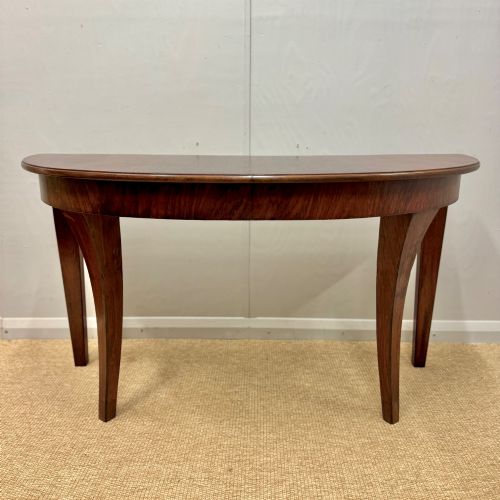
A 19th century demilune console offers a half-round silhouette that sits flush against a wall while bringing period proportion to an entrance hall or drawing room.
19th Century Demilune Console
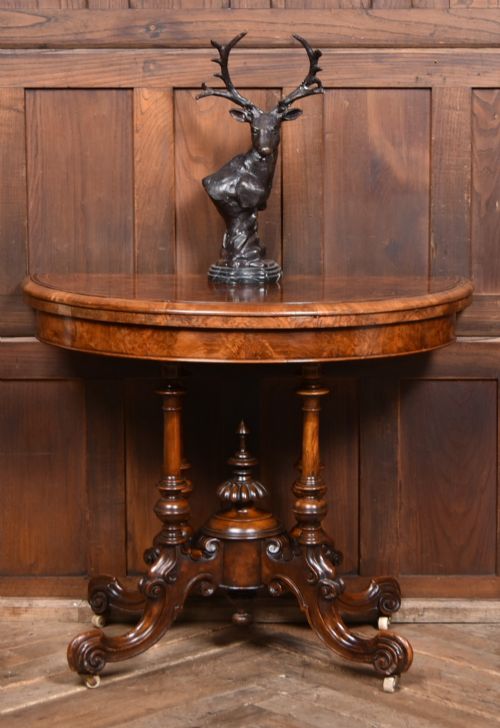
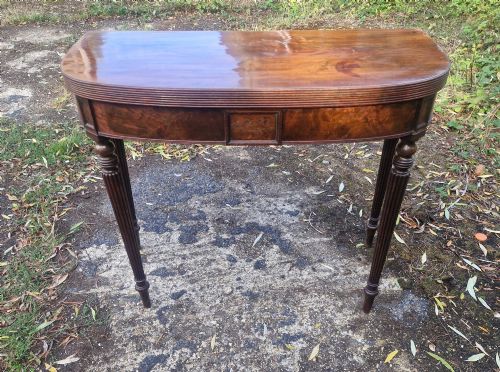
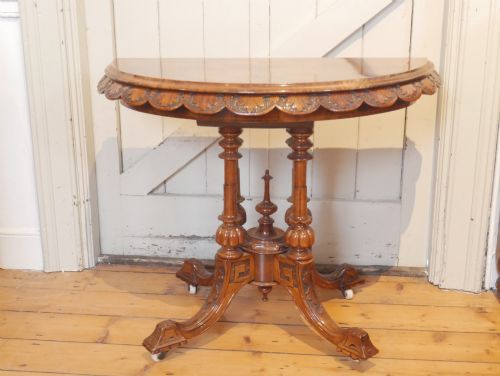
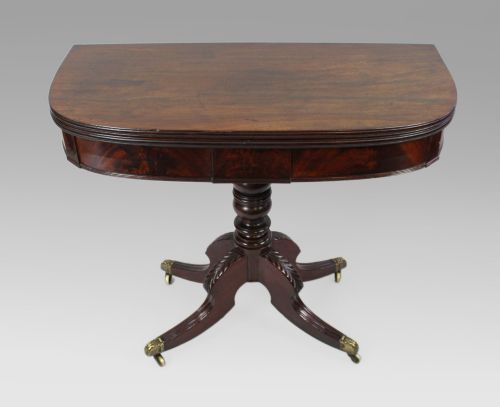
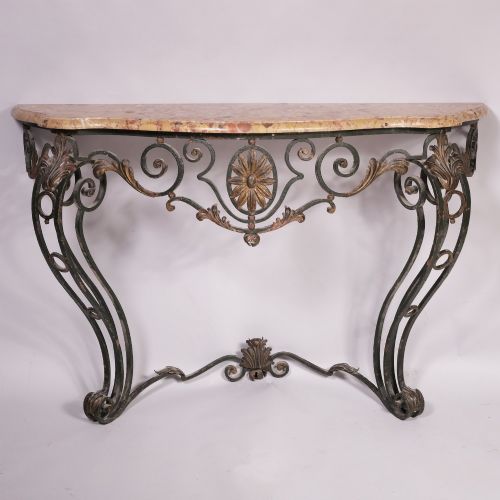
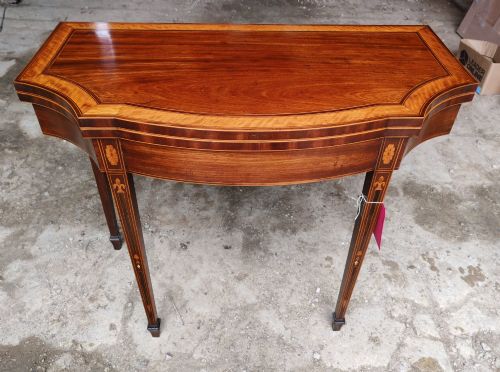
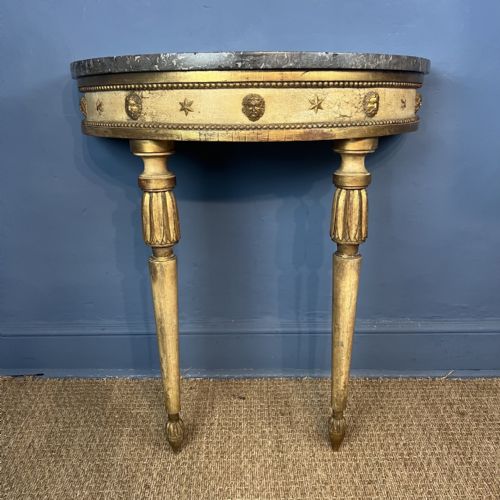
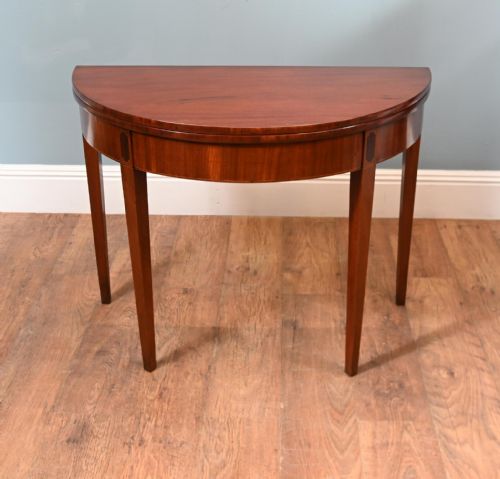
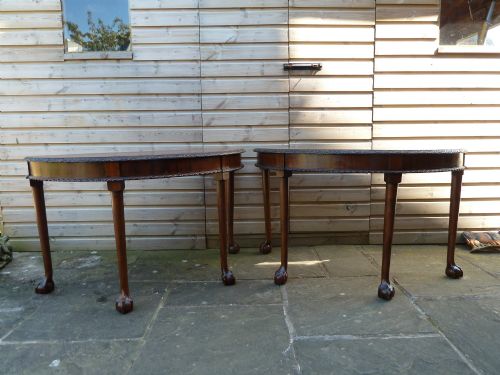
A 19th century demilune console appears in various guises across this selection, spanning card tables, games tables, tea tables, and dedicated wall consoles. These pieces emerge from Georgian, Regency, and Victorian periods, often displaying the characteristic half-round or D-shaped footprint designed to save space.
The versions most commonly met on this page are constructed from mahogany or walnut, frequently featuring fold-over tops that transform a side table into a playing surface. Makers of the era also produced console tables topped with marble or decorated with marquetry, drawing upon Neoclassical, Sheraton, and Louis XV design manners.
Materials and Construction
Cabinet makers utilised dense timbers such as mahogany, rosewood, walnut, and satinwood, frequently applying burr veneers or contrasting boxwood stringing to create decorative surface patterns. Frames incorporate solid secondary woods with precise joinery to support heavy marble slabs or hinged folding tops.
Surface ornamentation relies on hand carving, parcel gilding, and floral marquetry rather than cast components. Legs range from straight tapering supports to concave profiles, dolphin carvings, or shaped pedestals characteristic of Regency and Victorian workshops.
Marble-topped console tables appear frequently alongside wooden fold-over card and tea tables from the early 19th century.
The Distinction of Execution
Quality rests upon the selection of timber and the precision of the cabinet work, particularly where veneers meet at curved edges and corners. Superior examples display tightly figured grains, such as burr walnut or flame mahogany, matched symmetrically across the demilune top.
Structural integrity in the hinge mechanisms and leg assemblies separates finer pieces from more utilitarian workshop output. A well-executed console maintains smooth movement in its folding top and crisp definition in its carved or inlaid details without reliance on heavy restoration.
Thonet·Gillows
The 19th Century Demilune Console Glossary
- Demilune
- A half-moon shape characteristic of tables and consoles designed to stand flat against a wall. This profile became particularly popular during the Georgian and Regency periods for space-saving elegance.
- Fold-over
- A table top hinged along the back edge that opens out to double its surface area, frequently revealing a baize-lined interior for card games. This mechanism allows a compact console to function as a games or tea table.
- Marquetry
- The art of applying pieces of veneer to a structure to form decorative patterns and pictorial designs. Victorian makers utilised contrasting timbers like satinwood and walnut to achieve floral motifs.
- Parcel gilt
- Partially gilded woodwork where gold leaf highlights specific carved details such as mouldings or feet. This technique often appears on Regency and Neoclassical console frames.
- Stringing
- Thin inlaid lines of contrasting wood used to outline the edges of table tops and drawer fronts. It provides a crisp border that defines the geometric shape of the furniture.
19th Century Demilune Console: Frequently Asked Questions
How do I use a demilune console today?
These tables fit easily into narrow hallways, living rooms, or dining spaces where a full-depth table would block foot traffic. Many examples feature folding tops that open out when guests gather for games or tea.
Positioning one beneath a mirror or painting creates a traditional focal point while providing a surface for lamps or decorative objects.
What is the difference between a console and a card table?
A console table stands permanently against a wall as a decorative and functional support for objects. A card table incorporates a hinged top that unfolds to reveal a playing surface.
Many 19th-century demilune tables were built to serve both functions, remaining closed against the wall until needed for evening entertainment.
How do I identify a Regency period piece?
Regency furniture draws heavily upon classical Greek and Roman motifs, featuring clean lines, mahogany or rosewood veneers, and sometimes brass inlay or parcel gilt accents. The legs often show concave shaping, reeding, or animal forms.
These pieces typically date from the early decades of the 19th century and exhibit restrained elegance compared to later Victorian ornamentation.
Are marble tops original to these tables?
Many console tables designed in the 19th century incorporated heavy marble slabs to provide a durable surface for display. These stone tops were fitted directly into the wooden frames during manufacture.
Examining the underside and the fit against the wooden moulding helps confirm whether the marble belongs to the original construction of the table.