
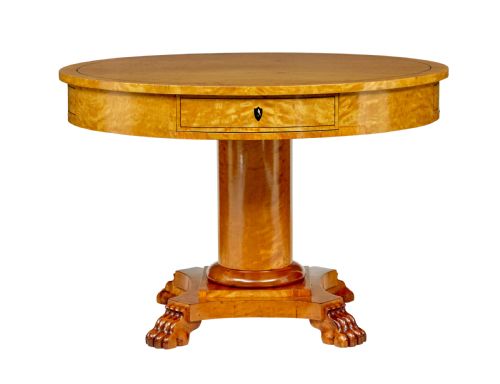
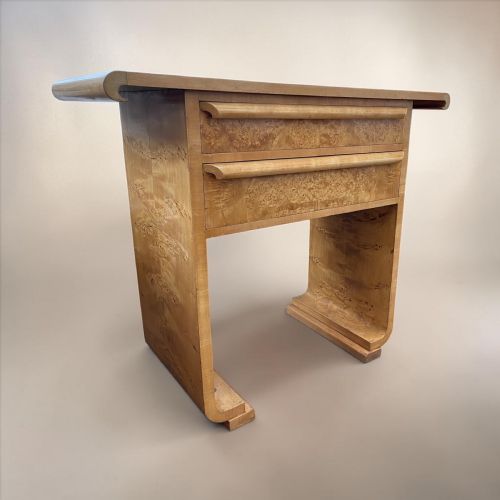


Blonde Wood Hall Table
These blonde wood hall table pieces offer pale timber surfaces in console, centre, and side forms, bringing practical proportion and quiet grain movement to narrow spaces.
Blonde Wood Hall Table
A blonde wood hall table encompasses console tables, centre tables, and side tables constructed from lighter timbers like birch, maple, and ash. These items span the nineteenth century, the Edwardian era, and the art deco period, fulfilling narrow passage requirements.
The most common forms seen on this page are nineteenth-century console tables and centre tables rendered in birch, maserbirch, and maple. Swedish Biedermeier and Victorian examples dominate the selection, often featuring circular or half-round configurations suited to wall placement.
Makers and designers range from individual cabinetmakers working in the nineteenth century to notable commercial houses like Fortnum and Mason during the art deco epoch. Buyers encounter various regional expressions, including Hungarian ash and satin birch variants.
How they were made
Construction relies on pale hardwoods and exotic veneers applied to carcase timbers, with birch, maple, and ash forming the primary visual elements. Cabinetmakers selected burr maple and maserbirch for their intricate grain patterns, often contrasting them with ebonised wood or ebony details.
Surface treatments and secondary materials include glass inserts and polished timber finishes that highlight the natural blonde hue of the wood. Techniques range from neoclassical revival veneering to nineteenth-century turning and joining methods.
Some tables wear their ebonised details like sharp evening dress against pale blonde timber.
What varies in quality
The refinement of the timber selection dictates the visual hierarchy, with matched burr maple or maserbirch veneers representing superior cabinetmaking over plain stock. Natural figuring, grain continuity across surfaces, and the crisp execution of empire revival or Biedermeier moulding separate standard examples from finer works.
Structural integrity and the fidelity of period details, such as ebonised accents and glass integration, govern the overall standard of each console or centre table. The precision in handling pale timbers without muddying their natural colour demonstrates the maker's skill.
Fortnum and Mason
The Blonde Wood Hall Table Glossary
- Console table
- A table designed to stand against a wall, frequently supported by brackets or front legs. These items often feature half-round or rectangular tops suited to narrow hallways.
- Maserbirch
- A figured variety of birch showing knotty or swirling growth patterns. Cabinetmakers prize this timber for its decorative veneer qualities in Biedermeier furniture.
- Biedermeier
- A Central European style spanning the nineteenth century characterised by utilitarian comfort and clean lines. This aesthetic highlights the natural beauty of blonde woods without excessive ornamentation.
- Centre table
- A freestanding table intended to stand away from walls as a focal point in a room. Circular and octagonal shapes appear frequently in nineteenth-century and Edwardian examples.
- Ebonised wood
- Timber treated with a dark stain or finish to imitate ebony. Makers utilise this technique to create sharp contrasts against pale maple and birch surfaces.
Blonde Wood Hall Table: Frequently Asked Questions
Where should I place a blonde wood hall table?
These tables suit narrow entranceways, hallways, and reception rooms where pale timber surfaces reflect light and maximise spatial perception. Half-round console variations sit flush against walls, while circular centre tables function best in wider landings.
Selecting the correct form depends on the architectural flow of your interior. Console shapes preserve floor area, whereas side and occasional tables offer adaptable surface space.
How do I identify a Biedermeier table?
Biedermeier pieces typically display restrained neoclassical proportions combined with prominent use of light woods such as birch and maserbirch. Ornamentation remains minimal, allowing the natural grain to define the visual character.
Construction methods from this nineteenth-century period focus on clean geometric lines and polished timber surfaces. Makers avoided heavy carving in favour of smooth, uninterrupted veneers.
How do I care for antique maple and birch surfaces?
Maintain blonde wood surfaces by dusting with a soft, dry cloth and avoiding direct, prolonged exposure to sunlight. Excessive light can alter the tone of pale nineteenth-century timbers over time.
Apply specialist furniture wax sparingly to nourish the wood and preserve the polished finish. Avoid silicone-based sprays which can degrade historic varnish layers.