


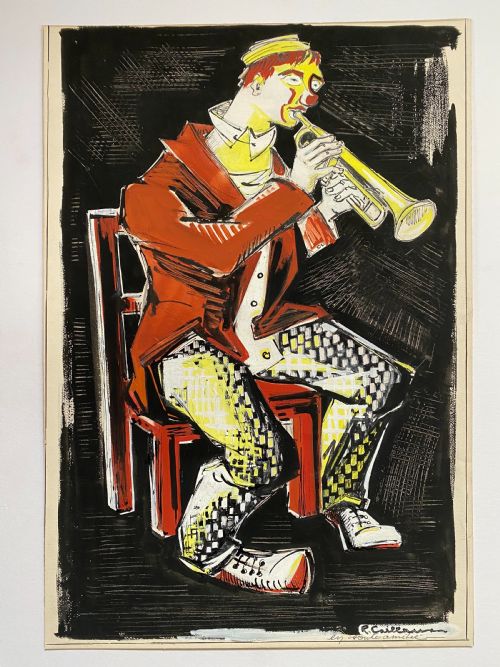


1950s Original Paper Painting
A 1950s original paper painting delivers the immediate, unvarnished touch of mid-century hand-applied pigment directly to your wall.
1950s Original Paper Painting
A 1950s original paper painting brings mid-century modernism, post-impressionism and realism straight to the wall through direct works on paper.
The selections span from 1950 to 1960, showing vibrant French gouache, expressive watercolours, ink studies and pastel portraits.
Subjects range from Mediterranean landscapes and botanical studies to portraits, street scenes and dynamic musical depictions.
How these works were made
Artists built these compositions primarily using gouache, watercolour, ink and pastel applied directly onto paper supports.
Framing commonly incorporates glass and light wood to protect the delicate paper surfaces while maintaining mid-century aesthetics.
Current listings encompass works dated from 1950 to 1960, utilising paper, glass, wood, gouache, watercolour, ink and pastel.
What varies in quality
Quality rests upon the sureness of the hand, where decisive brushstrokes in gouache or watercolour distinguish masterly execution from hesitant practice.
The strength of composition and clarity of mid-century expression elevate certain works above standard illustrative records.
Louie Stanley Maurice Prince·Adrian Heath·Lester Epstein·Archille Zavatta·Murphy·Henry J Neave·R Goodhind
The 1950s Original Paper Painting Glossary
- Gouache
- An opaque watercolour paint that dries to a matte finish, widely utilised for vibrant mid-century colour fields.
- Pastel
- A dry medium of powdered pigment bound into sticks, allowing for immediate textural portraits and studies on paper.
- Post-Impressionism
- A style extending impressionism while rejecting its limitations, emphasising symbolic content and heavier weight in paint.
- Mid-Century Modern
- A design movement spanning roughly from the mid-1940s to the late 1960s, reflected here in abstract and expressive compositions.
1950s Original Paper Painting: Frequently Asked Questions
How should I frame a paper painting?
Mount the work behind glass using acid-free materials to prevent the paper from touching the glazing directly.
Keep the piece away from direct sunlight to preserve the fugitive nature of mid-century watercolours and gouaches.
Are these works unique?
Every piece listed under this phrase is a one-off hand-painted work rather than a mechanical reproduction.
Artists applied their chosen medium directly to the sheet, ensuring distinct brushwork and individual character in each creation.
How do I identify a 1950s style?
Look for characteristic mid-century traits such as abstracted forms, flattened perspectives and vibrant palettes.
The subject matter often reflects post-war optimism, modernist landscapes and expressive figurative studies typical of the decade.
What is the difference between gouache and watercolour?
Watercolour relies on transparent washes that allow the white of the paper to illuminate the pigment.
Gouache includes a white filler that renders the paint opaque, producing solid blocks of flat, matte colour.