







1930s Female Nude Art
These pieces of 1930s female nude art capture the bold lines and stylised elegance of interwar design through sculpture and painting.
1930s Female Nude Art
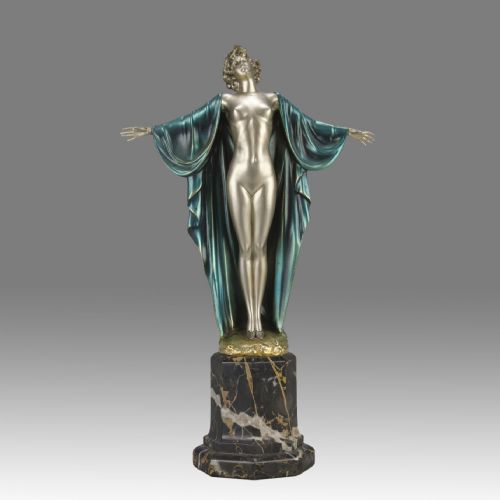
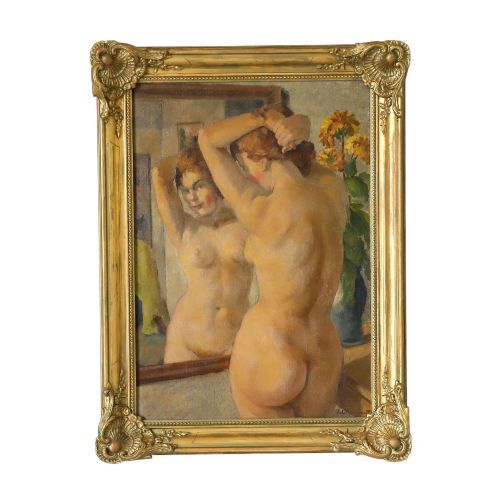
When you search for 1930s female nude art, you encounter a distinct blend of classical form and modernist geometry typical of the period. The selection on this page centres primarily on Art Deco sculptures, oil paintings, and figurative table lamps from France, England, and Sweden.
The figures frequently adopt dynamic poses such as dancers, bathers, or seated studies reflecting the artistic movements of School of Paris and Swedish Modern. These works capture the era's fascination with physical culture, movement, and stylised anatomy.
Materials and Construction
Sculptural works in this category rely heavily on cast metals including bronze, cold painted bronze, gilt bronze, and patinated spelter, frequently mounted upon heavy bases of marble or onyx. Artisans also utilised opalescent glass, porcelain, and carved wood to achieve varied surface textures and translucency.
Two-dimensional pieces use oil paint or coloured drawing media on canvas and paper. These mediums support the Post-Impressionist brushwork and linear precision seen across French and British ateliers of the decade.
Several ladies balance precariously upon hoops, glass balls, or swans, proving that 1930s balancing acts were not confined to the circus ring.
Judging Quality and Execution
Quality in these figures rests upon the crispness of the casting and the finesse of the surface finish, distinguishing a master modeller's work from standard commercial output. In paintings and drawings, the strength of the draughtsmanship and the expressive handling of the medium dictate the standing of the piece.
The integration of the figure with its functional elements, particularly in table lamps and wall sconces, separates superior design from ordinary manufacture. Cohesion between the sculptural subject and its material base signals higher workshop standards.
Ferdinand Preiss·Philippe de Rougemont·Josef Lorenzl·Henri Vincent-Anglade·Lucien Gibert·Gaetan Dumas·Sibylle May·Lucille Sevin·Royal Dux·Ugo Cipriani·C Neuhaus·Henry Bird
The 1930s Female Nude Art Glossary
- Spelter
- A zinc alloy frequently utilised as a cost-effective alternative to bronze during the interwar period. It accepts patination and metallic paint finishes readily.
- Cold painted bronze
- A method where the metal object is painted with natural cold colours rather than subjected to high kiln temperatures. This finish requires careful handling to preserve the original pigment.
- Opalescent glass
- Glass containing ingredients that scatter light to create a milky or glowing appearance. It gained widespread popularity in French decorative objects of the period.
- Post-Impressionism
- An artistic movement extending beyond French impressionism that prioritises symbolic content and geometric forms over naturalistic representation.
- Patinated metal
- Metal treated with chemicals or heat to produce a coloured surface layer. This technique enhances depth and highlights sculptural contours.
1930s Female Nude Art: Frequently Asked Questions
What defines 1930s female nude art?
These works combine traditional figurative subjects with the sharp angles, streamlined forms, and decorative luxury of the interwar decades. They reflect the dominant aesthetic movements spanning France, England, and Scandinavia.
You encounter these subjects across diverse media, from bronze cabinet figures and opalescent glass lamps to oil paintings on canvas and framed drawings.
How were figural lamps used originally?
Figural lamps served as functional art pieces designed to cast ambient illumination across domestic interiors. The female form frequently interacted with the light source, such as balancing a globe or standing beside a glowing panel.
Living with them involves placing them on side tables or desks where their sculptural silhouette and electrical fittings operate safely together.
How do I distinguish bronze from spelter?
Bronze is a heavier copper alloy that develops a deep, stable patina over decades and rings with a resonant tone when struck. Spelter is softer, lighter, and more prone to chipping beneath its painted or patinated surface.
Examining the underside or areas of wear often reveals the paler grey metal beneath a flaking spelter finish, whereas bronze remains uniform in colour.
Are these pieces strictly French?
While Paris served as the primary hub for the trade with artists and foundries operating in Montparnasse, production was international. British workshops and Swedish designers contributed significantly to the period's output.
You find English makers and Scandinavian artists represented alongside French sculptors and painters within the same aesthetic family.
What is School of Paris?
This term describes the diverse community of foreign and domestic artists who lived and worked in Paris during the decades between the world wars. They shared studios, exhibited together, and exchanged modernist ideas.
Their output in painting and sculpture rejected rigid academic standards in favour of individual expression and experimental handling of the human figure.