
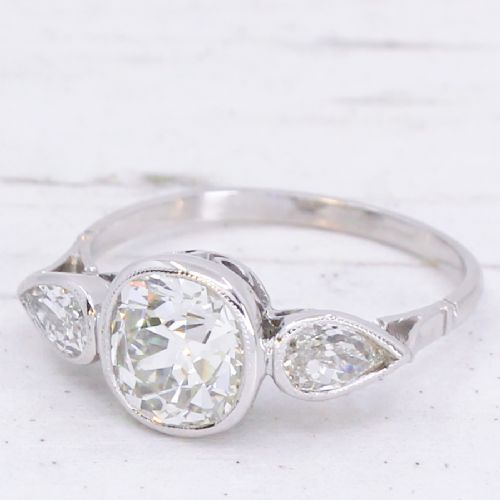
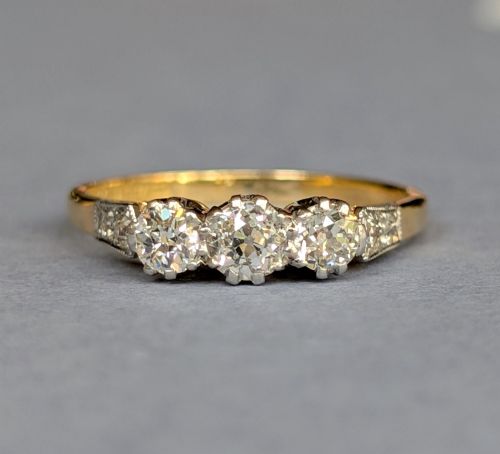


1930s Diamond Trilogy Ring
A 1930s diamond trilogy ring balances geometric restraint with exceptional brilliance, making it the definitive choice for an engagement or anniversary.
1930s Diamond Trilogy Ring
A 1930s diamond trilogy ring presents three stones mounted in a straight line, symbolising the past, present, and future. These pieces belong firmly to the Art Deco movement, carrying the crisp, architectural lines typical of the period.
The version you will most often meet on this page combines old cut diamonds or brilliant cut diamonds with platinum settings atop gold bands. Alongside pure diamond examples, many pieces set a central sapphire, ruby, or emerald flanked by diamonds.
The pieces seen here stretch from the 1920s through the 1930s and into the 1940s, capturing the evolution of geometric mounting techniques. Platinum on gold or white gold forms the standard framework for these enduring designs.
Materials and Construction
Goldsmiths of the era utilised platinum to secure diamonds, taking advantage of the metal's strength to form delicate, low-profile settings that held stones firmly while minimising visible metal. This platinum work was frequently married to yellow gold, white gold, or palladium bands.
The stones themselves display hand-cut facets, predominantly old cushion cuts, old pear cuts, and old European cuts shaped by hand rather than laser precision. This gives each stone a softer, broader flash of light compared to modern brilliant cuts.
1930s Diamond Trilogy Ring Retail Price Guide 2026
Typical asking prices for 1930s diamond trilogy ring among the pieces listed under this phrase on Sellingantiques today, from the lower quarter to the upper quarter. They describe what is for sale here now, not the wider market.
Some rings hide tiny geometric pierced galleries underneath, visible only to the wearer when the hand turns toward the light.
Judges of Quality
Quality rests in the harmony of the three principal stones and the crispness of the metalwork surrounding them. Top-tier examples show a balanced proportion where the side stones complement the central gem without one overpowering the composition.
The precision of the geometric platinum work defines the upper end of the range. Master jewellers achieved microscopic grain-setting and sharp pierced galleries that elevate simple three-stone layouts into architectural sculptures.
The 1930s Diamond Trilogy Ring Glossary
- Trilogy ring
- A ring featuring three principal stones set in a row. This design gained immense popularity during the Art Deco era.
- Old cut diamond
- A diamond cut by hand before modern machinery standardised proportions. These stones feature smaller tables and larger culets.
- Art Deco
- A design style spanning the 1920s and 1930s characterised by geometric symmetry, clean lines, and stylised motifs.
1930s Diamond Trilogy Ring: Frequently Asked Questions
How do I style a trilogy ring?
Living with a vintage trilogy ring involves appreciating its low-profile Art Deco architecture. Because the settings sit close to the finger, they suit daily wear when paired with care.
Many collectors wear them alone as statement engagement rings or stack them with plain wedding bands that match the yellow or white gold of the original shank.
How are sapphires and rubies used?
Many period pieces substitute the outer or central diamonds with natural corundum, specifically Burmese sapphires or Colombian emeralds and rubies. These coloured gems add striking contrast against the bright white platinum settings.
Such three-stone variations remain faithful to the geometry of the Art Deco movement while introducing rich tones into the jewellery.
How do I identify the period?
Identifying the era requires examining the combination of metals and the cut of the stones. Pieces from this decade typically employ platinum-topped gold construction alongside hand-cut old European or cushion diamonds.
Stylistic cues include stepped shoulders, geometric pierced work under the gallery, and hallmarks stamped into the inner shank indicating gold fineness.