
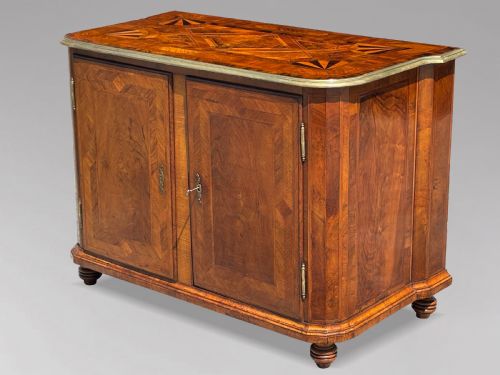


18th Century Walnut Buffet
An 18th century walnut buffet brings substantial regional character and warm timber tones to a dining space.
18th Century Walnut Buffet
When you search for an 18th century walnut buffet, you enter a domain of sturdy provincial storage pieces originating mainly from France and Italy. These forms serve as serving cabinets, commodes, and cupboards designed to anchor a room with functional presence.
Most examples found here date to the 18th century, though occasional later interpretations from around 1900 and 1910 appear in similar stylistic veins. Styles range from French Provincial and Italian Baroque to Queen Anne and Georgian interpretations.
Beyond standard sideboards, the forms stretch to include two-body cupboards, dressers, and dumb waiters. Walnut remains the unifying material, often paired with secondary woods like cherrywood or oak.
Materials and construction
The primary material across these pieces is walnut, valued for its rich grain and dependable density. Cabinetmakers frequently incorporated fruitwood, cherrywood, and oak into the secondary framing and interiors.
Decorative techniques rely on physical construction and surface enrichment rather than applied ornament. Marquetry inlay appears on select serving pieces, while crossbanded borders frame drawer fronts and panels.
Metal hardware plays a structural and visual role, with brass and iron mounts, handles, and hinges securing doors and drawers. Carved details emerge directly from the solid walnut timber on regional French and Italian bodies.
Some dumb waiters even managed to carry the dessert course without dropping a single tart.
Judging quality in walnut furniture
Quality rests in the harmony of the timber selection and the integrity of the regional construction. Pieces featuring rich, figured walnut grain and deliberate marquetry inlay stand apart from plain utility surfaces.
The refinement of the carving dictates much of the distinction between workshops. Crisp, confident hand-carving on structural elements shows greater maker skill than repetitive or soft moulding profiles.
Originality of surface finish and hardware substantially influences the character of a piece. Retaining period brass or iron mounts alongside stable, honest timber movement marks the better survivors of this era.
The 18th Century Walnut Buffet Glossary
- Buffet
- A low sideboard or cabinet traditionally used for storing and serving food. These storage pieces anchor dining rooms with broad timber surfaces.
- Marquetry
- Decorative inlay work using various woods to create pictorial or geometric patterns on the surface. It adds visual complexity to cabinet doors and tabletops.
- Commode
- A low freestanding cabinet or chest of drawers developed in France during the 18th century. They offer enclosed storage behind hinged doors or stacked drawers.
- Crossbanded
- A border technique where veneer is laid with the grain running perpendicular to the central panel. This frames drawer fronts and tabletops with a contrasting border.
- Dumb waiter
- A tiered movable serving stand designed to hold dishes without requiring a servant present. These pieces utilise central columns supporting rotating or fixed circular trays.
18th Century Walnut Buffet: Frequently Asked Questions
What is a buffet deux corps?
A buffet deux corps is a large two-body storage piece featuring a smaller upper cupboard stacked securely upon a deeper lower sideboard base.
These monumental items provide expansive display and linen storage for large dining halls.
How do I care for antique walnut?
Keep walnut furniture away from direct heat sources and drastic humidity shifts to prevent the timber from splitting or warping.
Apply a gentle beeswax polish occasionally to nourish the grain and maintain a natural protective sheen.
Are French and Italian buffets different?
French provincial buffets tend to feature softer serpentine lines and restrained carved panels suited to domestic rural settings.
Italian examples often lean into heavier baroque or rococo flourishes with pronounced architectural mouldings.