



18th Century Parquetry Sideboard
An 18th century parquetry sideboard brings geometric wood patterning and period weight into a room.
18th Century Parquetry Sideboard
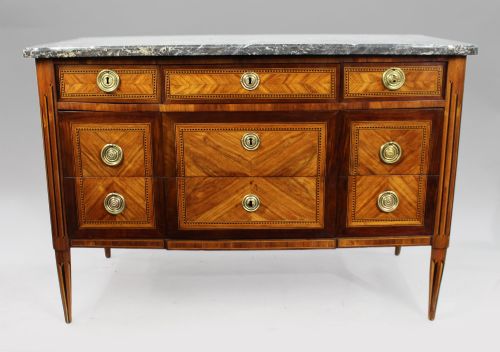
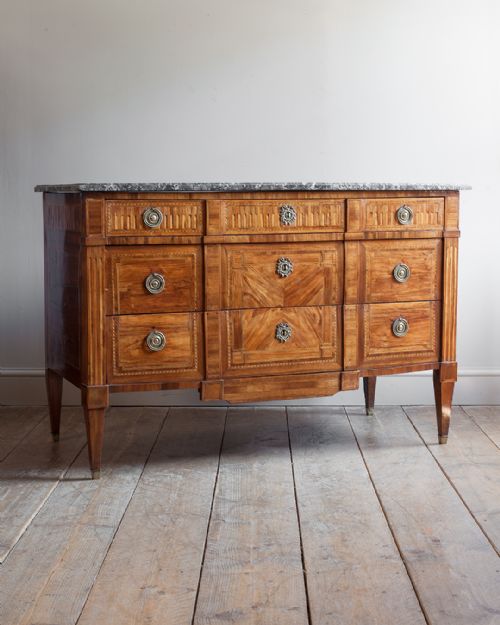
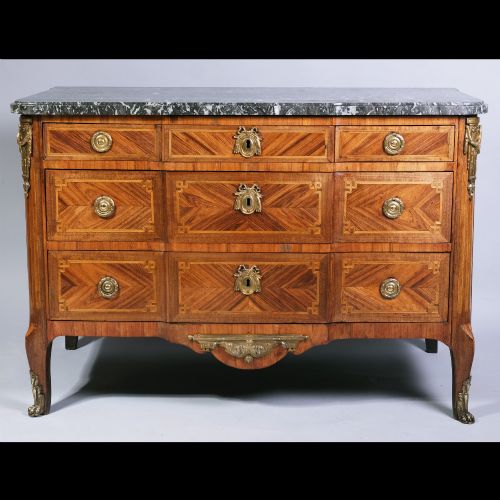
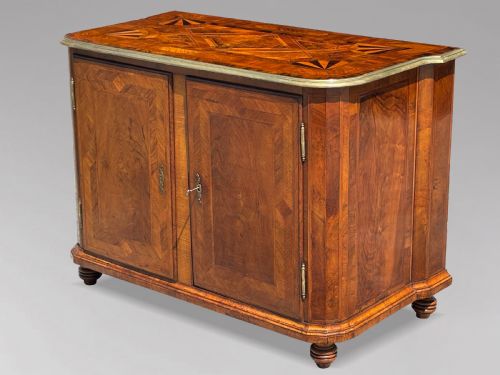
When you search for an 18th century parquetry sideboard, you encounter case pieces and serving tables defined by geometric wood veneers. The selections here predominantly span commodes and chests of drawers configured with parquetry surfaces from the 18th century. Origins reach across French, Italian, Austrian, and English workshops, encompassing styles from Louis XVI and Régence to Chippendale and Baroque.
Maltese and continental examples sit alongside English serving tables, showing the broad geography of this cabinetwork. You meet bombé profiles and breakfront shapes rather than standard straight-fronted sideboards, reflecting how 18th century cabinetmakers approached storage and display. Walnut and kingwood dominate the timber work, frequently paired with marble tops and cast mounts.
Materials and construction
Cabinetmakers constructed these pieces using dense carcases of walnut and kingwood, overlaid with precise geometric fruitwood veneers arranged in parquetry patterns. The timber selection relied on contrasting grains to create optical depth across the drawer fronts and sides.
Mounts of cast ormolu and brass accent the corners, keyholes, and legs, while heavy marble slabs form fitted tops on many of the continental commodes. Iron hardware frequently secures internal drawer construction, hidden behind the decorative exterior surfaces.
18th Century Parquetry Sideboard Retail Price Guide 2026
Typical asking prices for 18th century parquetry sideboard among the pieces listed under this phrase on Sellingantiques today, from the lower quarter to the upper quarter. They describe what is for sale here now, not the wider market.
Current listings feature walnut, kingwood, fruitwood, and mahogany across French Louis XVI, Régence, Baroque, and Chippendale styles.
Judging quality in parquetry furniture
The sophistication of the veneer geometry dictates the upper tier of these pieces, where grain alignment and timber contrast demand advanced carpentry. Simpler executions rely on straightforward planking or repetitive patterns with less tonal variation between the woods.
The integration of metal mounts and stone tops separates standard joinery from high-status items. Fine-grained ormolu and thick, contoured marble slabs demonstrate workshop investment, whereas secondary woods and plain hardware indicate more utilitarian production.
The 18th Century Parquetry Sideboard Glossary
- Parquetry
- A geometric mosaic of wood veneers laid down in patterns like cubes, chevrons, orlozenges. This technique relies on precision sawing and fitting.
- Bombe
- A swelling, outward-curved commode profile that bulges outward on the front and sides. Cabinetmakers used this curved form extensively in French and continental workshops.
- Ormolu
- Gilded bronze used for decorative mounts and feet on high-end furniture. The metal is cast, chased, and coated in gold leaf.
- Breakfront
- A cabinet or commode facade where the central section projects forward from the flanking sides. This architectural arrangement creates shadow lines across the storage units.
- Kingwood
- A dense, heavy tropical timber displaying rich dark brown tones with golden streaks. Makers utilised it extensively for contrasting banding and veneered surfaces.
18th Century Parquetry Sideboard: Frequently Asked Questions
How do I identify French Louis XVI style?
Louis XVI pieces display straight tapering legs, rectilinear carcases, and classical symmetry. The ornamentation draws on ancient Roman and Greek motifs.
Parquetry on these items tends toward crisp geometric cubes and trellis patterns rather than the asymmetrical curves of earlier periods.
Where were these pieces made?
Production centres span France, Italy, Austria, Malta, and England. Each region developed distinct proportions and timber preferences.
French workshops favored kingwood and ormolu mounts, while English makers utilised mahogany for serving tables.
How do I care for marble tops?
Marble surfaces require regular dusting with a soft cloth and immediate blotting of acidic liquids. Avoid harsh chemical cleaners that etch the stone.
Waxing the surrounding wooden parquetry protects the veneer without risking contact with the fitted stone insert.