



Continental Parquetry Commode
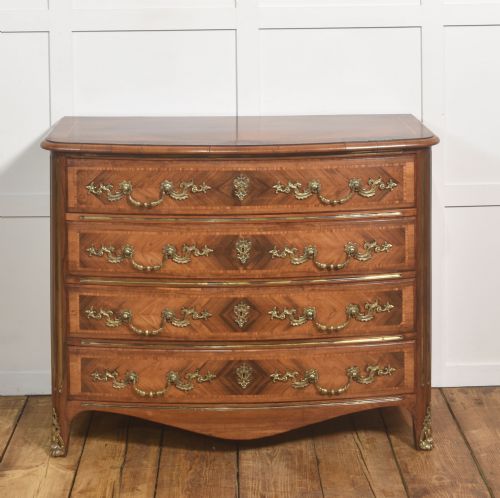
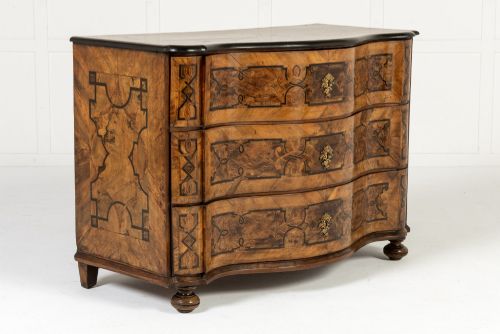
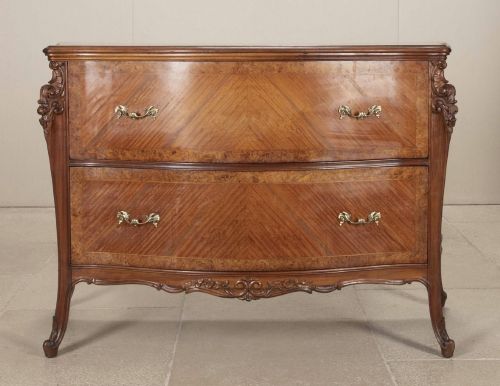
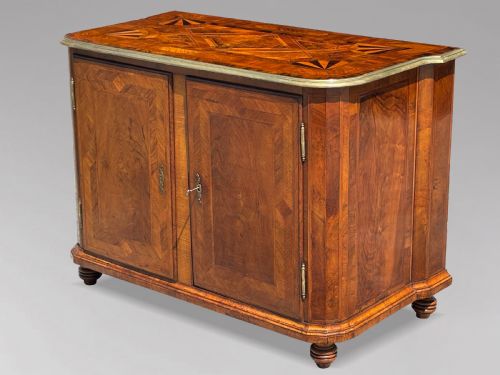
A continental parquetry commode brings geometric wooden patterns and serpentine drawers to a room.
Continental Parquetry Commode
A continental parquetry commode functions as a decorative chest of drawers originating from European workshops. When you search for this phrase, you find pieces designed for grand interiors with substantial storage capacity.
The selections here span from the eighteenth century through to the twentieth century, encompassing styles from German Baroque to French Louis XV. The forms range from bombe profiles to breakfront arrangements with shaped drawer fronts.
Maltese, Italian, Austrian and French examples appear frequently alongside general continental items. Buyers encounter variations in wood species and decorative veneers rather than standard rectangular drawer chests.
How they were made
Cabinetmakers constructed these chests using solid structural timbers overlaid with decorative veneers arranged in precise geometric patterns. Walnut, fruitwood, kingwood, burr walnut and satinwood provide the contrasting tones seen across the parquetry surfaces.
Metal mounts in ormolu and brass accent the corners, handles and feet of many pieces. Stone masons fitted shaped marble slabs to the upper surfaces of selected commodes to complete the construction.
Continental Parquetry Commode Retail Price Guide 2026
Typical asking prices for continental parquetry commode among the pieces listed under this phrase on Sellingantiques today, from the lower quarter to the upper quarter. They describe what is for sale here now, not the wider market.
The inventory includes items spanning the eighteenth, nineteenth and early twentieth centuries.
What varies in quality
The precision of the veneer work and the complexity of the parquetry layout determine the distinction between standard and superior examples. Artisans who achieved seamless transitions across serpentine curves and bombe contours produced work of the highest order.
The choice of cabinet woods and the preservation of original mounts influence the overall standard of a commode. Finer pieces demonstrate meticulous matching of timber grains and sophisticated handling of regional styles such as German Baroque or French Rococo.
The Continental Parquetry Commode Glossary
- Parquetry
- Geometric wood inlay forming decorative patterns across a surface. Cabinetmakers arrange small blocks of contrasting timbers to create visual depth on drawer fronts and tops.
- Commode
- A low decorative chest of drawers designed for domestic rooms. These pieces typically feature multiple drawer tiers and resting on short legs or feet.
- Bombe
- A swelling, outward-curved commode profile characteristic of eighteenth-century continental furniture. This contoured shape demands advanced woodworking skill to veneer successfully.
- Serpentine
- A wave-like curved outline featuring a convex centre flanked by concave ends. This contour appears frequently on the drawer fronts of Italian and German chests.
- Ormolu
- Gilt-bronze mounts applied as decorative highlights on furniture. These cast metal elements accent the corners and handles of high-status pieces.
Continental Parquetry Commode: Frequently Asked Questions
What is a continental parquetry commode?
A continental parquetry commode is a European chest of drawers decorated with geometric veneer patterns. These pieces serve as storage furniture with elaborate decorative surfaces.
They originate from various European regions including Italy, Germany, France and Austria across several centuries.
How do I style a commode at home?
Place a commode against a primary wall in a living room, hallway or bedroom as a focal storage unit. The surface accommodates lamps, mirrors or decorative objects.
Ensure the proportions suit the room scale, particularly with larger bombe or breakfront examples.
How do I date an antique commode?
Dating relies on stylistic markers such as Baroque, Rococo or Neoclassical design elements combined with construction methods. Timber choices and regional characteristics provide further chronological clues.
Eighteenth-century pieces often display hand-cut joinery and specific regional veneer preferences distinct from later nineteenth-century revivals.
What is the difference between marquetry and parquetry?
Parquetry utilises geometric blocks of wood to create repeating patterns like cubes or herringbone designs. Marquetry employs varied veneers to form pictorial scenes or floral motifs.
Both techniques decorate the exterior surfaces of continental chests of drawers.