




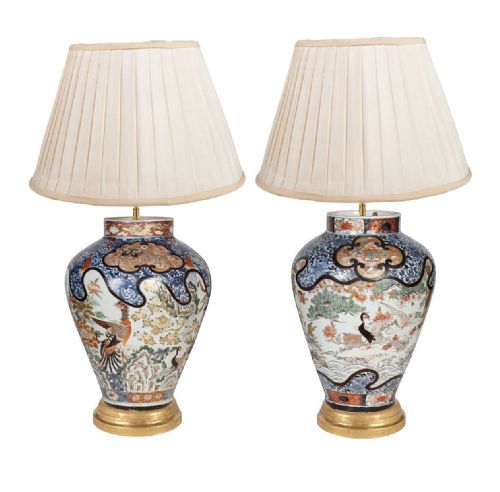
18th Century Japanese Vase
An 18th century japanese vase brings hand-painted Imari palettes and Arita porcelain into a room, offering centuries of ceramic history.
18th Century Japanese Vase
When you search for an 18th century japanese vase, you encounter Arita porcelain vessels decorated in the distinctive Imari palette. These pieces span from the late seventeenth century through the eighteenth century, with several examples originating from the Edo period. You frequently find lidded vases, trumpet shapes, and bottle forms among the available selections.
Many of these historical vessels have undergone conversion into table lamps over time, integrating older ceramic bodies with modern electrical fittings. The listings include individual pieces, pairs, and larger garnitures consisting of three matching vessels. Each form demonstrates the traditional kiln techniques of historic Japanese potteries.
Materials and construction
The foundation of these objects is Arita porcelain, shaped by hand before undergoing high-temperature kiln firing. Artisans then applied underglaze cobalt blue and overglaze enamel colours, frequently incorporating iron red and gold leaf highlights.
Certain vessels feature fitted lids or brass mounts added during later centuries, particularly when individual vases or pairs were adapted into lighting. The material composition relies on fine ceramic paste combined with mineral pigments for the characteristic palette.
18th Century Japanese Vase Retail Price Guide 2026
Typical asking prices for 18th century japanese vase among the pieces listed under this phrase on Sellingantiques today, from the lower quarter to the upper quarter. They describe what is for sale here now, not the wider market.
Some swift-footed hares and noble horses managed to trot right across eighteenth-century porcelain without ever spilling their tea.
Judging quality in historic ceramics
Quality rests upon the clarity of the hand-painted decoration and the crispness of the porcelain form. Pieces with intricate motifs, such as birds, chrysanthemums, or figures of horses and hares, demonstrate superior artistic execution.
The condition of the glaze and enamel work dictates the desirability of a piece. Vases that retain their original lids and untouched porcelain bodies command greater attention from collectors than heavily altered examples.
The 18th Century Japanese Vase Glossary
- Arita porcelain
- Japanese porcelain produced in the town of Arita in Hizen province. This material forms the durable white body characteristic of the period.
- Imari palette
- A decorative style utilising underglaze blue, iron red, and gold on a white porcelain ground. This colour scheme defines the majority of the pieces.
- Garniture
- A matched set of three or more vases designed for display together on a mantelpiece or cabinet. These sets demonstrate uniformity in design and scale.
- Edo period
- The period in Japanese history spanning from 1603 to 1868. This era encompasses the production dates of the porcelain vessels found here.
- Trumpet vase
- A vessel featuring a flared, trumpet-shaped neck widening towards the rim. This specific silhouette appears frequently among early pieces.
18th Century Japanese Vase: Frequently Asked Questions
Are these vases safe to use with water?
Many of these antique porcelain pieces have structural age or historic adaptations like lamp wiring, making them more suited for display than for holding water.
Using them as decorative objects protects the delicate overglaze enamels and any historic metal mounts from moisture damage.
How do I identify an Arita Imari piece?
Look for the characteristic combination of underglaze cobalt blue and iron red enamel, often highlighted with gold leaf on a white porcelain base.
The motifs commonly include floral patterns, birds, and traditional Japanese imagery painted during the Edo period.
Can I remove the lamp fittings?
Removing electrical components requires careful assessment, as some conversions involve drilling through the base or adding fixed brass collars.
Consulting a professional restorer ensures that the underlying porcelain is not damaged during the process of reversing any modern alterations.
How should I clean my antique vase?
Dust the surface gently with a soft, dry cloth to prevent accumulation without disturbing the fragile overglaze enamels.
Avoid chemical cleaners, abrasive sponges, and immersion in water, particularly on areas where gold leaf or enamel is present.