




18th Century Cutlery Boxes
These 18th century cutlery boxes offer refined storage for dining tables, combining period craftsmanship with practical elegance that collectors prize.
18th Century Cutlery Boxes
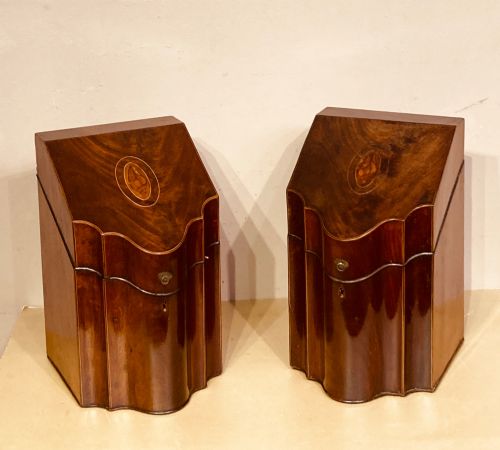
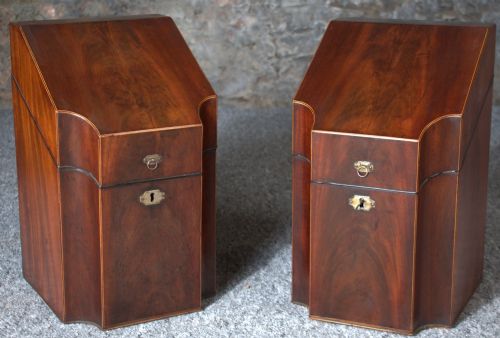
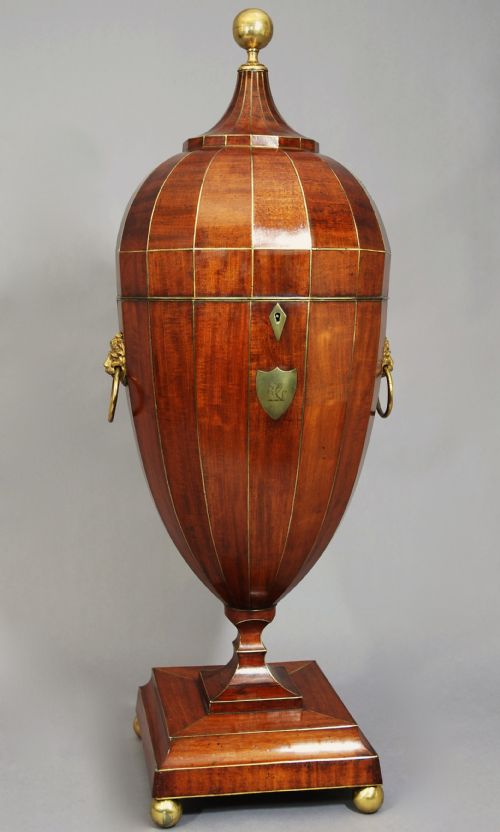
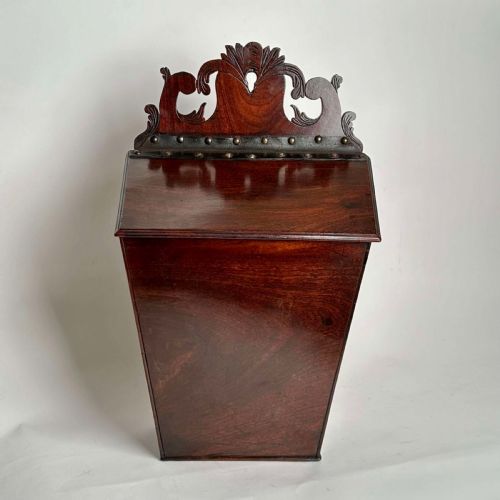
When you search for 18th century cutlery boxes, you find specialised vessels designed to house dining implements during the Georgian period. The pieces on this page primarily take the form of slanted knife boxes, elegant cutlery urns, and serpentine storage containers.
Makers constructed these items to sit on sideboards or serving tables in prosperous dining rooms. Alongside standard knife boxes, you encounter related Georgian forms such as stationery boxes, wine bottle carriers, and country oak trays.
Mahogany dominates the selection, frequently enhanced by boxwood and satinwood inlay or fitted with brass hardware. Surviving examples often appear as matched pairs, reflecting their original deployment flanking a dining room sideboard.
What varies in quality
Quality rests significantly on the choice of timber and the dexterity shown in the wood grain selection. Figured mahogany with deep, warm patination separates superior examples from plain timber carcasses.
The sophistication of the silhouette defines the upper tier of objects, particularly sharply executed serpentine or bow fronts. Subtle details such as fine boxwood stringing and well-preserved brass or silver hardware distinguish finer workshops.
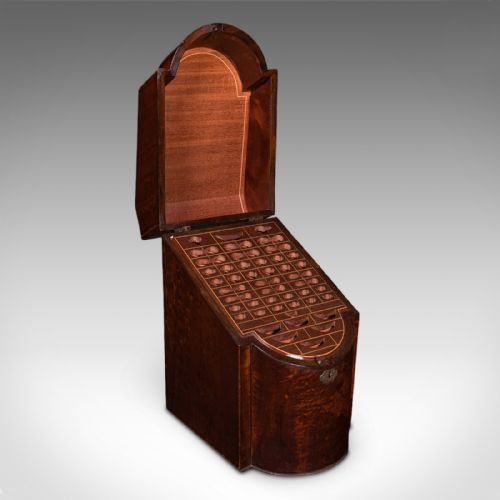
Structural integrity and the survival of internal partitions dictate desirability among collectors. Alterations, such as conversions for stationery use, influence how original the interior layout remains today.
Listings demonstrate that mahogany is the primary timber used for 18th century cutlery boxes, supplemented by Welsh oak, boxwood, and satinwood.
The 18th Century Cutlery Boxes Glossary
- Serpentine
- A curved shape featuring a convex centre flanked by concave sides, frequently seen on advanced Georgian box fronts. This contour requires immense skill from the woodworker.
- Bow front
- A convex, outwardly curved front profile that softens the rigid geometry of storage boxes. It appears on late 18th century examples.
- Inlay
- The technique of embedding contrasting woods like boxwood or satinwood into the primary mahogany surface to create decorative patterns. It defines the Sheraton style.
- Escutcheon
- A protective brass plate surrounding the keyhole of a box. It frequently incorporates a small shield or urn motif.
- Cutlery urn
- A tall, vase-shaped wooden vessel utilised for storing dining implements during formal Georgian dinners. These grand pieces stood on pedestals beside the dining table.
18th Century Cutlery Boxes: Frequently Asked Questions
What were 18th century cutlery boxes used for?
These boxes served to store silver-handled knives, forks, and spoons securely between formal dining occasions. Servants kept them locked on sideboards until meals were served.
They also functioned as status symbols in wealthy households, displaying fine mahogany and decorative brasswork to visiting guests.
Can I use an antique cutlery box for stationery?
Many period boxes are successfully utilised today to hold letters, paper, and envelopes on desks. Historical conversions sometimes occurred decades ago to adapt the pieces for writing rooms.
The internal wooden partitions often accommodate modern envelopes and small office supplies without modification.
What is the difference between a knife box and a cutlery urn?
Knife boxes feature a distinct sloping lid and vertical profile intended for sideboard placement. Cutlery urns take a monumental vase shape, often standing on a pedestal or directly on the floor.
Urns represent the grandest form of Georgian dining storage, whereas standard boxes appeared in greater numbers across typical country houses.