


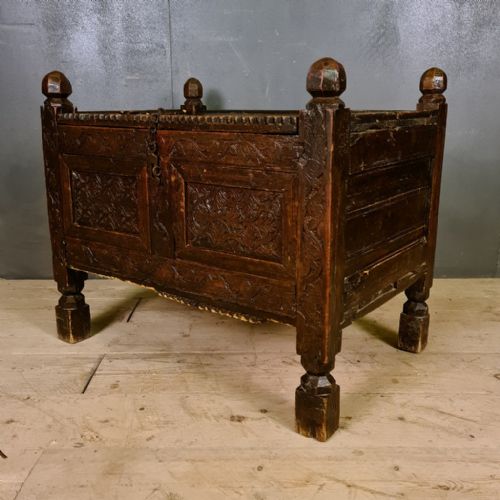


17th Century Folk Art
These pieces of 17th century folk art bring domestic utility and early domestic expression into a modern room.
17th Century Folk Art
When you search for 17th century folk art, you encounter domestic items and religious or secular carvings that reflect early European craftsmanship. The selection centres predominantly on pieces originating from Dutch and English traditions.
You meet utilitarian household objects alongside decorative works. These include oak mangle boards, slipware tavern jugs, spoon racks, coffers, and carved wooden figures.
The inventory mixes genuine period examples with later interpretations, such as mid-twentieth-century oil portraits rendered in an earlier style. Oak and earthenware dominate the physical forms.
Materials and construction
Makers utilised native timber, specifically oak and assorted woods, shaped through chip carving and panel construction. Surfaces on items such as coffer lids and mangle boards display deliberate, tactile incisions.
Potters worked in earthenware, applying lead glazes and slip to pitchers, jugs, and strawberry jars. These ceramic pieces received liquid clay decoration before firing to achieve surface patterns.
Painters used oil on canvas for portraits, while sculptors carved polychrome pigments directly onto wooden figures of Christ and secular men.
Object forms span functional kitchenware, storage chests, hand-carved figures, and framed portraits.
Judging quality and period integrity
Quality rests upon the depth and clarity of the carving alongside the preservation of original surfaces. Crisp chip carving on an oak mangle board demonstrates greater skill than blunt or heavily worn incisions.
The integrity of the glaze on slipware jugs and strawberry jars affects desirability. Stable lead glazes and intact slip trails indicate superior ceramic production.
Dating requires careful observation of tool marks and material ageing, distinguishing seventeenth-century production from later revivals or twentieth-century interpretations.
The 17th Century Folk Art Glossary
- Slipware
- Pottery decorated with slip, a liquid mixture of clay and water, applied before firing. This technique created contrasting linear or patterned designs on jugs and jars.
- Mangle Board
- A domestic wooden board used historically with a roller to smooth linen. Examples often feature elaborate chip carving and dates.
- Chip Carving
- A style of relief carving where small chips are removed from a flat wooden surface using chisels or knives. It is commonly found on seventeenth-century domestic woodwork.
- Lead Glaze
- A shiny coating applied to earthenware pottery prior to firing, providing a waterproof finish. It gives early jugs their characteristic sheen.
- Coffer
- A large wooden chest used for storage, typically constructed from oak. These sturdy boxes often feature panelled sides and hinged lids.
17th Century Folk Art: Frequently Asked Questions
What is 17th century folk art?
It encompasses domestic objects, ceramics, and wood carvings produced for everyday use or regional decoration during the seventeenth century. The category includes items made by rural craftsmen rather than court artists.
Survival rates vary by material, with durable oak and glazed earthenware forming the bulk of surviving examples today.
How were mangle boards used?
A mangle board was wrapped with damp linen and rolled back and forth with a cylindrical rolling pin to press the fabric smooth. They served as functional laundry tools in Dutch and Scandinavian households.
Because they were frequently given as courtship gifts, many display intricate chip carving and significant marriage dates.
What is slipware pottery?
Slipware involves coating earthenware bodies with a watery clay mixture to form decorative trails or backgrounds. Potters utilised this method to ornament tavern jugs and strawberry jars before the final kiln firing.
The resulting glaze preserved the decorative patterns through centuries of domestic handling.
How do I care for antique oak?
Antique oak requires stable humidity and protection from direct sunlight to prevent timber splitting or warping. Dusting with a dry cloth maintains the surface without introducing moisture.
Avoid modern liquid polishes, as they build up residue on historic wood finishes.
Are all listed pieces seventeenth century?
The material spans multiple eras, including seventeenth-century originals alongside eighteenth and nineteenth-century domestic pieces. You also find mid-twentieth-century works styled to mimic earlier portraiture.
Examining the listed period details for each item clarifies its exact age and origin.