


15ct Gold Heart
A 15ct gold heart represents a distinct period of high-karat British jewellery making, combining sentimental motifs with warm, rich gold.
15ct Gold Heart
A 15ct gold heart typically appears in Victorian and Edwardian pendants, brooches, rings, and lockets. These items utilise the characteristic warm tone of British 15-carat yellow and rose gold, a standard that was discontinued in the twentieth century.
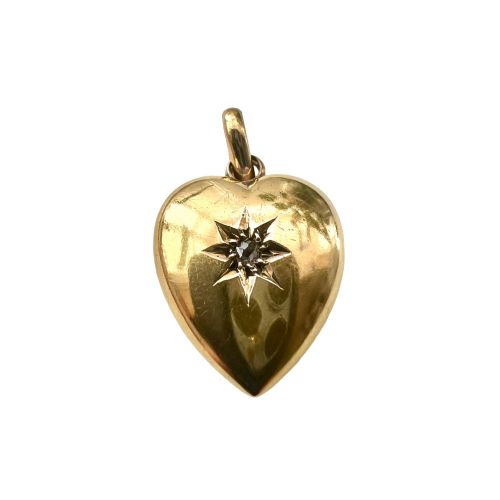
Buyers encounter numerous forms, including puffy heart pendants, double heart motifs, and hinged bangles or bracelets set with heart padlocks. Many pieces incorporate sentimental elements such as hair compartments, miniature photo frames, or engraved monograms.
The selection ranges from simple solid gold tokens to elaborate examples set with gemstones. The Victorian era provides the majority of surviving pieces, alongside Edwardian variations and occasional Georgian or later iterations.
How they were made
Goldsmiths fabricated these items using 15-carat yellow and rose gold, hammering sheet metal into hollow puff pendants or casting solid structural frames. Components were often hand-chased, engraved, or finished with guilloche enamel.
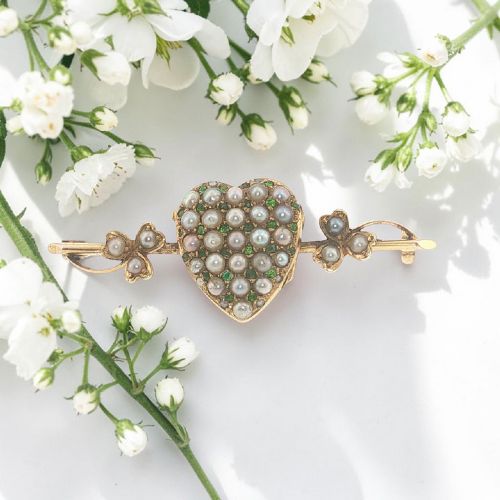
Gemstones including seed pearls, turquoise, old-cut diamonds, rubies, and garnets were secured using grain settings, collets, or seed pearl stringing techniques. Memorial pieces frequently integrated woven human hair beneath rock crystal or glass lenses.
The listings span Victorian and Edwardian periods, featuring materials such as 15ct gold, seed pearls, turquoise, diamonds, and rubies across pendant, brooch, and ring forms.
What varies in quality
Quality depends upon the weight and structural integrity of the gold work, particularly in hollow puff pendants that are susceptible to dents. Thicker gauges of metal and crisp, hand-applied chasing distinguish superior examples from lighter production.
The selection and arrangement of gemstones dictate overall refinement, with well-matched natural seed pearls, uniform turquoise cabochons, and secure old-cut diamonds raising the standard. Intricacy of design, such as winged motifs or integrated enamel work, also separates standard items from exceptional ones.
The 15ct Gold Heart Glossary
- 15ct Gold
- A specific British gold standard containing 62.5 percent pure gold, marked by a characteristic rich yellow or rose warmth that was replaced by 9ct and 18ct standards in the early twentieth century.
- Puffy Heart
- A hollow, three-dimensional heart pendant formed from two convex stamped metal halves joined at a central seam, often light in weight but voluminous in appearance.
- Double Heart
- A motif featuring two adjacent or entwined hearts, frequently symbolising union or romantic attachment in Victorian and Edwardian rings and pendants.
- Guilloche Enamel
- A decorative technique where transparent enamel is applied over engine-turned metalwork, creating repeating geometric patterns that show through the coloured glass layer.
- Seed Pearl
- Tiny, naturally occurring saltwater pearls, often half-drilled and glued or pegged onto gold pins in clustered floral or star formations.
15ct Gold Heart: Frequently Asked Questions
Why is 15ct gold no longer made?
The British government introduced legislation in the early twentieth century to alter standard gold purities, replacing the 15-carat and 9-carat system with 9-carat and 18-carat standards to align with international metrics.
Consequently, antique items bearing the 15ct hallmark provide a distinct dating window primarily spanning the Victorian and Edwardian periods.
How do I tell a locket from a pendant?
A pendant is typically a solid or hollow decorative ornament designed solely for visual display on a chain or necklace.
A locket incorporates an internal compartment, hinged cover, or glass panel intended to house miniature photographs, locks of hair, or small mementos.
Can I wear a hollow heart daily?
Hollow gold heart pendants and bracelets require careful treatment because the thin sheet metal can dent or crush under heavy pressure.
Removing the jewellery before sleeping, swimming, or engaging in strenuous physical activity prevents structural damage to the vintage metalwork.
What does a double heart symbolise?
Double heart designs historically represented romantic union, engagement, or marriage, often incorporating two distinct gems or intertwined bands.
Victorian makers frequently paired these motifs with seed pearls or diamonds to emphasise fidelity and enduring affection.