
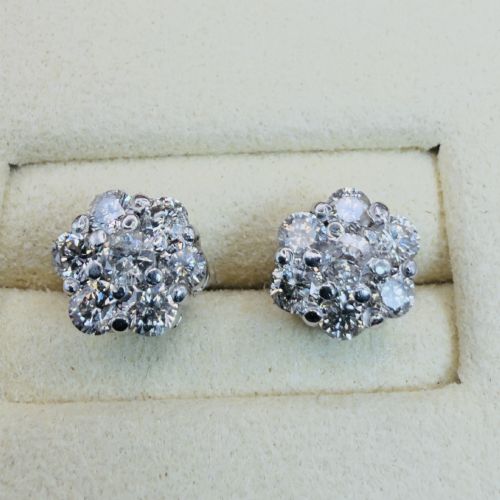


1 Carat Diamond Earrings
1 carat diamond earrings span Victorian clusters to Mid-Century drops, offering enduring brilliance paired with precious metals.
1 Carat Diamond Earrings
When searching for 1 carat diamond earrings, buyers encounter a diverse selection of antique and vintage jewellery spanning from the Victorian era through the Edwardian period, Art Deco years, and Mid-Century Modern designs. The most common form on this page is the classic stud or cluster earring, though drop and night and day configurations appear regularly.
The materials used across these eras combine diamonds with platinum, yellow gold, white gold, and occasionally accents of emerald, sapphire, opal, ruby, or seed pearl. Origins trace through the nineteenth and twentieth centuries, reflecting changing aesthetic preferences from elaborate antique mountings to streamlined mid-century styles.
Materials and construction
The foundational metals utilised in these earrings include platinum and various purities of gold, notably 18ct white gold, 18ct yellow gold, and 9ct gold. These metals are shaped into claw settings, bezels, and cluster arrangements designed to secure the central stones while complementing the metal colour.
Stones are faceted using historical cuts such as old mine cuts, old European cuts, rose cuts, and baguette cuts. Master jewellers set these diamonds alongside pearls and coloured gemstones using techniques appropriate to each period, from Victorian claw work to Edwardian filigree and Art Deco geometric positioning.
Stones include diamonds paired with emeralds, sapphires, rubies, opals, and pearls across stud and drop formats.
Aspects of quality
Quality in these earrings relates to the harmony between the cut of the diamonds and the integrity of the period setting. Stones featuring older facet patterns like old mine or old European cuts display distinctive light reflection that differs from modern brilliant cuts.
The precision of the metalwork, whether platinum or gold, determines how well the structure supports the stones over decades of wear. The integration of secondary gems, such as sapphires, emeralds, or pearls, also influences the overall refinement of the piece.
The 1 Carat Diamond Earrings Glossary
- Old mine cut
- An early diamond cut characterised by a near-square girdle, high crown, and small table. This cut precedes modern brilliant faceting and was common in Victorian jewellery.
- Platinum
- A dense, durable white metal frequently utilised in Edwardian and Art Deco mountings to hold delicate stone settings securely.
- Cluster design
- An arrangement where a central diamond or gemstone is surrounded by a border of smaller stones, resembling a floral daisy pattern.
- Drop earring
- A style that hangs below the earlobe, often incorporating articulated sections that move with the wearer.
- Rose cut
- A vintage diamond cut featuring a flat base and a domed top covered in triangular facets, offering a soft luminescence rather than intense brilliance.
1 Carat Diamond Earrings: Frequently Asked Questions
How do I wear drop earrings?
Drop earrings hang below the earlobe and add movement and length to the silhouette. They suit evening attire and formal occasions where the cascading design can be fully appreciated.
Secure fastenings such as screw backs or lever-backs help keep these pieces balanced and comfortable during extended wear.
What is a cluster setting?
A cluster setting arranges multiple smaller stones tightly around a central diamond or gemstone. This technique maximises visual presence and creates a distinct geometric or floral outline.
Popularised during the Victorian and Mid-Century eras, this design style enhances overall sparkle without requiring a single massive stone.
Are these platinum or gold?
Pieces in this collection incorporate platinum, 18ct white gold, 18ct yellow gold, and 9ct gold depending on the decade of creation. Edwardian and Art Deco makers frequently favored platinum for its strength in delicate wirework.
Mid-Century and Victorian examples often showcase yellow or white gold mountings that reflect the prevailing metal preferences of those times.