
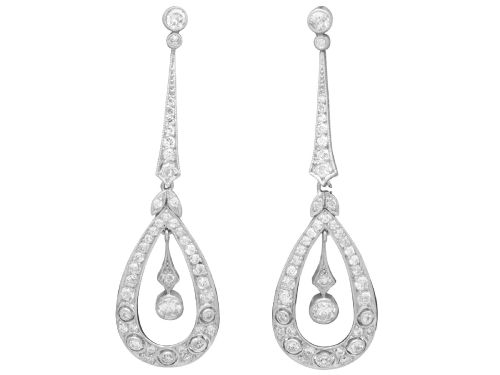


1930s Diamond Drop Earrings
These 1930s diamond drop earrings deliver unmistakable Art Deco geometry and movement, bringing period grace directly to the ear.
1930s Diamond Drop Earrings
When searching for 1930s diamond drop earrings, a buyer encounters sophisticated geometric designs born from the Art Deco movement. The pieces available span the period from the 1920s through the 1940s, capturing a distinct era of design innovation.
The primary forms on this page include drop earrings, circular earrings, cluster earrings, and convertible night and day pairs, occasionally accompanied by matching jewellery sets. Platinum and 18ct white gold dominate the settings, frequently paired with old cut or rose cut diamonds alongside sapphires and emeralds.
How they were made
The makers of these jewels utilised durable precious metals like platinum, palladium, and 18ct or 14kt white and yellow gold to secure multiple diamonds securely without heavy metal bulk. This metallurgical choice allowed for intricate, openwork frameworks that maximised light entry into the stones.
Gems were shaped into old cuts and rose cuts, reflecting the cutting standards of the period prior to modern brilliant faceting. Stones were then meticulously arranged in geometric motifs that gave drop earrings their signature fluid movement.
Some pairs let wearers unscrew the bottom drops entirely, proving 1930s designers understood the eternal struggle of day-to-night styling.
What varies in quality
Quality in these jewels rests on the architectural integrity of the metalwork and the matching of the central and accent stones. Superior pieces display seamless articulation in the drop elements, ensuring the earrings move fluidly when worn.
The distinction between standard and exceptional pieces lies in the subtlety of the millegrain work and the purity of the platinum or white gold framing. Higher grade examples also feature well-matched diamond carat weights and harmonious gemstone accents like emeralds or sapphires.
The 1930s Diamond Drop Earrings Glossary
- Art Deco
- A design style from the 1920s and 1930s characterised by sleek geometric shapes, stylised motifs, and modern industrial lines. It remains the defining aesthetic for this jewellery category.
- Old cut
- A diamond cutting style that precedes the modern brilliant cut, typically featuring a small table, high crown, and large open culet. These stones catch candlelight and lower light settings distinctively.
- Rose cut
- An antique diamond cut with a flat base and a domed crown faceted into triangles. It offers a soft, translucent glow rather than sharp brilliance.
- Millegrain
- A decorative technique involving a row of tiny raised metal beads along the edge of a setting. It softens harsh metal lines and adds refined texture.
- Dormeuses
- Traditional French sleeping earrings designed with secure fastenings so the wearer could keep them on overnight. They often feature a drop configuration suitable for day and night wear.
1930s Diamond Drop Earrings: Frequently Asked Questions
Can I wear these earrings every day?
These antique earrings were built with durable platinum and gold, making them robust enough for regular wear if handled with reasonable care. Their secure drops and sturdy clasps suit evening outings and special daytime events alike.
Because they contain old cut diamonds and delicate millegrain details, avoid wearing them during rigorous physical activities or swimming. Storing them in a lined box protects the articulated joints from unnecessary strain.
How do I identify Art Deco style?
Art Deco style is easily recognised by its strict symmetry, repeating geometric patterns, and clean architectural lines. Pieces from this era reject Victorian organic curves in favour of chevrons, sunbursts, and streamlined shapes.
In earrings, this translates to linear drops, rectangular clusters, and strong vertical emphasis. The juxtaposition of white platinum with calibre-cut sapphires or emeralds further reinforces this distinct aesthetic.
What metals were used in the 1930s?
Platinum was the preferred metal for fine diamond jewellery during the 1930s due to its strength and bright white finish. This allowed jewellers to create delicate, lace-like settings that held stones securely with minimal visible metal.
White gold and palladium also appeared frequently as alternative white metals, while yellow gold featured in specific regional styles or transitional pieces. These metals often show the natural patina expected of genuine antique items.