39,269  PAGES BROWSED TODAY PAGES TODAY 224  ANTIQUES UPLOADED TODAY NEW ARRIVALS
Sort Order
Items Per Page
ID #SA1231180
FOR SALE
£1,850
Email
Save
James Kay Rsw, Close of a Peaceful Day, Antwerp - Antique Oil Painting
Brave Fine Art
for sale €2,165     $2,350
£1,850
Brave Fine Art

Brave Fine Art

Sellingantiques Verified Since Nov 2018
View Dealers Stock Page
  • About Us
    Exquisite antique paintings that capture the imagination.
Id #SA1231180
PDF SHARE
SAVE

James Kay Rsw, Close of a Peaceful Day, Antwerp - Antique Oil Painting

1900 - 1920
For Sale by Brave Fine Art
Description

This early 20th-century oil painting by Scottish artist James Kay RSW (1858-1942) depicts a busy harbour scene at Antwerp.

There's something about James Kay's harbour scenes that seems to convey not only the sights, but also the sounds of a place. Boats appear to knock gently against their moorings, water laps against timber, funnels breathe smoke into the air and, somewhere beyond the picture, one imagines the continuing clatter of a working port. Yet here, as the title Close of a Peaceful Day suggests, the noise is beginning to subside.
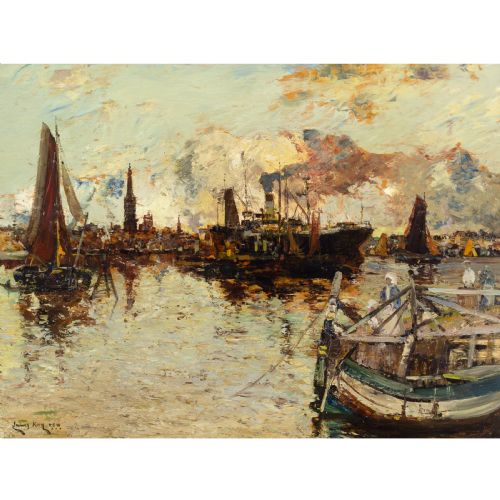
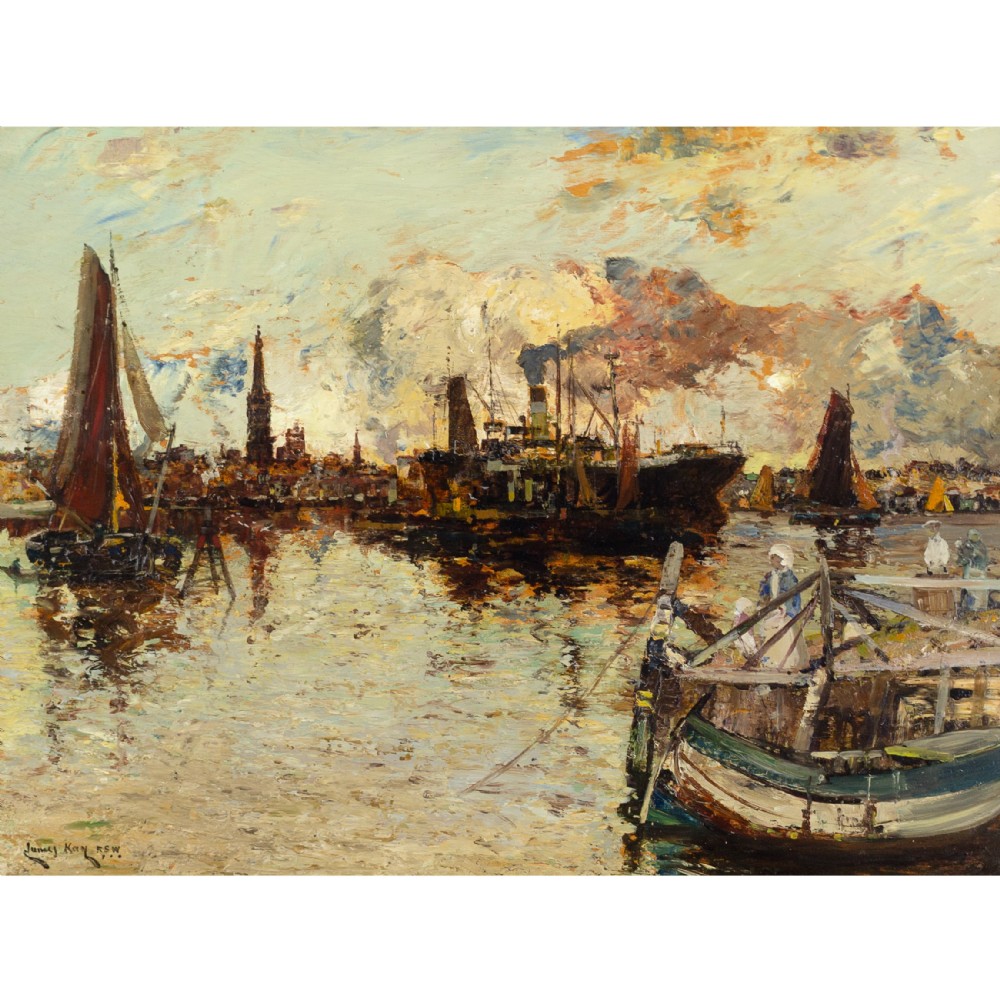
Painted at Antwerp, the view places a substantial steam vessel at its centre, surrounded by the smaller sailing craft and working boats that animated the city's waterways. In the foreground, figures linger beside a moored boat while across the water masts, funnels and the spires of the city rise into an extraordinary sky. Smoke pours from the steamer and becomes almost indistinguishable from the clouds above it.

Kay had travelled to Belgium to find his subject, but he understood this world instinctively. Raised at Lamlash on the Isle of Arran as the son of a Royal Navy man, and later celebrated for his paintings of Glasgow and the Clyde, he had spent much of his life looking at ports. He knew their peculiar mixture of movement and stillness: enormous vessels temporarily at rest, water forever shifting beneath them, smoke carried away on the wind and small human figures moving among machines.

It's this sense of movement that makes the painting particularly compelling. Kay has little interest in describing every component of the steamer with mechanical precision. Instead, forms are constructed through vigorous passages of colour. Rust, ochre, black, cream, blue and flashes of red jostle together across the harbour, while the water fractures them again into restless reflections. Even Antwerp itself seems to flicker in and out of definition.

Above everything is the sky. Broad, broken strokes of cream, blue, orange and grey sweep across the upper half of the composition, carrying the smoke with them. Kay was painting modern industry, but he approached it with the sensitivity of a landscape painter.

This picture was exhibited at the Royal Glasgow Institute of the Fine Arts in 1915, as catalogue number 230. Its title seems especially evocative in that year. There's no need to impose a wartime narrative upon the scene, but the idea of a peaceful day inevitably carried a particular resonance in Europe during the First World War.

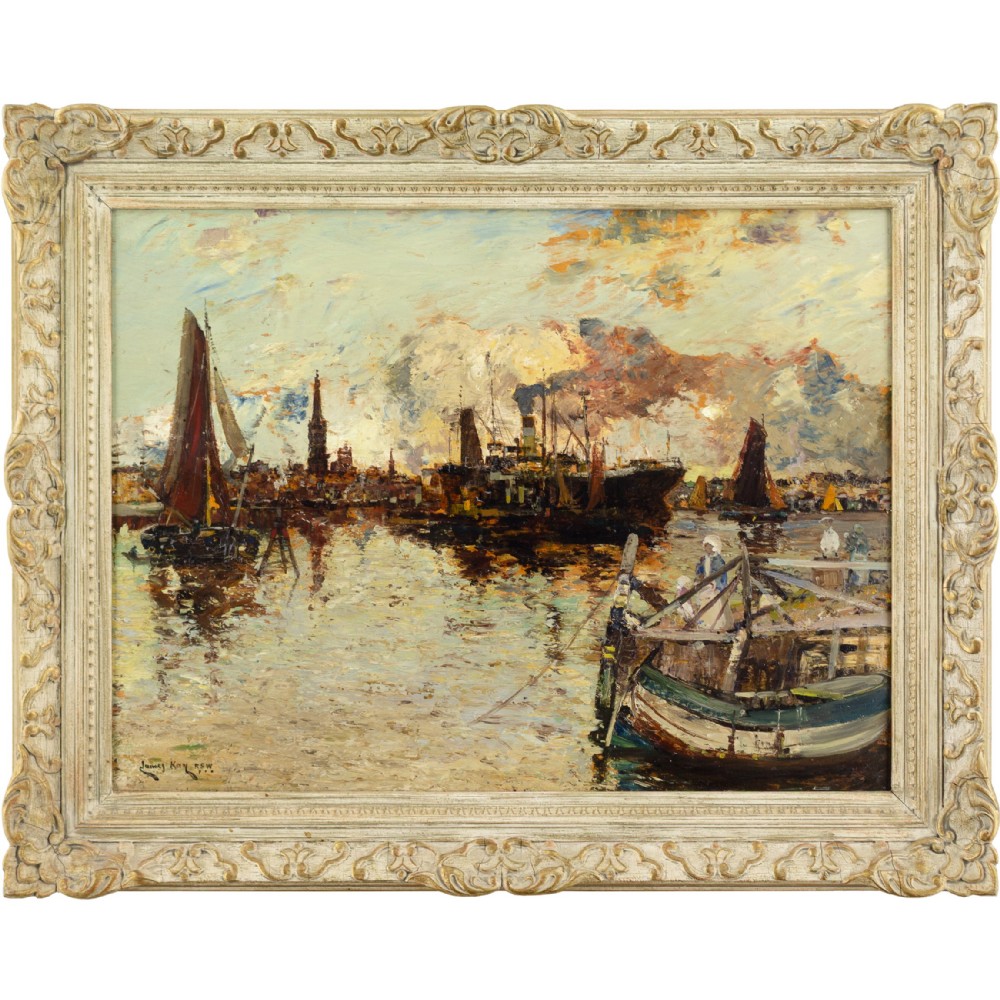
Signed in the lower left and held in a substantial carved wooden frame.

Learn more about James Kay in our directory.

Medium: Oil on panel

Overall size: 29½” x 25” / 74.5cm x 60cm

Year of creation: 1915

Labels & Inscriptions: Exhibition label on the reverse.

Provenance: Private collection, UK.

Exhibited: Royal Glasgow Institute of the Fine Arts, 1915, no. 230.

Condition: Overall very good. Frame with various marks and showing its age.

Artist’s auction maximum: £22,000 achieved in 2003 for ‘Rue Saint Romain, Rouen’.

Our reference: BRV2347

Physical Dimensions
Height
60cm (23.62")
Width
74.5cm (29.33")
Depth
5cm (1.97")
Declaration

Brave Fine Art has dated this Impressionist Harbour Oil Painting to the 1910s.

Reference Numbers
Sellingantiques Reference
SA1231180
Dealers Internal Reference
BRV2347
Description
This early 20th-century oil painting by Scottish artist James Kay RSW (1858-1942) depicts a busy harbour scene at Antwerp.
There's something about James Kay's harbour scenes that seems to convey not only the sights, but also the sounds of a place.
Brave Fine Art

Boats appear to knock gently against their moorings, water laps against timber, funnels breathe smoke into the air and, somewhere beyond the picture, one imagines the continuing clatter of a working port. Yet here, as the title Close of a Peaceful Day suggests, the noise is beginning to subside.

fig 1. An impressionist oil painting depicting ships moored in a harbour at dusk with a cathedral spire in the background, housed in an ornate carved gilt frame.
fig 1. James Kay Rsw, Close of a Peaceful Day, Antwerp - Antique Oil Painting

Painted at Antwerp, the view places a substantial steam vessel at its centre, surrounded by the smaller sailing craft and working boats that animated the city's waterways. In the foreground, figures linger beside a moored boat while across the water masts, funnels and the spires of the city rise into an extraordinary sky. Smoke pours from the steamer and becomes almost indistinguishable from the clouds above it.

Kay had travelled to Belgium to find his subject, but he understood this world instinctively. Raised at Lamlash on the Isle of Arran as the son of a Royal Navy man, and later celebrated for his paintings of Glasgow and the Clyde, he had spent much of his life looking at ports. He knew their peculiar mixture of movement and stillness: enormous vessels temporarily at rest, water forever shifting beneath them, smoke carried away on the wind and small human figures moving among machines.

It's this sense of movement that makes the painting particularly compelling. Kay has little interest in describing every component of the steamer with mechanical precision. Instead, forms are constructed through vigorous passages of colour. Rust, ochre, black, cream, blue and flashes of red jostle together across the harbour, while the water fractures them again into restless reflections. Even Antwerp itself seems to flicker in and out of definition.

Above everything is the sky. Broad, broken strokes of cream, blue, orange and grey sweep across the upper half of the composition, carrying the smoke with them. Kay was painting modern industry, but he approached it with the sensitivity of a landscape painter.

This picture was exhibited at the Royal Glasgow Institute of the Fine Arts in 1915, as catalogue number 230. Its title seems especially evocative in that year. There's no need to impose a wartime narrative upon the scene, but the idea of a peaceful day inevitably carried a particular resonance in Europe during the First World War.

Signed in the lower left and held in a substantial carved wooden frame.

Learn more about James Kay in our directory.

Medium: Oil on panel

Overall size: 29½” x 25” / 74.5cm x 60cm

Year of creation: 1915

Labels & Inscriptions: Exhibition label on the reverse.

Provenance: Private collection, UK.

Exhibited: Royal Glasgow Institute of the Fine Arts, 1915, no. 230.

Condition: Overall very good. Frame with various marks and showing its age.

Artist’s auction maximum: £22,000 achieved in 2003 for ‘Rue Saint Romain, Rouen’.

Our reference: BRV2347

Height
60cm (23.62")
Width
74.5cm (29.33")
Depth
5cm (1.97")
Date of Manufacture

Brave Fine Art has dated this Impressionist Harbour Oil Painting to the 1910s.

Reference Numbers
Sellingantiques Ref
SA1231180
Dealers Internal Ref
BRV2347
Brave Fine Art
Brave Fine Art
Sellingantiques verified Since Nov 2018

Exquisite antique paintings that capture the imagination.

Dealer Profile

You can view the stock and full dealer information on the Brave Fine Art Profile Page
PDF SHARE
SAVE
An impressionist oil painting depicting ships moored in a harbour at dusk with a cathedral spire in the background, housed in an ornate carved gilt frame.
1 / 2
Archive I An impressionist oil painting depicting ships moored in a harbour at dusk with a cathedral spire in the background, housed in an ornate carved gilt frame.

James Kay Rsw, Close of a Peaceful Day, Antwerp - Antique Oil Painting
Archive II An impressionist oil painting depicting ships moored in a harbour at dusk with a cathedral spire in the background, housed in an ornate carved gilt frame. View II
FURTHER BROWSING

Visitors also looked at these ⇣

Enlarged Archival View
Telephone 01684 215986
Location
21 Enterprise Way
Arle Road
Cheltenham
Cotswolds
GL51 8LZ
United Kingdom

Under appointment only.
Verified Since Nov 2018
Items For Sale 74
Items Sold 1,833
Brave Fine Art
Brave Fine Art
Verified Since Nov 2018
View Dealer Info
Location: 21 Enterprise Way, Arle Road, Cheltenham, Cotswolds, GL51 8LZ, United Kingdom, , Under appointment only.
Verified
Nov 2018
For Sale
74
Sold
1,833
An impressionist oil painting depicting ships moored in a harbour at dusk with a cathedral spire in the background, housed in an ornate carved gilt frame.
James Kay RSW, Close Of A Peaceful Day, Antwerp - Antique Oil Painting
Ref: SA1231180
An impressionist oil painting depicting ships moored in a harbour at dusk with a cathedral spire in the background, housed in an ornate carved gilt frame.
Detail View 1
Archival Detail
Every single antique dealer on our platform is individually approved by our internal team. We verify their professional trade history, ethical standards, and photographic quality to ensure a secure, high-standard buying environment. Upon joining, every dealer agrees to a strict 9-point code of conduct. While issues can occasionally arise, our dealers typically resolve them swiftly and directly with the buyer. In fact, since our founding in 2002, Sellingantiques has only had to step in to help resolve an issue on roughly five occasions—a true testament to the quality of our dealers and their dedication to your happiness.
Our dealers are highly experienced in packing and shipping fragile, high-value antiques. Because you are in direct contact with the dealer, you will be able to easily go through all available shipping and insurance options together to ensure your item arrives safely.
Antiques are the ultimate green purchase. By choosing historical pieces over newly manufactured goods, you completely eliminate the carbon footprint of modern mass production while preserving exceptional, timeless craftsmanship.

Scottish Impressionist maritime art emerged in the late nineteenth and early twentieth centuries, defined by loose brushwork, textured impasto, and an emphasis on atmospheric light over waterscapes, docks, and shipping vessels.

Artists during this era typically applied linseed oil-based pigments directly onto stretched linen or cotton canvas, often mounting the completed work within hand-carved wood or molded gesso gilt frames.

Authentic works show signature characteristics of the era, including visible layered impasto, period-appropriate canvas weave, natural age craquelure, artist signatures or inscriptions, and age-consistent framing materials.

Place the artwork above a sideboard, mantelpiece, or console table to establish a focal point, pairing the traditional gilt frame against neutral walls, contemporary panelling, or tailored modern furniture.

Keep the painting away from direct sunlight, extreme humidity, and heat sources. Clean gently using a soft, dry camel-hair brush to remove dust from the textured impasto surface and ornate frame details without applying water or chemical cleaners.
items
Add keywords to the filter
Price
£100
£250000
Era
Movements
Material
Origin
Stock Location
Freshness
Online Payments
Categories