
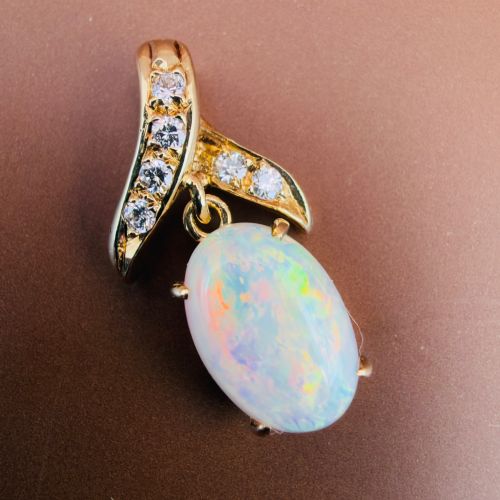
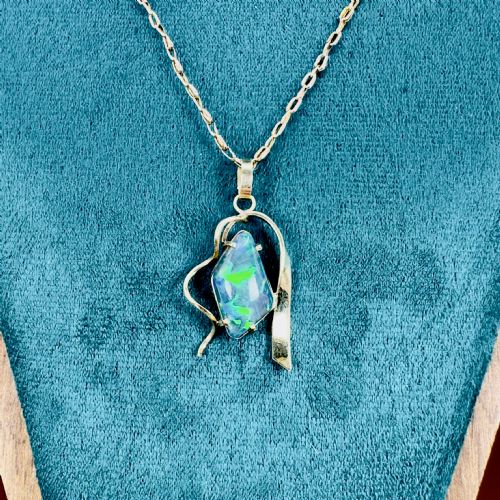


Yellow Gold Opal Necklace
These yellow gold opal necklaces bring together fiery play-of-colour and warm metalwork, offering a distinctive piece of jewellery that collectors seek for its varied periods.
Yellow Gold Opal Necklace
A yellow gold opal necklace unites precious metal with stones showing varied optical plays, spanning Victorian, Edwardian and mid-century eras. The examples found here range from simple solitary drops to complex cluster settings.
Most pieces date from the nineteenth and twentieth centuries, taking the form of pendants, pendant brooches and fitted necklaces. These items showcase cabochon stones, black opals and fire opals mounted in various purities of gold.
How they were made
Goldsmiths utilised yellow gold ranging from nine to eighteen carats, shaping settings through casting, wirework and filigree techniques. Stones were secured via claw mounts or bezels, occasionally accompanied by seed pearls, rubies or diamonds.
Lapidaries shaped opals into cabochons and oval cuts to maximise the play-of-colour, alongside doublet constructions that paired natural opal material with a backing.
Several pendants double as brooches, ensuring your jewellery works double shifts between your lapel and your neckline.
What varies in quality
Quality rests upon the optical play within the opal, the weight and purity of the gold mounting, and the presence of supporting diamonds or rubies. Pieces with substantial stone weight and intricate filigree work command greater attention from collectors.
The integrity of the setting and the security of the stones differentiate standard production from finer examples, alongside the visual balance between the opal and its gold frame.
The Yellow Gold Opal Necklace Glossary
- Cabochon
- A stone shaped and polished with a smooth convex surface rather than faceted. This style highlights the internal play-of-colour in opals.
- Doublet
- A composite gem made of two layers, often combining a thin slice of natural opal with a darker backing to enhance colour.
- Filigree
- Ornamental work formed of fine twisted wire soldered together in delicate patterns. This technique appears frequently in vintage gold mounts.
- Play-of-colour
- The optical phenomenon where spectral colours shift across the stone as the viewing angle changes. It remains the defining characteristic of quality opals.
- Solitaire
- A single gem set alone in a piece of jewellery. These designs draw attention entirely to the central stone.
Yellow Gold Opal Necklace: Frequently Asked Questions
How do I date a yellow gold opal necklace?
Dating relies upon stylistic markers such as filigree work, stone cuts, and metal purities like nine, fourteen, fifteen or eighteen carat gold. Victorian and Edwardian examples often feature seed pearls and distinct organic motifs.
Mid-century and later twentieth-century pieces shift towards bolder cluster arrangements and cleaner geometric lines, reflecting the aesthetic preferences of those decades.
Are opals fragile to wear every day?
Opals contain water within their structure and possess a lower hardness than diamonds, meaning they require mindful wear to avoid knocks and scratches. Protective settings like bezels help shield the girdle of the stone.
Removing the necklace during physical tasks prevents unnecessary strain on the gold chain and the mounting prongs.
What is the difference between an opal and a black opal?
Standard opals display play-of-colour against a light white or translucent body tone. Black opals feature a dark body tone, ranging from grey to jet black.
This dark background intensifies the spectral flashes within the stone, making the blues and greens appear much more vivid.
Can these pendants be worn as brooches?
Certain historical pieces were constructed to serve dual purposes as both pendants and brooches. These items incorporate a hidden loop alongside a pin mechanism on the reverse.
Such convertible designs offer versatility in how the jewellery can be displayed on garments or chains.