
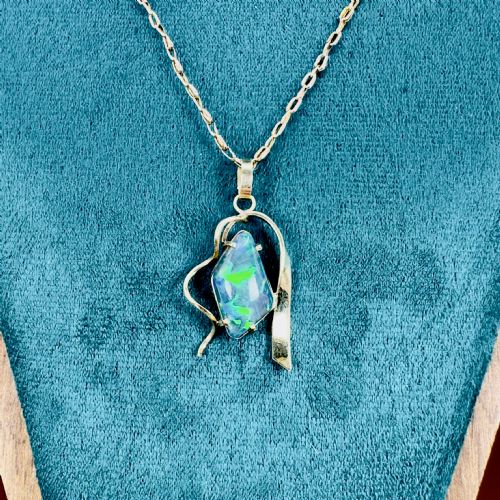


Gold Opal Necklace
A gold opal necklace brings together the shifting play-of-colour in natural stones and the warmth of precious metal in pendant and drop forms.
Gold Opal Necklace
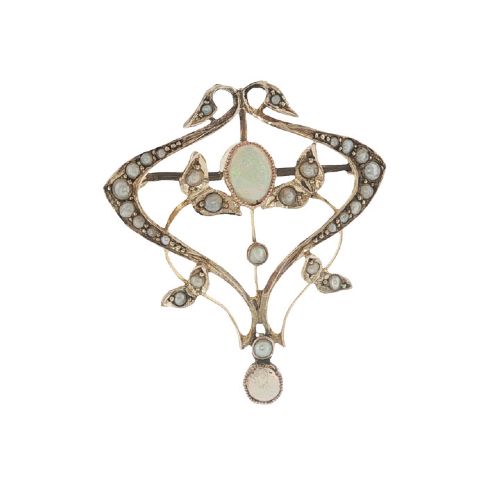
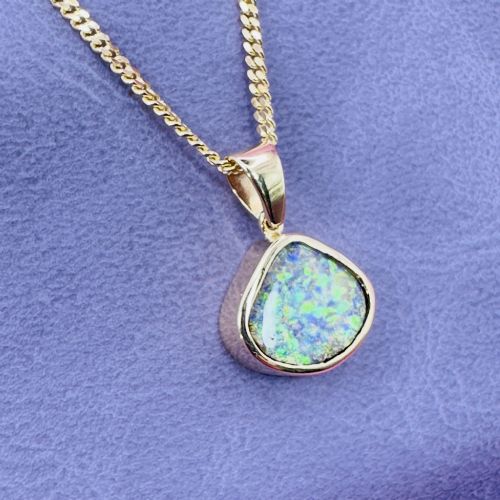
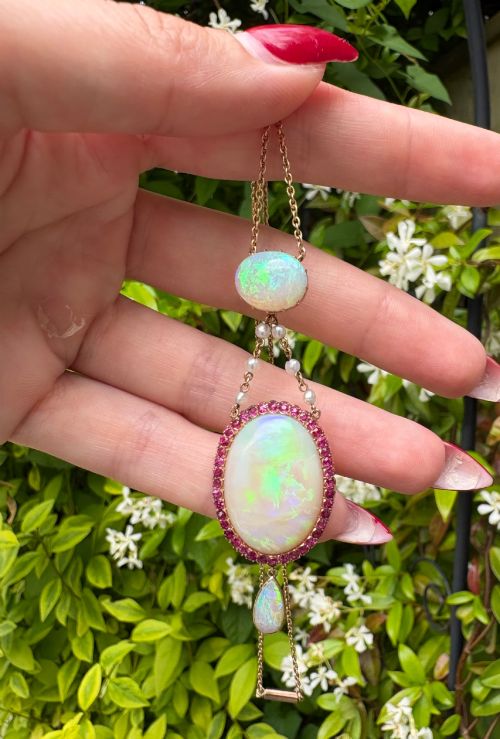
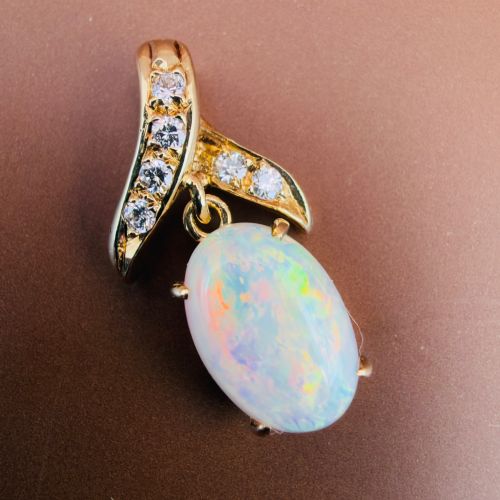
A gold opal necklace combines the distinctive flash of opal with various purities of gold, most frequently seen as pendants or drop necklaces on this page. These items span from late Victorian and Edwardian examples to Art Deco and mid-century modern designs, reflecting a wide chronological range.
The stones themselves appear in numerous configurations, from solitaire cabochons to intricate clusters surrounded by diamonds, rubies, or seed pearls. Buyers will encounter both simple 9ct gold settings and higher purity 15ct or 18ct gold mounts, alongside occasional platinum elements.
Forms range from organic heart shapes and unusual boulder black opals to structured geometric Art Deco drops. Pendant brooches also feature, offering dual wearability derived from earlier Victorian and Edwardian traditions.
How they were made
Goldsmiths utilised various purities of gold, notably 9ct and 15ct, alongside 18ct white gold and platinum for later pieces, shaping the metal into delicate filigree, bezels, and prong settings. Stones were cut primarily as cabochons to display the internal play-of-colour, occasionally accompanied by faceted diamonds, rubies, or seed pearls.
Techniques varied across periods, with Victorian and Edwardian makers employing detailed wirework and bow motifs, while Art Deco artisans favoured geometric lines and platinum accents. Natural solid opals and doublets were secured into custom mounts designed to catch and reflect light through the open back or closed settings.
Some Victorian pieces double as brooches, letting wearers pin their heart on their sleeve quite literally.
What varies in quality
Quality rests significantly on the optical performance and stability of the opal itself, particularly the intensity and breadth of the play-of-colour across the stone. The weight and purity of the gold mount, from standard 9ct to higher-grade 15ct and 18ct gold, further define the tier of the piece.
The precision of the setting work and the integration of secondary stones like diamonds or seed pearls separate standard production from finer examples. Maker marks, original clasps, and the overall integrity of the design contribute to the distinction between everyday vintage items and notable antique survivals.
Murrle Bennett
The Gold Opal Necklace Glossary
- Cabochon
- A gem polished with a smooth, rounded top rather than faceted edges. This shape allows opals to display their characteristic play-of-colour most effectively.
- Doublet
- A composite stone made of a thin slice of opal glued to a darker backing material like ironstone. This method enhances the perceived body colour and durability of the gem.
- Seed pearl
- A very small natural or cultured pearl, often half-drilled and threaded or glued into Victorian and Edwardian cluster designs. They provide a soft, luminous border to central opals.
- Lavaliere
- A pendant necklace featuring a central drop stone suspended below the main chain or collar. This style gained particular popularity during the Edwardian and Art Deco periods.
- Play-of-colour
- The optical phenomenon where a stone flashes spectral colours when moved in the light. It is caused by the interference and diffraction of light through microscopic silica spheres within the opal.
Gold Opal Necklace: Frequently Asked Questions
How do I care for my opal necklace?
Opals contain water within their structure, meaning they require gentle treatment to avoid drying out or cracking. Store them away from extreme heat and harsh chemicals, and clean them only with a soft, damp cloth.
Because gold and soft gems can scratch easily, keep your necklace in a dedicated lined box or pouch when not being worn. Avoid submerging antique settings in ultrasonic cleaners, as this can damage delicate foils or pearls.
What is the difference between solid opals and doublets?
A solid opal consists of a single piece of genuine opal material cut and polished into shape. These represent the natural form of the stone as mined from the earth.
Doublets combine a thin layer of natural opal on top of a supportive backing, such as dark ironstone or onyx, to strengthen the stone and deepen the visual contrast of the colours.
How can I tell an Edwardian opal necklace from a Victorian one?
Victorian pieces often feature heavier gold work, such as 15ct yellow gold, incorporating rich details like seed pearls, rubies, and intricate bow or heart motifs. The overall aesthetic tends to be romantic and substantial in weight.
Edwardian designs frequently transition towards lighter mounts, including early uses of platinum and 18ct white gold, paired with diamonds in airy, lace-like configurations that reflect a more delicate sensibility.
Are these necklaces suitable for daily wear?
Many of these pieces were built for regular use, but antique and vintage items require a mindful approach to daily activities. Opals have a lower hardness rating than diamonds, making them susceptible to scratches if struck hard against surfaces.
If worn regularly, check the settings periodically to ensure the claws or bezels holding the opal and accent stones remain secure.