


Yellow Gold Madonna Charm
A yellow gold madonna charm is a devotional pendant, worn for protection and personal faith, blending French artistry with lasting precious metal.
Yellow Gold Madonna Charm
A yellow gold madonna charm is a small devotional pendant representing the Virgin Mary, the Madonna and Child, or the Sacred Heart. These objects function simultaneously as items of personal jewellery and expressions of Catholic devotion, typically designed to be suspended from a chain or hung on a chatelaine.
The selections available here stem largely from French workshops active around the turn of the twentieth century, spanning from the late Victorian era through the Art Nouveau period and into the mid-century. Most examples combine the function of a pendant with the miniature scale of a charm.
The iconography frequently depicts the Virgin Mary standing, holding the infant Jesus, or presenting the Sacred Heart, often accompanied by Latin inscriptions or floral motifs. These pieces reflect the rich tradition of French religious metalwork produced during the Third Republic and subsequent decades.
How they were made
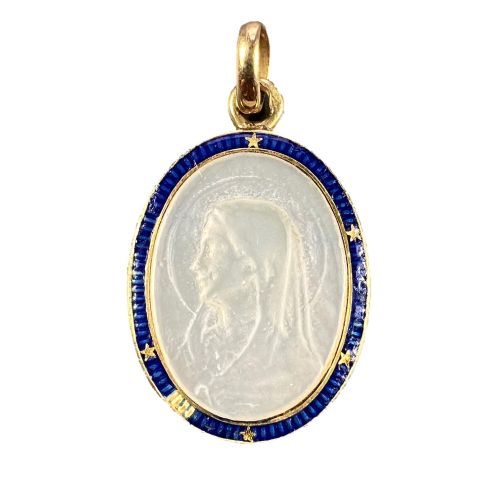
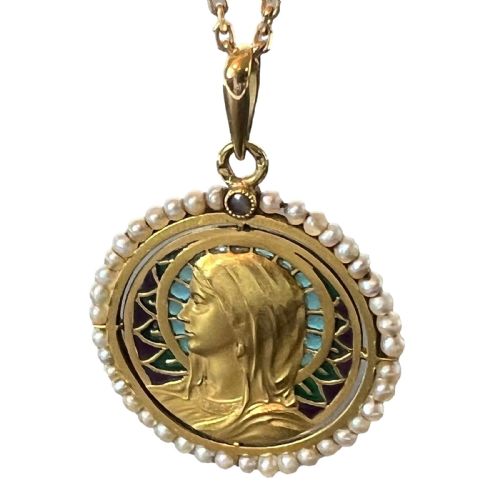
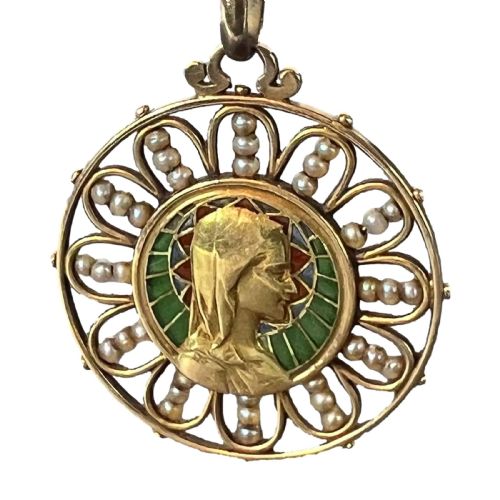
Surface decoration frequently incorporates vitreous enamels, notably plique-a-jour, which allows light to pass through translucent coloured sections like stained glass. Mother of pearl provides an iridescent background for low-relief figures, while seed pearls are set by hand as delicate borders.
The inventory spans the late nineteenth century through the 1950s, utilising 18ct yellow gold, enamel, seed pearls, and mother of pearl.
What varies in quality
Quality in these devotional charms is determined by the crispness of the metal relief and the sophistication of the enamel work. Superior examples display finely hand-chased details on the figures and flawless application of plique-a-jour enamel without cracking or discoloration.
The reputation of the medalist or workshop also influences the standing of a piece, with signed works by notable French designers commanding greater attention. Additionally, the integration of supplementary materials such as seed pearls or mother of pearl panels indicates a higher level of craftsmanship.
Emile Monier·Emile Dropsy·Oscar Roty
The Yellow Gold Madonna Charm Glossary
- Plique-a-jour
- An enamelling technique where enamel is applied to a cellular framework without a backing, creating a translucent effect similar to miniature stained glass. This method requires considerable skill to prevent the enamel from fracturing during firing.
- Medal
- A flat or slightly curved metal disc struck with a commemorative or devotional image on one or both sides. In this context, these objects served as religious tokens or awards.
- Seed pearl
- A very small, natural or saltwater pearl, often measuring less than two millimetres in diameter. They are traditionally drilled and strung or pinned into intricate cluster settings.
- Sacred Heart
- A Catholic devotional symbol representing the physical heart of Jesus Christ as a representation of his divine love for humanity. It is commonly depicted encircled by thorns or surmounted by a flame.
- Mother of pearl
- The iridescent internal layer of mollusc shells, harvested for its lustrous play of colour. It is carved into thin plaques to serve as a luminous backing for applied gold figures.
Yellow Gold Madonna Charm: Frequently Asked Questions
What is a madonna charm?
A madonna charm is a small pendant depicting the Virgin Mary, usually cast or stamped in 18ct yellow gold. These miniature works of art served as personal devotional items.
Many incorporate decorative elements such as enamel work or mother of pearl backgrounds. They were commonly worn on chains or added to charm bracelets as expressions of faith.
How do I date these charms?
Dating relies heavily on stylistic cues, such as the flowing organic lines typical of Art Nouveau designs or the simpler geometric forms of later decades. Maker marks stamped onto the metal surface also help establish a production period.
French pieces from this category frequently date from the late nineteenth century through the mid-twentieth century. Hallmarks stamped on the gold provide official confirmation of the metal standard and origin.
What materials are used?
The primary material across these pieces is 18ct yellow gold, sometimes accompanied by variations in rose or white gold. Gemstones and organic materials appear frequently as secondary elements.
Enamel, particularly the translucent plique-a-jour variety, adds colour to the metallic surfaces. Mother of pearl and seed pearls provide contrasting textures and luminous highlights.
Who made these religious medals?
Many of these devotional charms were produced by specialised French medalists and workshops operating during the late nineteenth and early twentieth centuries. Artists signed their metalwork with tiny stamped signatures along the edge or reverse of the medal.
Notable names associated with these pieces include Emile Dropsy and Emile Monier. These artisans supplied religious goods to the French market and international buyers.