
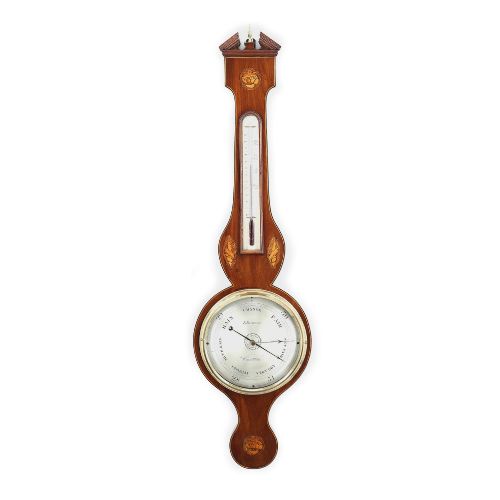
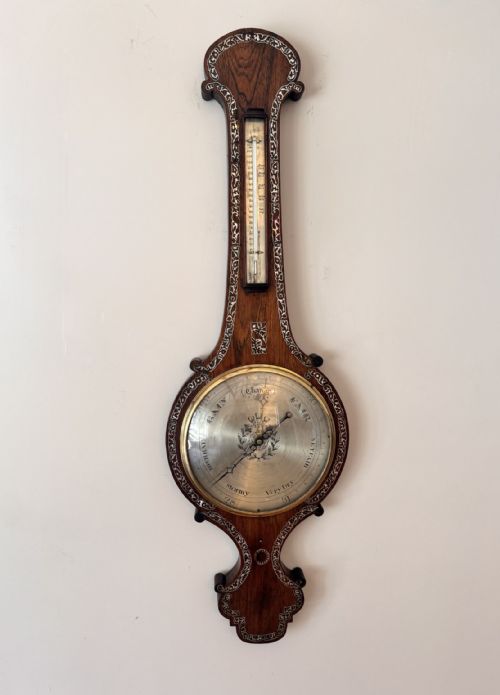


Wooden Wheel Barometer
A wooden wheel barometer brings practical science and rich timber grain together on a wall, making it a focal point for any traditional room.
Wooden Wheel Barometer
A wooden wheel barometer combines a large round dial at the base with a long thermometer stem above, housed in an expanded wooden case often called a banjo shape. These instruments measure atmospheric pressure using mercury columns linked to a visible dial face.
The versions most commonly found here date from the Regency and Victorian eras, spanning the nineteenth century from eighteen fifty to eighteen ninety. Mahogany cases dominate the selection, accompanied by examples in walnut, rosewood, and bird's eye timber.
Makers from various regional British towns signed their dials, ranging from Weymouth and Norwich to Liverpool and Cambridge. Neoclassical marquetry details and mother-of-pearl inlay frequently decorate the timber frames of these pieces.
Materials and construction
Cabinet makers built the distinctive cases using solid and veneered hardwoods like mahogany, walnut, and rosewood over pine carcases. Fine boxwood stringing and contrasting wood inlay defined the Neoclassical and Regency aesthetics.
Glass protected the silvered brass dial faces and the mercury thermometer tubes mounted in the upper trunks. Brass bezels, indicators, and dampeners added metallic contrast to the polished wooden surfaces.
Makers from provincial English towns such as Weymouth, Norwich, York, and Cambridge signed the dials found across these pieces.
Assessing quality and finish
The refinement of the cabinet work separates standard regional production from superior pieces. Crisp carving around the onion tops and intricate wood inlay signal higher workshop standards.
The legibility and engraving quality of the brass dial plates indicate the maker's skill. Retaining original mercury tubes and unbroken glass bezels preserves the integrity of the instrument.
B. Besozzi of Weymouth·Molton of Norwich·Jenkins Of Old Swindon·L Casatelli of Liverpool·W.E. Pain of Cambridge·Vecchio & Co of Shaftsbury·A. Rivolta·J Groce, York·F Salteri & Co., Nottingham
The Wooden Wheel Barometer Glossary
- Wheel barometer
- An instrument measuring atmospheric pressure where a mechanical linkage turns a pointer around a circular dial. The design became popular during the Georgian and Victorian periods.
- Banjo case
- A wall-hanging wooden case shaped like a banjo, featuring a narrow trunk for a thermometer and a wider circular base for the barometer dial.
- Onion top
- A rounded, bulbous pediment shape capping the top of certain Victorian barometer cases. This profile distinguishes specific regional English cabinet styles.
- Marquetry
- Decorative veneer work forming pictorial or geometric patterns using various coloured woods. It appears on Neoclassical examples from the late nineteenth century.
- Silvered dial
- A brass dial plate treated with a silver solution to create a matte white finish for engraved numbers and maker inscriptions.
Wooden Wheel Barometer: Frequently Asked Questions
Where should I hang a wooden wheel barometer?
Hang the instrument on an interior wall away from direct sunlight, central heating radiators, and damp draughts. Sudden temperature swings can affect the wood and the movement of the internal mercury.
Ensure the wall fixing is secure, as these hardwood cases carry considerable weight from the glass and mercury components.
How do I date a wooden wheel barometer?
Examine the shape of the wooden case, the style of the dial engraving, and any signature belonging to the maker. Regency models often feature simpler mahogany outlines, while Victorian versions introduce carved walnut and elaborate mother-of-pearl inlay.
Makers frequently recorded their working towns on the brass dial face, which helps cross-reference historical trade directories.
Are these barometers still accurate?
Many nineteenth-century mercury barometers remain mechanically sound and respond accurately to changes in air pressure. The internal glass tube and cistern must remain intact and filled with clean mercury for proper function.
They serve as working scientific instruments alongside their role as decorative wall pieces in period interiors.