

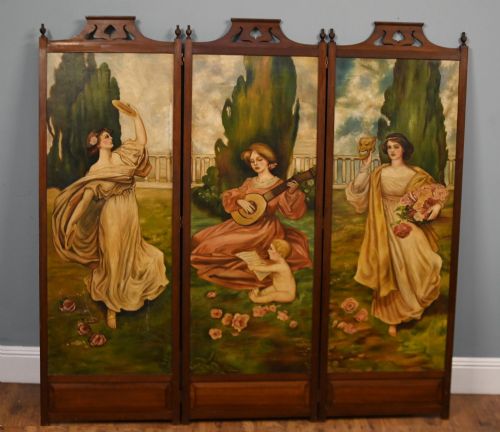
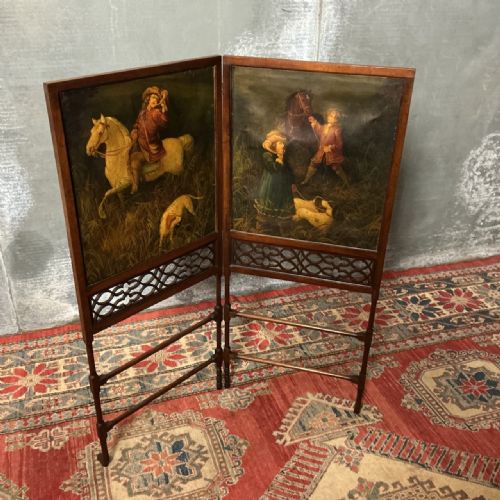
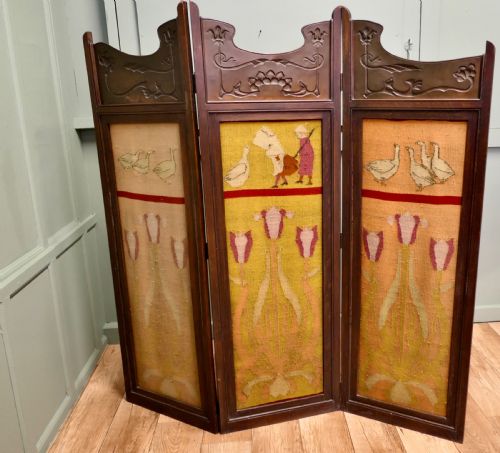

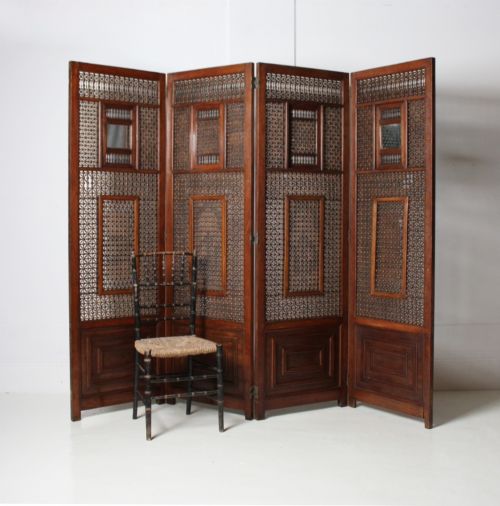


Wooden Partition Screen
These wooden partition screen pieces divide spaces with architectural presence, offering both flexible zoning and rich decorative detail.
Wooden Partition Screen
A wooden partition screen functions as a folding room divider or architectural screen, creating private areas within large rooms. These items span periods from the eighteenth century through the Edwardian era and the nineteen-thirties.
The selections on this page range from four-fold painted Indian screens to Chinese hardwood screens and early twentieth-century oak frames. Folding screens and room dividers dominate the forms present.
Originating from diverse traditions including Anglo-Indian, Chinese traditional, Persian revival, and Arts and Crafts styles, each wooden partition screen brings distinct regional craftsmanship into an interior.
How they were made
Construction relies heavily on hardwood, oak, and mahogany frames joined to support multiple folding panels. Brass hardware frequently secures the hinges between sections.
Surfaces receive intricate treatments such as lacquer, oil paint, and carved detailing including mashrabiya fretwork. Some examples incorporate canvas panels or textile inserts like wool and velvet.
Wooden Partition Screen Retail Price Guide 2026
Typical asking prices for wooden partition screen among the pieces listed under this phrase on Sellingantiques today, from the lower quarter to the upper quarter. They describe what is for sale here now, not the wider market.
One unexpected survivor once served a political debating society at Eton College.
What varies in quality
Quality rests on the depth and crispness of the carving, alongside the precision of the joinery across the folding panels. Superior examples maintain structural rigidity while retaining smooth movement at every hinge.
The artistic execution of surface finishes, from hand-painted oil panels to detailed coromandel lacquer work, dictates the distinction between standard room dividers and exceptional pieces.
The Wooden Partition Screen Glossary
- Mashrabiya
- A traditional architectural projecting wooden window screen or partition formed of intricate turned wood lattices. This technique creates geometric patterns that filter light and air.
- Coromandel lacquer
- A Chinese incised lacquer technique where motifs are carved into a dark ground and filled with colours. Finished panels display rich texture and depth.
- Padauk
- A dense tropical hardwood prized for its durable nature and deep reddish-brown colouration. It provides a sturdy foundation for heavily carved furniture.
- Fretwork
- Ornamental perforated woodwork created by cutting patterns through thin boards. It appears frequently on screens to lighten the visual weight of large panels.
Wooden Partition Screen: Frequently Asked Questions
How do I care for lacquered wooden screens?
Dust the surfaces gently with a dry, soft cloth to prevent abrasive particles from scratching the delicate lacquer or painted details.
Keep the panels away from direct sunlight and fluctuating heat sources to protect the wood and surface finishes from warping.
What is the difference between an Indian and a Chinese screen?
Indian examples often feature deep relief carvings, fretwork, and padauk timber, reflecting traditional architectural joinery.
Chinese screens frequently utilise lacquered surfaces, coromandel techniques, or hardwood frames depicting regional motifs and figures.
Can these screens support their own weight?
Most multi-panel folding designs stand securely when arranged in a zigzag or stepped configuration that distributes the weight evenly.
Avoid pulling the panels into a completely flat straight line, as this places excessive strain on the connecting hinges.