
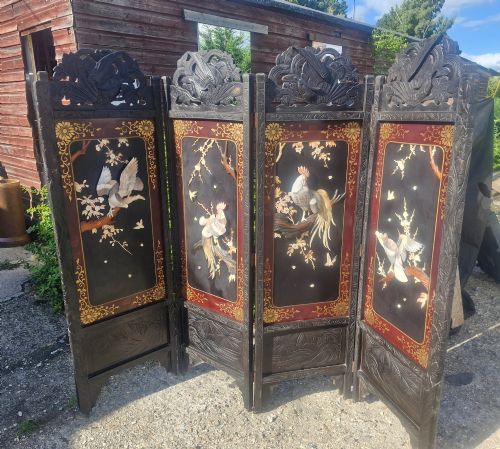

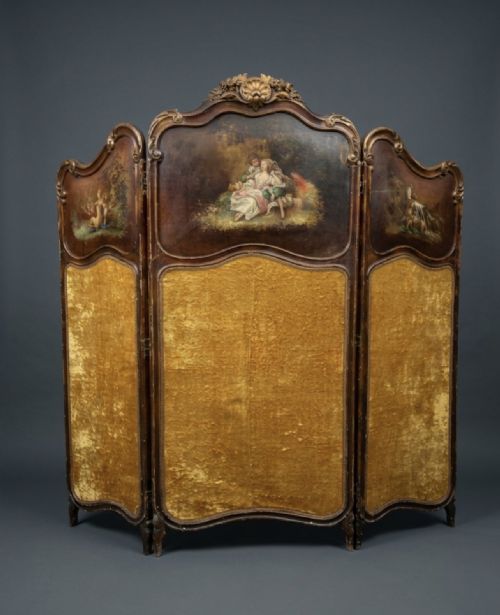

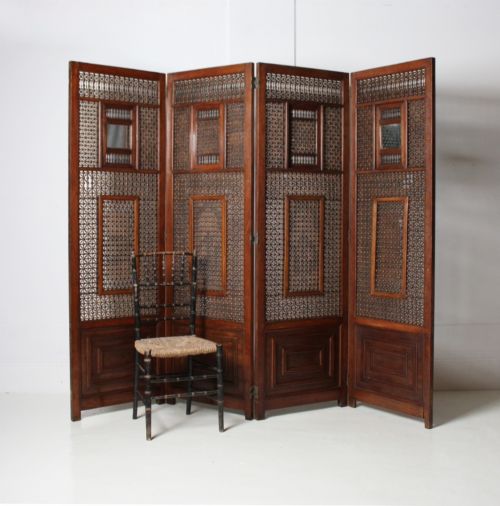


Wooden Panel Privacy Screen
These wooden panel privacy screen examples offer architectural division and rich surface detail, making them ideal for reshaping a room.
Wooden Panel Privacy Screen
A wooden panel privacy screen functions as both a decorative focal point and a practical room divider. Buyers searching for a wooden panel privacy screen encounter folding configurations spanning multiple periods, from the nineteenth century into the early twentieth century.
The pieces on this page draw from diverse regional styles, including French Rococo Revival, Anglo-Indian, Japanese Meiji, Scandinavian Country, Islamic Revival, Chinese Republic Era, and Regency. Folding screens and room dividers dominate the forms available here, often utilising hinged multi-panel construction.
Origins range widely across England, France, Sweden, China, Japan, and Burma, reflecting distinct local craftsmanship and cultural aesthetics. Whether utilised for modesty or spatial division, each wooden panel privacy screen brings a specific historical character to an interior.
Evaluating quality and execution
Quality reveals itself in the depth of carving, the precision of joinery, and the execution of painted or lacquered details. Superior examples exhibit deliberate handwork, whether in intricate fretwork or finely rendered pastoral scenes.
Materials also distinguish the range, as dense hardwoods and intact original textiles or brass fittings elevate a piece. The integration of the panels within the frame demonstrates the level of care invested by the maker.
The listings span the nineteenth century, Regency, and early twentieth century, utilising oak, walnut, mahogany, hardwood, paint, lacquer, brass, and velvet.
The Wooden Panel Privacy Screen Glossary
- Privacy screen
- A movable partition designed to shield areas of a room from view. These objects often feature multiple hinged panels.
- Mashrabiya
- An architectural element featuring carved wooden latticework. This technique appears on nineteenth-century panel room dividers.
- Meiji
- A Japanese period associated with intricate decorative arts. Pieces from this era often incorporate carved bone and lacquer.
- Fretwork
- Ornamental design created by cutting patterns through wood. This technique provides ventilation and visual lightness on screen panels.
- Needlepoint
- Canvas work embroidery utilised on panel inserts. It adds textured textile detail to nineteenth-century and Regency frames.
Wooden Panel Privacy Screen: Frequently Asked Questions
How do I place a screen?
Position the panels to catch natural light or to divide large living spaces into distinct zones. Angle the outer leaves slightly to stabilize the structure on the floor.
Allow enough clearance for the hinges to articulate smoothly without scraping against walls or furniture.
Can screens be folded flat?
Most folding designs allow the leaves to close against one another in a stack. Double-action hinges permit movement in both directions on certain formats.
Check the hinge type before attempting to fold the panels beyond their intended range of motion.
How are wooden panels cleaned?
Dust the carved and painted surfaces gently using a soft, dry cloth. Avoid chemical polishes that might damage aged lacquer or oil paint.
Test any conservation cleaner on a hidden area of the wood before applying it across the entire panel.
What defines a modesty screen?
Modesty screens were historically used to create private changing spaces within larger chambers. They typically feature painted panels or fabric inserts.
These pieces tend to be smaller in scale than architectural room dividers while offering solid visual blockage.