

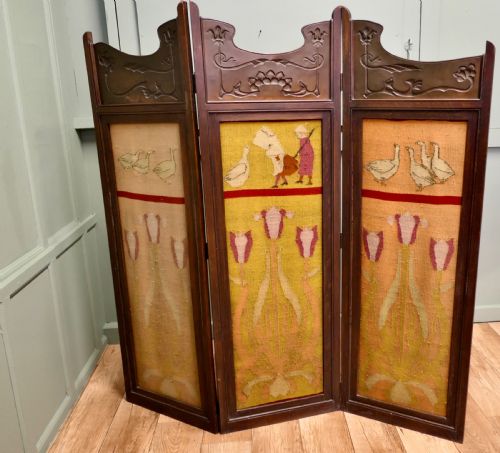

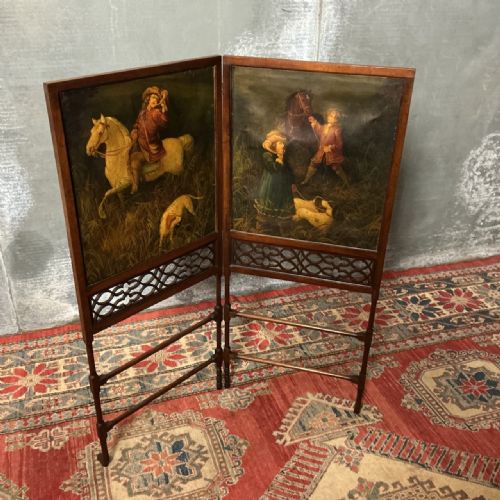


Wooden Floor Screen
A wooden floor screen divides a room or shields a hearth, combining sturdy timber frames with decorative panels.
Wooden Floor Screen
A wooden floor screen serves as a practical divider for large rooms or a decorative barrier near a fireplace. These pieces range from multi-fold folding screens to ornate fire screens and room dividers.
The versions most commonly met on this page span the eighteenth, nineteenth, and early twentieth centuries, drawing on global design traditions. Buyers encounter everything from French walnut and Edwardian mahogany frames to intricate Japanese Meiji and Chinese Coromandel lacquer works.
Makers utilised diverse regional styles, incorporating Chinoiserie motifs, Islamic Revival mashrabiya panels, and Art Nouveau copper accents. Each piece reflects the interior domestic habits of its period, balancing spatial division with visual artistry.
Materials and construction
Frames rely on solid hardwoods including mahogany, walnut, oak, and general timber, providing the structural backbone for multiple hinged leaves. These woods are joined and carved to support heavy decorative inserts without warping.
Panels employ specialised decorative techniques such as deep carved bone figures, hand-painted pastoral scenes, needlework wool panels, and traditional Chinese Coromandel lacquer. Metal elements in brass and copper appear frequently as structural hinges, decorative mounts, or integrated lamp conversions.
Wooden Floor Screen Retail Price Guide 2026
Typical asking prices for wooden floor screen among the pieces listed under this phrase on Sellingantiques today, from the lower quarter to the upper quarter. They describe what is for sale here now, not the wider market.
Listings feature wood and hardwood structures paired with brass, copper, and lacquer across the nineteenth and twentieth centuries.
Assessing quality and execution
Quality rests upon the depth and precision of the carving in the timber and the skill executed in the panel infills, whether hand-painted oils, woven tapestry, or carved lacquer. Superior examples show crisp detailing that remains sharp across all folding panels.
The integrity of the hinges and the stability of the joints determine how well a multi-fold screen stands over time. Better pieces maintain balance and smooth articulation without sagging or straining the primary wooden frame.
The Wooden Floor Screen Glossary
- Coromandel lacquer
- A Chinese incised lacquer technique where layers of dark lacquer are carved to reveal coloured grounds beneath. This method creates textured surfaces often seen on folding room dividers.
- Mashrabiya
- An architectural element of turned wooden lattice-work used to form decorative panels and screens. It provides ventilation and filtered light while dividing interior spaces.
- Pole screen
- A type of screen featuring an adjustable panel mounted on a central vertical pole and pedestal base. They were designed to shield a person's face from the direct heat of an open fire.
- Chinoiserie
- European artistic style reflecting Chinese aesthetic traditions through decorative motifs and lacquerwork. It frequently appears on eighteenth and nineteenth century furniture.
- Meiji
- A Japanese historical period associated with intricate craftsmanship in metal, wood, and bone inlay. Pieces from this era often feature detailed figurative carving.
Wooden Floor Screen: Frequently Asked Questions
How were wooden floor screens used historically?
These screens divided large drawing rooms into intimate seating areas or blocked drafts near doorways and fireplaces. They offered a flexible way to alter the layout of a room before built-in walls became standard.
In domestic settings, they also served as backdrops for social gatherings or concealed utility areas. Their portability meant furnishings could be rearranged to suit the season or occasion.
How do I care for a lacquered wooden screen?
Keep wooden and lacquered surfaces away from direct sunlight and strong heat sources to prevent the timber from splitting and the lacquer from cracking. Dust gently with a dry, soft cloth without applying modern chemical polishes.
Maintain stable indoor humidity levels to protect delicate inlays like bone or metal mounts. Inspect hinges periodically to ensure the weight of the panels rests evenly.
How can I tell an 18th-century screen from a 19th-century one?
Eighteenth-century examples often feature deep Coromandel lacquer with specific hand-ground pigments and dense multi-layered sap applications. The timber framing techniques and joinery reflect hand-tool methods distinct from later periods.
Nineteenth-century pieces frequently embrace revival styles or global influences such as Anglo-Indian and Islamic Revival designs. Examining the backboards, hinge types, and fastening methods helps clarify the manufacturing era.
Can multi-fold screens support themselves safely?
Multi-fold screens rely on being arranged in a zig-zag configuration rather than standing in a straight line. This accordion stance distributes the weight of the heavy wooden panels and prevents tipping.
When positioning a divider, ensure the hinges move freely so the leaves can be angled correctly. On uneven floors, careful placement of the folds maintains overall stability.