







William IV Canterbury Stand
A william iv canterbury stand is a partitioned stand for music and papers, bringing classical restraint and practicality to a room.
William IV Canterbury Stand
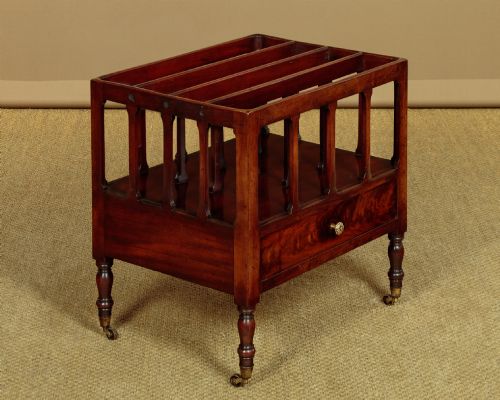
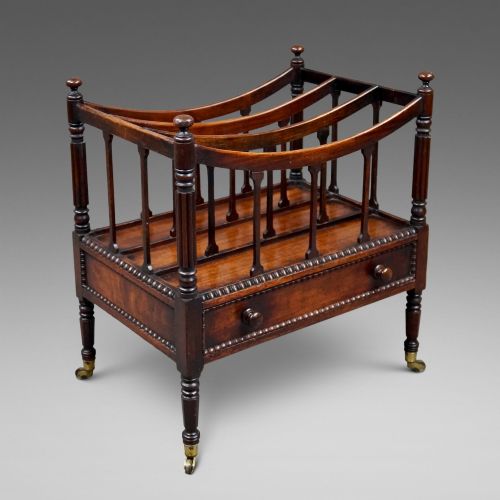
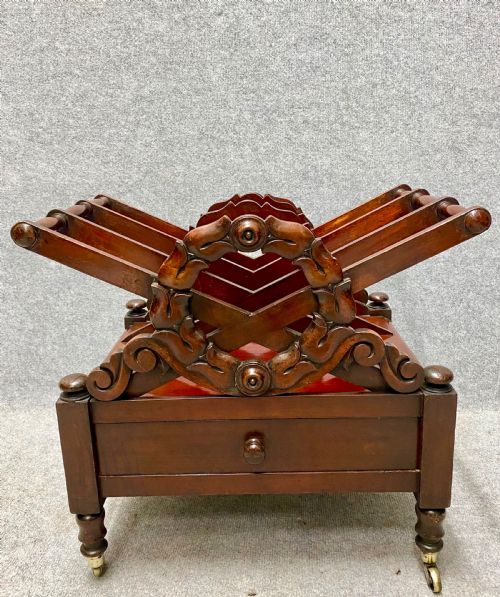
A william iv canterbury stand is primarily a low, partitioned piece designed to hold sheet music, magazines, and newspapers in a domestic setting. These items typically feature distinct vertical divisions, often with a carrying handle or a small drawer incorporated into the base.
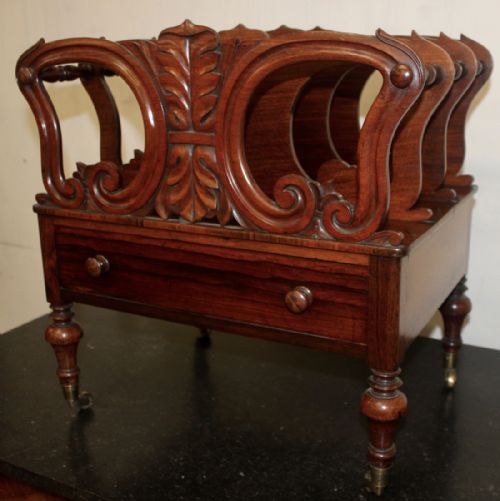
The versions most commonly met on this page date from the nineteenth century, reflecting the stylistic transition from the Regency period into the early Victorian era. Formats range from simple four-division mahogany models to more elaborate rosewood music stands equipped with castors.
Materials and construction
Cabinet makers utilised dense timbers such as mahogany and rosewood to build the structural divisions and frames of these pieces. These woods were often polished to a high sheen, revealing rich grain patterns.
Brass fittings, including castors and handles, were commonly integrated into the design to allow easy movement across floor surfaces. Certain examples also incorporated detailed carved elements or subtle inlay work along the rails.
William IV Canterbury Stand Retail Price Guide 2026
Typical asking prices for william iv canterbury stand among the pieces listed under this phrase on Sellingantiques today, from the lower quarter to the upper quarter. They describe what is for sale here now, not the wider market.
Named after an archbishop who requested a supper tray with partitions, the stand quickly evolved into a dedicated home for sheet music.
Quality and craftsmanship
The distinction between standard and superior pieces rests on the choice of timber and the crispness of the joinery. Finer examples display carefully selected grain alignment and robust structural joints that withstand regular handling of heavy folios.
Decorative elaboration also sets examples apart, moving from plain turned supports to finely carved rosewood frames and integrated drawers. The presence of original brass castors and fittings contributes significantly to the integrity of the piece.
J.C.Loudon
The William IV Canterbury Stand Glossary
- Canterbury
- A low stand with divisions used for holding music sheets and periodicals. It originated in the late eighteenth century and remained popular through the Victorian era.
- Rosewood
- A dense, dark timber prized for its contrasting grain, frequently utilised in fine nineteenth-century cabinet making. It takes a high polish.
- Mahogany
- A durable hardwood commonly employed for furniture frames throughout the Georgian and nineteenth-century periods. Its warm reddish-brown tone became a staple of British interiors.
- Castor
- A small wheel fitted to the legs of furniture to permit smooth movement. In this context, they are often cast in brass.
William IV Canterbury Stand: Frequently Asked Questions
What is a william iv canterbury stand?
A william iv canterbury stand is a dedicated piece of furniture designed to hold sheet music and periodicals within a parlour or drawing room.
Characterised by vertical partitions and a low profile, it combines functional storage with the refined aesthetic of the 1830s.
How were these stands used?
These pieces served to keep loose sheets of music, newspapers, and magazines tidy and accessible beside a piano or seating area.
Their partitioned design allowed musicians to sort scores easily during an evening's entertainment.
Where should I place it?
A william iv canterbury stand sits well beside a desk, a piano, or in a traditional sitting room setting.
Its compact footprint allows it to function as a side table while keeping reading materials close at hand.
How do I identify the period?
Identifying the period involves looking at the timber selection, such as rosewood or mahogany, alongside the characteristic proportions of the 1830s.
Subtle details like turned supports and brass castors help distinguish pieces from earlier Georgian or later Victorian iterations.