

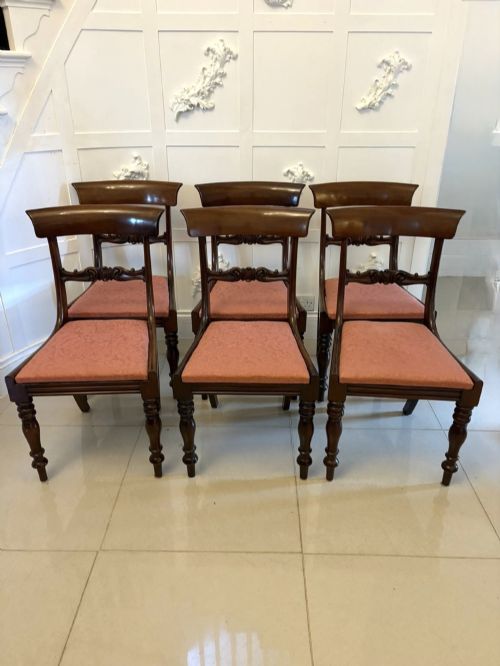


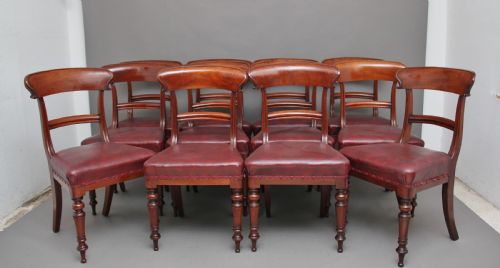


William IV Bar Back Chairs
William iv bar back chairs bring solid nineteenth century presence to a dining room through robust timber and sculptural curved rails.
William IV Bar Back Chairs
William iv bar back chairs are nineteenth century dining seats defined by their horizontal top rails, appearing frequently in sets ranging from pairs to tens.
Most examples originate from the Georgian, Regency, and William IV periods, constructed primarily as side chairs alongside occasional elbow chairs.
The form bridges the transition from Regency elegance to the heavier proportions of early Victorian furnishing, retaining clean architectural lines.
How They Were Made
Cabinetmakers built these seats from dense hardwoods like mahogany and occasional rosewood, frequently incorporating carved details into the horizontal back rail.
Seats were traditionally constructed as overstuffed pads and secured over wooden frames, then covered in materials such as leather, velvet, fabric, or tapestry.
Support came from turned and reeded forelegs, sometimes paired with brass castors to ease movement across dining room floors.
William IV Bar Back Chairs Retail Price Guide 2026
Typical asking prices for william iv bar back chairs among the pieces listed under this phrase on Sellingantiques today, from the lower quarter to the upper quarter. They describe what is for sale here now, not the wider market.
Some dining chairs arrive accompanied by a lone carver, ready to preside over the table like an undisputed monarch.
What Varies in Quality
The density and figuring of the mahogany timber dictate the visual weight and foundational integrity of each piece in a set.
Carving depth on the transverse back bar distinguishes standard production from finer cabinet work, alongside the crispness of turned leg details.
Completeness within larger sets alters desirability, as matched groups preserved intact carry greater consistency than assembled collections.
The William IV Bar Back Chairs Glossary
- Bar back
- A chair design featuring a solid horizontal wooden rail across the top of the backrest, often curved for comfort. This rail frequently displays carved central appliques or scrolls.
- Carver
- An armchair designed with elbow supports, traditionally placed at the head of a dining table to match the surrounding side chairs. These pieces share the same stylistic rail and leg turning as the set.
- Reeded
- A decorative surface treatment comprising parallel convex mouldings carved into wood legs. This technique adds vertical visual interest to cylindrical supports.
- Overstuffed
- An upholstery style where the padding extends entirely over the seat frame edges so no wood is visible from above. This method provides a generous cushion for dining.
- Rosewood
- A heavy, dark timber with distinct figuring utilised for select high-end seating during the period. Its rich grain offers an alternative to standard mahogany.
William IV Bar Back Chairs: Frequently Asked Questions
How many chairs came in a standard set?
Dining sets from this era commonly appeared in groupings of four, six, eight, or ten to accommodate period dining tables.
Larger configurations often stayed together through generations, while smaller pairs served as supplemental seating.
Are these chairs comfortable for modern dinners?
The curved horizontal back rail provides lumbar support while seated around a dining table for extended periods.
Overstuffed upholstery variants offer traditional padding depth suited to contemporary dining use.
How do I identify the William IV period?
William IV pieces sit between Regency lightness and Victorian heaviness, displaying robust proportions and carved bar backs.
Turned and reeded forelegs coupled with dense mahogany construction typify this specific stylistic window.
Can I mix side chairs and carvers?
Dining sets historically paired multiple side chairs with matching armchairs intended for the table ends.
Matching timber and leg turning ensure visual continuity when combining both forms in a room.