
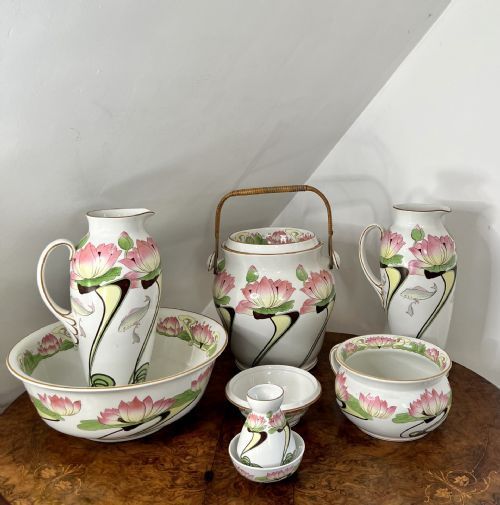


White Pottery Water Jug
A white pottery water jug serves practical household needs while displaying the diverse decorative traditions of ceramic history.
White Pottery Water Jug
When you search for a white pottery water jug, you encounter vessels produced for domestic utility across the Georgian and Victorian eras. These range from large one-gallon vessels intended for general service to specialised wash set pitchers and hotel ice water containers.
The versions most frequently met on this page include Staffordshire earthenware and pearlware pieces, often decorated with transfer-printed scenes, relief moulding, or enamel highlights. They span periods from the seventeenth-century Dutch Delftware examples to late nineteenth-century Arts and Crafts designs.
Each white pottery water jug reflects the prevailing tastes of its decade, whether through classical transfer prints depicting civic buildings or botanical ironstone patterns. They survive as functional objects that transitioned from everyday washing equipment to collectible display pieces.
Materials and Construction Methods
Makers relied on earthenware, pearlware, ironstone china, and tin-glazed earthenware bodies to form these jugs, often applying an opaque glaze to achieve the desired white surface. Some early examples incorporate fritware or bisque porcelain parian ware to create specific textural qualities.
Potters shaped the vessels using throwing techniques or mould-pressed methods such as cabbage leaf moulding and relief decoration. Decoration was subsequently applied through underglaze painting, blue and white transfer printing, or enamel hand-colouring before firing.
The listings span multiple centuries, incorporating Georgian pearlware, Victorian ironstone, and seventeenth-century Dutch Delftware forms.
Distinctions in Quality and Execution
The refinement of the ceramic body and the clarity of the glaze set finer pieces apart from standard utility ware. Ironstone and pearlware versions often exhibit sharper relief moulding and more durable surfaces than standard earthenware.
Artistic execution in transfer printing or underglaze painting distinguishes exceptional workshop output from routine commercial production. Precision in handling details such as applied handles, spouts, and pictorial alignment indicates superior craftsmanship.
Minton·Doulton Lambeth·Livesley Powell and Co·Jones and Walley·Mason
The White Pottery Water Jug Glossary
- Pearlware
- A refined earthenware developed in the late eighteenth century featuring a thin glaze with a slight bluish tint in the recesses. It was designed to mimic Chinese export porcelain more closely than standard creamware.
- Ironstone
- A heavy, durable type of ceramic patented in the nineteenth century that combined earthenware clay with slag and feldspar. It resists chipping and provided a sturdy white base for transfer-printed decoration.
- Tin-Glazed Earthenware
- Pottery covered with a lead glaze made opaque by the addition of tin oxide. This technique forms a smooth white surface suitable for direct painting in blue or polychrome pigments.
- Transfer Printing
- A decoration method where an engraved copper plate transfers a design onto tissue paper, which is then stamped onto the ceramic surface before glazing and firing. It allowed intricate pictorial scenes to be replicated consistently.
- Bisque Porcelain
- Unglazed ceramic fired once to create a matte, porous white surface with a texture similar to marble. It gained popularity in the nineteenth century for decorative tablewares and portrait jugs.
White Pottery Water Jug: Frequently Asked Questions
How were these jugs used?
These jugs served practical daily roles in domestic settings, holding water for washing, table service, or general household chores. Large examples functioned within larger bedroom wash sets or hotel dining rooms.
Over time, many transitioned from utilitarian kitchen and bedroom items into decorative display pieces kept on sideboards or mantelpieces. Their robust construction allowed them to withstand heavy daily handling before entering collections.
How do I date a white pottery water jug?
Dating relies heavily on observing the ceramic body, glaze characteristics, and decorative style visible on the piece. Pearlware typically points to the late eighteenth and early nineteenth centuries, while ironstone and transfer-printed patterns often indicate the Victorian era.
Maker marks stamped or printed on the base provide the most reliable chronological markers when present. Stylistic clues, such as the presence of Arts and Crafts motifs or Regency shapes, further narrow the production window.
What is the difference between earthenware and ironstone?
Earthenware is a porous, lower-fired pottery body that requires a complete glaze to hold liquids effectively. It tends to be lighter in weight and more susceptible to chipping along the rim.
Ironstone is a much harder, denser semi-vitreous ceramic developed to withstand industrial and domestic wear. It provides a heavier, sturdier white canvas that resists cracking and holds intricate relief moulding very sharply.
Are transfer printed jugs waterproof?
Yes, the glazing process seals the underlying earthenware or ironstone body entirely, making the vessel fully water-tight for practical use. The printed and painted decorations sit beneath or within this protective glass layer.
Care should still be taken with antique pieces to avoid thermal shock from boiling water, which can craze the historic glaze. Hand washing preserves the enamel highlights and prevents modern detergents from dulling the surface.