



White Painted Wood Armchair
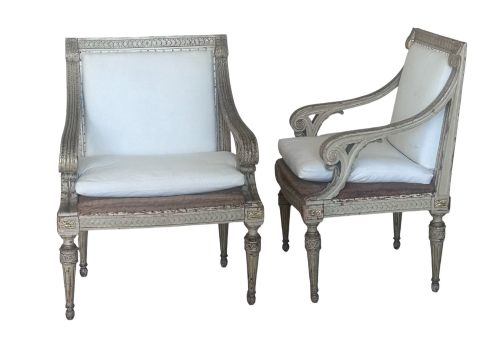
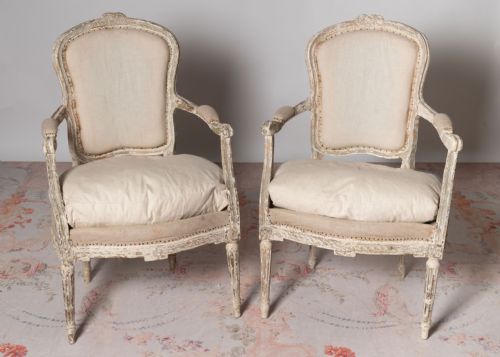
A white painted wood armchair brings light and historic form into a room, offering seats shaped by eighteenth-century neoclassical ideals down to twentieth-century vintage French designs.
White Painted Wood Armchair
A white painted wood armchair encompasses seating shaped across the eighteenth, nineteenth, and early twentieth centuries, spanning periods from the George III era to Edwardian times. These chairs take structural cues from diverse stylistic movements, including Louis XVI, Gothic Revival, Arts and Crafts, Chinoiserie, and Nordic Art Nouveau.
The selections available here lean heavily toward pairs and larger sets rather than isolated pieces, originating from workshops in France, Britain, Sweden, and Italy. Formats range from formal Bergere models and faux bamboo frames to heavier dug-out seating and rustic rush-seated versions.
Buyers seeking a white painted wood armchair will encounter surfaces showing original historic finishes alongside later decorative coats applied over time. Each piece relies on solid timber frameworks beneath its paint, combining functional seating with distinctive period profiles.
Materials and construction
Makers built these frames using sturdy timbers like beech, shaping structural elements to support woven cane seats, drop-in linen pads, or upholstered fabric cushions. Gesso layers often provided a smooth base for early paint applications, creating crisp decorative surfaces across carved mouldings.
Joinery methods varied according to the origin and date of the chair, uniting traditional pegged frames with turned components and steam-bent elements. Surface treatments combined wood, paint, and natural fibres to achieve both structural integrity and a finished decorative appearance.
White Painted Wood Armchair Retail Price Guide 2026
Typical asking prices for white painted wood armchair among the pieces listed under this phrase on Sellingantiques today, from the lower quarter to the upper quarter. They describe what is for sale here now, not the wider market.
Some nineteenth-century makers went to great lengths to imitate exotic bamboo using ordinary timber, fooling the eye with carved wooden joints.
Assessing quality and character
Distinctions in quality rest on the precision of the woodwork and the integrity of the underlying frame beneath the paint layers. Chairs retaining their earliest structural joins and refined carved details stand apart from utilitarian or heavily altered examples.
The harmony between the painted surface and the timber form dictates visual success, whether dealing with crisp neoclassical symmetry or the simpler lines of an Arts and Crafts model. The depth of the design, from French Louis revival curves to Swedish vernacular shaping, defines the character of each individual seat.
Morris and Co·Anton Rosen
The White Painted Wood Armchair Glossary
- Bergere
- An enclosed upholstered armchair with wooden framing exposed around the sides and back. These French seats frequently feature cane work or padded armrests.
- Faux bamboo
- A decorative turning technique imitating natural bamboo stalks on wooden furniture frames. Artisans carved or turned the timber to simulate joints and ridges.
- Gesso
- A plaster-like mixture applied to wooden surfaces to prepare them for gilding or painting. It creates a smooth, flat ground for fine decorative finishes.
- Neoclassical
- A style drawing inspiration from classical antiquity, marked by straight lines, symmetry, and restrained ornamentation. It dominates much eighteenth-century seating design.
- Rush seat
- A woven seating surface made from dried marsh rushes twisted into cords. This traditional method provides a sturdy, textured base often found on vernacular chairs.
White Painted Wood Armchair: Frequently Asked Questions
Are painted armchairs sturdy enough for daily use?
Solid wood frames constructed with traditional joinery provide reliable support for regular sitting. The durability depends primarily on the underlying timber condition rather than the painted finish.
Heavier structural forms, such as dug-out chairs or sturdy beech frames, handle everyday placement easily. Checking the joints ensures the piece remains stable under normal weight.
How do I identify a French style armchair?
French style armchairs typically display carved ornamentation, cabriole legs, or exposed wood framing around upholstered panels. Louis XVI examples show straight fluted legs and neoclassical symmetry.
Other French variants incorporate bergere enclosures or curved cartouche backs. The aesthetic focuses on decorative carving and refined proportions.
What is the difference between original and later paint?
Original paint dates to the period of manufacture, showing authentic wear patterns and historic pigment layers. Later paint represents subsequent decoration applied long after the chair's initial creation.
Many historic pieces received white coats in later decades to suit changing interior fashions. Both finishes offer decorative appeal depending on the desired look.
How do I style a white painted armchair at home?
A neutral white painted finish allows these armchairs to sit comfortably within both traditional and contemporary room settings. Pairing them with contrasting textiles or placing them near natural wood tones highlights their carved details.
Placing a single statement piece in a hallway or using a pair beside a fireplace draws attention to their historic form. The versatile colourway adapts easily to changing interior schemes.