


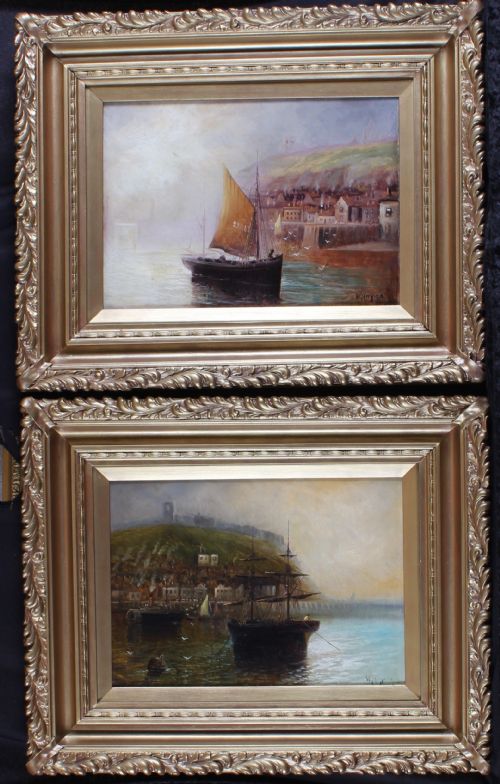


Whitby Harbour Picture
A whitby harbour picture brings the bracing Yorkshire coast into your room through watercolours and oils of the historic abbey and fishing dockyard.
Whitby Harbour Picture
A whitby harbour picture captures the maritime character of this Yorkshire port through works executed across several decades. The selection centres on marine watercolours and oil paintings depicting familiar local landmarks such as the abbey and the river Esk.
These works emerge from British fine art traditions spanning the Victorian era through to the mid-century period. Painters record the coastal topography, fishing vessels and local architecture with careful attention to atmospheric conditions.
Buyers encounter compositions ranging from detailed dockyard views to broader coastal landscapes featuring local craft like cobles. Most examples date from the late nineteenth century up to the mid-twentieth century.
Materials and methods
Artists executed these works primarily using watercolour pigment on paper or oil paint on canvas. Many pieces retain their original period framing, often comprising gilt wood and protective glass.
The application of watercolour pigment allows for delicate washes of sky and sea, whilst oil paint on canvas builds richer textures for marine subjects. Painters balance fine architectural draftsmanship with looser treatments of water and atmospheric light.
Listings span periods from Victorian and Edwardian times through to nineteen-fifty, utilising paper, canvas, watercolour pigment and oil paint.
Judging quality
Quality rests upon the artist's handling of light, scale and atmosphere in capturing the North Yorkshire coast. Stronger works demonstrate assured brushwork and compositional balance rather than mere topographical recording.
The preservation of the pigment and the integrity of the original paper or canvas support influence the overall standard. Examples that retain their period framing in gilt wood carry greater visual coherence.
Alfred George Morgan·Fred Waugh·James Thomas Watts·Albert Robert Quinton·William Kay Blacklock·Frank Rousse·Walter Meegan·Robert Leslie Howey·Rowland Henry Hill
The Whitby Harbour Picture Glossary
- Watercolour painting
- A work executed with water-soluble pigments on paper. This medium permits translucent washes that suit coastal skies and shifting marine light.
- Oil painting
- A work created using pigments bound in a drying oil, typically applied to canvas. This technique allows for deeper colour saturation and heavier impasto.
- Coble
- A traditional type of open fishing boat native to the north-east coast of England. These vessels frequently appear in maritime scenes from the region.
- Gilt wood
- Wood treated with gold leaf or a metallic substitute used for period framing. It provides a reflective border that complements marine subjects.
- Marine realism
- An artistic approach dedicated to the accurate depiction of ships, seas and coastal views. This style values topographical and nautical precision.
Whitby Harbour Picture: Frequently Asked Questions
What periods do these paintings date from?
The available works span from the Victorian and Edwardian eras through to the mid-twentieth century. Artists recorded the harbour and abbey across several decades of British fine art tradition.
Most examples reflect artistic styles prevalent around the turn of the century and into the nineteen-twenties and thirties.
Which subjects appear most often in these works?
Views of Whitby Abbey overlooking the town and the river Esk dominate the compositions. Fishing dockyards, marine hotels and local cobles off the coast also recur frequently.
Painters focused heavily on the maritime activity and distinctive topography of the Yorkshire coastline.
Are these paintings glazed?
Works executed on paper using watercolour pigment typically sit behind protective glass within their frames. This glazing safeguards the delicate paper surface from dust and moisture.
Canvas works using oil paint generally remain unglazed, allowing the textured paint surface to be viewed directly.
How should I display a marine watercolour?
Keep watercolours away from direct sunlight to prevent the pigments and paper from fading over time. Stable indoor humidity levels protect both the paper support and the original frame.
Position the work on a wall where ambient lighting enhances the subtle washes of the coastal scene.