
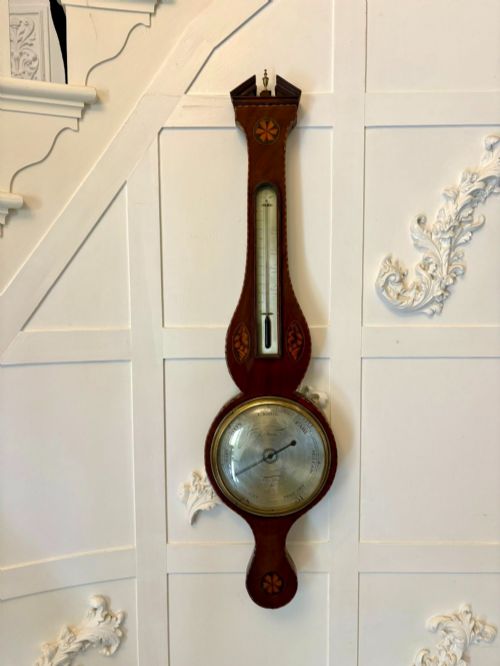
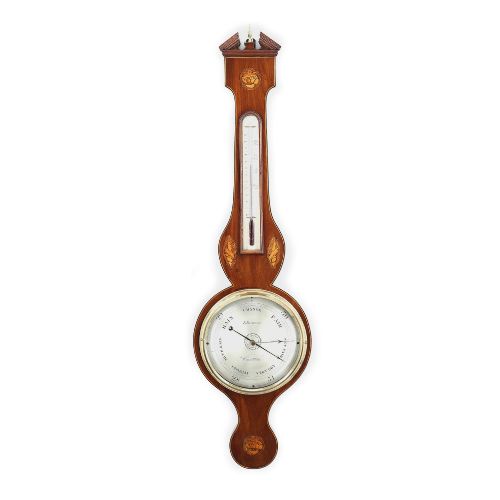
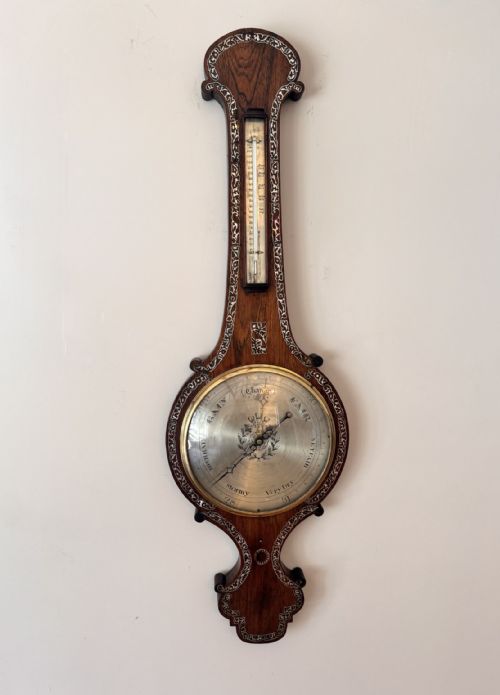


Wheel Barometer Vintage
When you want a wheel barometer vintage timepiece for the wall, you are choosing a mercurial instrument that combines weather prediction with cabinet work.
Wheel Barometer Vintage
A wheel barometer vintage piece, often called a banjo barometer due to its characteristic shape, is a domestic wall instrument designed to measure atmospheric pressure through the rise and fall of mercury in a tube. These instruments date from the Georgian, Regency, and Victorian periods, with mahogany and rosewood bodies dominating the selection.
Makers from London and provincial towns across Britain signed these dial faces, leaving a record of regional craftsmanship from the eighteenth and nineteenth centuries. The wall barometer serves simultaneously as a scientific tool and a decorative focal point for a period interior.
How they were made
Cabinet makers built the tall wooden cases using dense timbers like mahogany, rosewood, and walnut, frequently shaping the top into pediments or onion domes. They applied shell inlay, brass bezels, and mother-of-pearl accents to enrich the surfaces.
Inside the case, a glass tube containing liquid mercury connected to a float and a pulley system translated changes in atmospheric pressure into movement on the silvered metal dial.
Regional makers from Norwich, York, and Nottingham worked alongside prominent London instrument houses during the Georgian and Victorian eras.
What varies in quality
The standard of cabinet work dictates much of the appeal, separating simple pine-backed shells from richly figured mahogany and rosewood cases with delicate marquetry and boxwood stringing. Engraved silvered metal dials with crisp lettering and decorative brasswork indicate higher workshop output.
The integrity of the original glass, the complexity of the internal mercurial linkage, and the presence of signed dials by known makers distinguish ordinary domestic instruments from superior surviving examples.
B. Besozzi of Weymouth·Ganthony of London·Fagioli of Clerkenwell London·Joseph Somalvico & Co·Negretti & Zambra
The Wheel Barometer Vintage Glossary
- Wheel barometer
- A domestic weather glass where a pulley and wheel translate the movement of mercury into a rotating pointer on a dial.
- Banjo barometer
- A common descriptor for the wheel barometer due to the instrument's swollen base and slender neck resembling the musical stringed instrument.
- Silvered metal
- A brass or copper dial plate treated with a silver compound and engraved with weather forecasts and barometric numbers.
- Hygrometer
- A secondary dial mounted near the top of the case to measure atmospheric humidity.
- Spirit level
- A small horizontal glass vial set into the base of the instrument to ensure the barometer hangs plumb on the wall.
Wheel Barometer Vintage: Frequently Asked Questions
How do I hang a wheel barometer safely?
These instruments require a sturdy wall fixing that supports the weight of the dense timber case and internal glass components. Hang the piece securely from a screw or heavy bracket rather than a picture wire to maintain stability.
Ensure the wall is level before mounting, utilising the built-in spirit level at the base of the case to verify that the instrument hangs perfectly vertical for accurate mercury movement.
Can these barometers be calibrated for local weather?
Calibration involves adjusting the pointer via the rack and pinion mechanism accessible from the back or through the dial face, matching the reading to a known local barometric pressure.
Changes in altitude and weather systems require occasional minor adjustments using a small key to ensure the pointer reflects accurate meteorological conditions.
What timber was used for the cases?
Cabinet makers predominantly utilised Cuban or Honduras mahogany, rosewood, and walnut for the structural bodies of these wall instruments. Secondary woods like pine or oak appear on internal framing and backboards.
Finishes range from French polish to wax, highlighting the natural grain and figuring of the timber chosen for the specific Regency or Victorian commission.
How do I read the dial inscriptions?
The silvered metal dial typically bears weather predictions ranging from stormy and rain to change, fair, and very dry around the circular scale. The black pointer indicates current pressure, while the manually set brass indicator tracks previous readings.
Matching the moving needle against the engraved weather words reveals whether atmospheric pressure is rising or falling over the course of the day.