



Walnut Rococo Bed
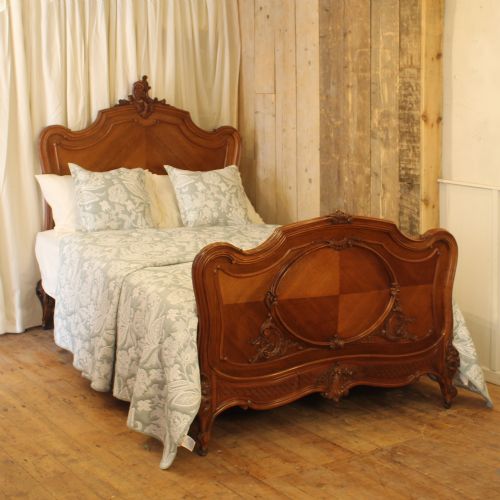
A walnut rococo bed brings flamboyant French curves and rich timber grain to the bedroom, offering grand scale alongside ornamental carving.
Walnut Rococo Bed
When searching for a walnut rococo bed, you are looking at substantial antique bedframes, double beds, king size bedsteads, and occasional daybeds rooted in nineteenth and early twentieth-century revival movements. These pieces draw heavily on French Louis XV style design, characterised by undulating lines and naturalistic ornamentation.
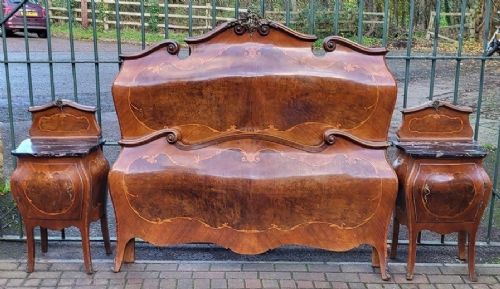
The version you are most likely to meet on this page is a carved walnut French bed dating from around eighteen ninety to nineteen ten, often retaining its original proportions while accommodating modern mattress sizes. Alongside standalone bedframes, you will occasionally encounter larger bedroom suites featuring matching bedside cabinets or six-piece groupings.
Origins stretch from French workshops to Italian makers, with craftsmanship spanning solid walnut, burr walnut veneers, and parcel gilt highlights. These grand sleeping quarters serve as dramatic focal points, frequently paired with newly upholstered headboards and footboards in contemporary or traditional textiles.
How they were made
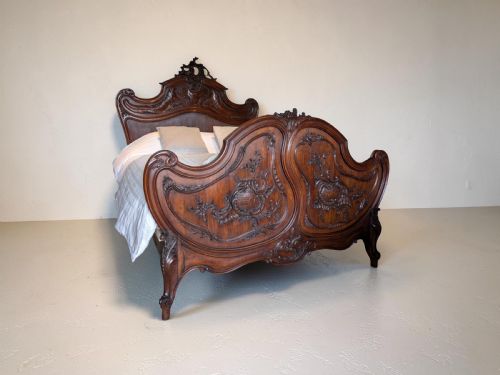
Makers utilised solid walnut and decorative burr walnut veneers applied over secondary timber carcases to achieve rich grain patterns and deep colour. Carvers worked directly into the timber to execute asymmetrical rococo scrolls, floral motifs, and sweeping cartouches along the headboards and footboards.
Surface ornamentation often included parcel gilt details and marquetry inlays, alongside painted leather panels in specific examples. Traditional joinery methods secured the substantial frames, while internal rails and upholstered sections accommodated textiles and mattresses.
Walnut Rococo Bed Retail Price Guide 2026
Typical asking prices for walnut rococo bed among the pieces listed under this phrase on Sellingantiques today, from the lower quarter to the upper quarter. They describe what is for sale here now, not the wider market.
A small carved end-of-bed two-seater sofa proves that sometimes furniture just wanted to sit down and rest too.
What varies in quality
The distinction between ordinary production and superior craftsmanship lies in the depth and crispness of the wood carving. Top-tier examples display hand-chiselled organic motifs with sharp undercut relief, whereas lesser pieces rely on shallow machine routing or simpler applied mouldings.
Timber selection equally dictates value, with figured burr walnut and book-matched veneers commanding greater appreciation than plain, uniform grain. The integrity of the structural frame, the quality of parcel gilding, and the presence of matching original bedside furniture also elevate a piece.
The Walnut Rococo Bed Glossary
- Louis XV Style
- A decorative aesthetic originating in eighteenth-century France and revived extensively during the nineteenth century, known for asymmetrical curves and lack of straight lines.
- Burr Walnut
- A highly prized timber cut from the abnormal growth of a walnut tree, yielding swirling, knotty grain patterns used in fine veneering.
- Parcel Gilt
- A technique where portions of a wooden object are selectively decorated with thin gold leaf or gilt paint to highlight specific carvings.
- Marquetry
- The art of applying decorative pieces of veneer to a structure to form intricate picture designs or geometric patterns.
- Sleigh Day Bed
- A form of bed or settee featuring scrolled ends of equal or near-equal height, designed for lounging as well as sleeping.
Walnut Rococo Bed: Frequently Asked Questions
Will these antique beds fit standard modern mattresses?
Many nineteenth and early twentieth-century bedsteads were built to slightly different dimensional standards than contemporary mattresses. It is essential to check the internal length and width specifications of each frame before purchasing a mattress.
Some bedframes have been professionally adapted over time to accommodate standard sizes, while others require custom-made mattresses to fit the historic wooden rails properly.
How do I care for antique walnut wood surfaces?
Walnut requires gentle maintenance to preserve its natural timber oils and prevent the finish from drying out. Regular dusting with a soft, dry cloth is usually sufficient for daily upkeep.
Avoid placing these beds near direct heat sources or strong sunlight, which can fade the wood and cause veneers to lift. Occasional application of a suitable beeswax polish helps maintain the lustre of the antique finish.
How can I tell the difference between periods?
Distinguishing between nineteenth-century production and early twentieth-century revivals involves examining construction techniques, hardware, and timber patination. Earlier pieces often display hand-cut joinery marks and deeper oxidation in the wood.
Revival pieces from nineteen hundred onwards frequently incorporate machine-assisted elements while maintaining the traditional French rococo vocabulary.
How do I dismantle and assemble these large bedframes?
These substantial bedsteads typically utilise metal bed bolts or traditional iron side-rail brackets to connect the headboard, footboard, and side rails. Assembly requires at least two people to support the heavy carved wooden components safely.
Care should be taken not to over-tighten bolts into historic wood threads, ensuring the structural stability of the joints without stripping the timber.