

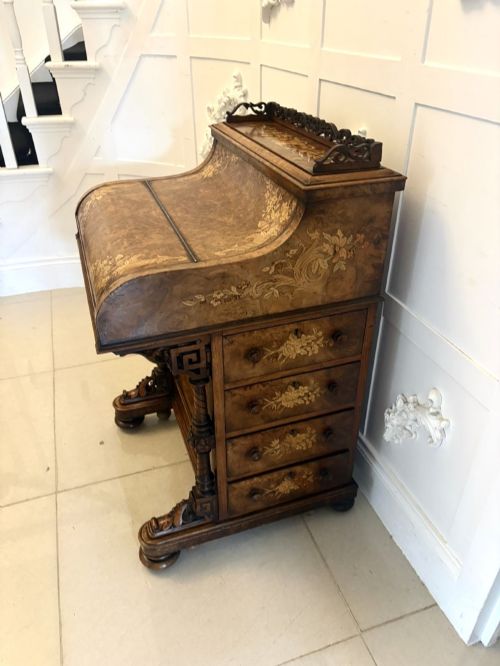


Walnut Piano Top Desk
A walnut piano top desk is a clever Victorian writing cabinet that hides its interior workspace beneath a sliding lid.
Walnut Piano Top Desk
A walnut piano top desk combines the compact footprint of a Davenport with a rolling or sliding lid reminiscent of a piano fall. These nineteenth-century writing cabinets belong to the Victorian period, appearing primarily across the mid-Victorian decades from eighteen-fifty to eighteen-seventy.
The primary form seen here is the davenport desk, often identified in the listings as a pop-up davenport or piano top davenport. These pieces provide a sloped writing surface that rises or slides forward as the main upper compartment opens.
Materials and construction methods
These desks rely fundamentally on walnut and burr walnut timbers, selected for their rich grain patterns and warm brown tones. Cabinet makers enhanced these surfaces using boxwood inlay and floral marquetry inlay, creating decorative motifs across the wood.
Internal components and hardware incorporate brass fittings alongside inset leather writing surfaces. The complex pop-up and sliding mechanisms demand precise carpentry to ensure the upper cabinet operates smoothly.
Walnut Piano Top Desk Retail Price Guide 2026
Typical asking prices for walnut piano top desk among the pieces listed under this phrase on Sellingantiques today, from the lower quarter to the upper quarter. They describe what is for sale here now, not the wider market.
These clever nineteenth-century desks double as fine furniture and mechanical puzzles that delight guests when they pop open.
Assessing quality in Victorian desks
Quality rests heavily on the selection of burr walnut veneer and the execution of the marquetry inlay. Finer examples display symmetrical grain matching and crisp, detailed floral patterns that remain intact across the curved surfaces.
The sophistication of the internal mechanism also distinguishes finer pieces from simpler ones. Desks where the pop-up action and sliding top operate with seamless precision represent the higher tier of cabinet making.
The Walnut Piano Top Desk Glossary
- Burr walnut
- A figured timber taken from the wart-like growths on walnut trees, prized for its swirling, highly decorative grain patterns. Cabinet makers utilised these distinct veneers on the primary exterior surfaces of finer desks.
- Marquetry
- The art of applying small pieces of veneer to form decorative patterns and pictures on a wooden surface. Floral motifs created through this technique frequently adorn Victorian writing furniture.
- Davenport desk
- A small, boxy writing desk featuring a sloping top and drawers fitted to one side. This specific form evolved significantly during the nineteenth century.
- Pop-up
- A descriptor for a desk mechanism where internal compartments rise automatically as the main desktop or lid is manipulated. This ingenious engineering allowed Victorian writers to conceal stationery neatly.
- Boxwood
- A dense, pale wood utilised for fine stringing and contrasting inlay details. Artisans embedded narrow strips of this timber to create crisp geometric borders around panels.
Walnut Piano Top Desk: Frequently Asked Questions
What is a piano top desk?
A piano top desk is a Victorian writing cabinet featuring a sliding or rolling lid that conceals an internal writing compartment. When opened, the mechanism often raises additional stationery drawers into view.
These pieces offer a compact footprint while providing dedicated storage for writing materials. The design merges the utility of a traditional davenport with clever nineteenth-century mechanical innovation.
How do I date these desks?
Dating relies on examining the construction style, timber selection, and decorative techniques characteristic of the nineteenth century. Most examples date from the mid-Victorian era between eighteen-fifty and eighteen-seventy.
Makers of this period favoured burr walnut veneers alongside floral marquetry and boxwood inlay. The presence of specific hardware styles and internal pop-up mechanisms further helps narrow down the period of manufacture.
How were these desks used originally?
Victorian writers utilised these compact cabinets for correspondence, letter writing, and storing personal documents. The sloping upper surface provided a convenient angle for writing.
Internal compartments and small side drawers kept inkwells, pens, and paper organised within arm's reach. The lockable top secured private correspondence when the desk was not in use.
How do I care for burr walnut?
Burr walnut furniture requires protection from direct sunlight and extreme humidity fluctuations to prevent the delicate veneer from drying out or splitting. Regular gentle dusting with a soft, dry cloth preserves the polished surface.
Occasional application of appropriate furniture wax maintains the natural lustre of the timber. Avoid placing hot or wet items directly on the walnut surfaces.