
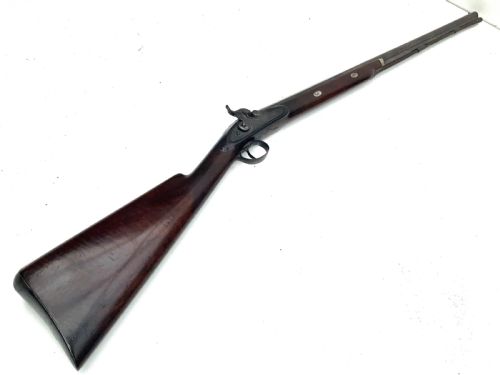
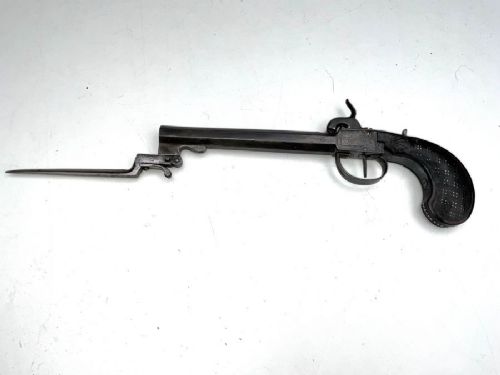


Walnut Percussion Gun
These walnut percussion gun examples are mid-nineteenth-century firearms valued by collectors for their historical action mechanisms and timber stocks.
Walnut Percussion Gun
A walnut percussion gun represents the mid-nineteenth-century development in firearm technology, moving away from flintlocks towards the percussion cap ignition system. When searching for a walnut percussion gun, buyers encounter military muskets, sporting rifles, fowlers, blunderbusses, and various pistols dating from the nineteenth century, including Victorian, Regency, and Georgian periods.
The selection ranges from British military arms bearing Tower marks and East India Company issues to fine London-made officers' pistols and sporting pieces by notable makers. Pocket revolvers and belt pistols with bayonets also appear, alongside mid-nineteenth-century American and European martial arms.
What varies in quality
The distinction between standard military issue and top-tier pieces lies in the refinement of the maker's work, the crispness of engraving on locks and furniture, and the selection of figured walnut stock timber. Maker attribution, such as signed London or provincial workshop pieces, elevates the standing of an individual firearm.
Overall preservation of original finish, matching serial numbers on mechanisms, and the integrity of the wood-to-metal fit separate working arms from exceptional collector examples.
Some pocket pistols arrived with folding triggers that popped out only when the hammer was pulled back.
John Manton & Son·Deane, Adams & Deane·Auguste Francotte
The Walnut Percussion Gun Glossary
- Percussion system
- An ignition method using a small priming cap struck by the hammer to fire the main charge. This technology superseded the flintlock in the nineteenth century.
- Blunderbuss
- A muzzle-loading firearm with a flared barrel designed to scatter shot at close range. These often feature brass barrels and robust walnut stocks.
- Fowler
- A long-barrelled smoothbore firearm intended for shooting birds and small game. They represent the sporting branch of nineteenth-century gunmaking.
- Transitional revolver
- A firearm design bridging the gap between single-shot pistols and fully developed multi-shot revolvers. These typically feature revolving barrels or cylinders operated manually or through early double-action mechanisms.
- Socket bayonet
- A blade attachment fitting over the muzzle of a military musket or carbine. It locks into position via a stud on the barrel.
Walnut Percussion Gun: Frequently Asked Questions
What periods do these guns cover?
The listings span the nineteenth century, encompassing Georgian, Regency, and Victorian eras.
Most pieces date specifically from the 1800s to the 1860s, reflecting the height of the percussion cap era.
How do I identify a military model?
Military versions often display specific government or regimental markings, such as Tower stamps or East India Company stamps.
They generally feature standard-issue steel barrels, iron furniture, and robust walnut stocks suited for active service.
Were these used in conflicts?
Several pieces date from the mid-nineteenth century and include American Civil War period revolvers and martial arms.
Carbines and muskets from this era saw widespread deployment in various military campaigns of the period.
What is the difference between a pistol and a fowler?
Pistols are shorter handguns designed for personal defence or officer use, including pocket and belt variants.
Fowlers are long guns with extended barrels built for shooting game birds in sporting contexts.