

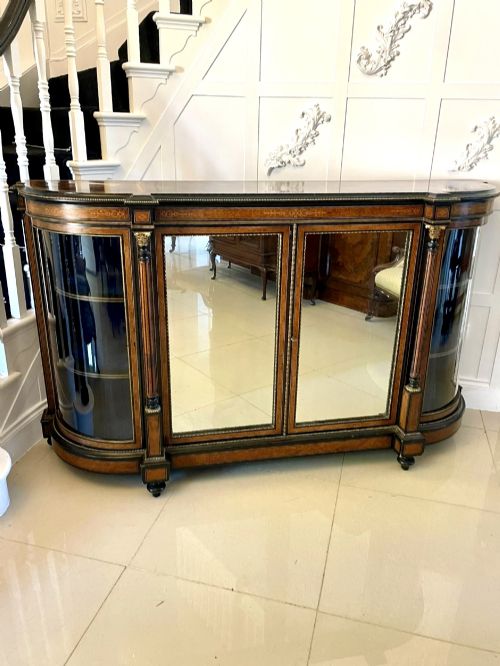
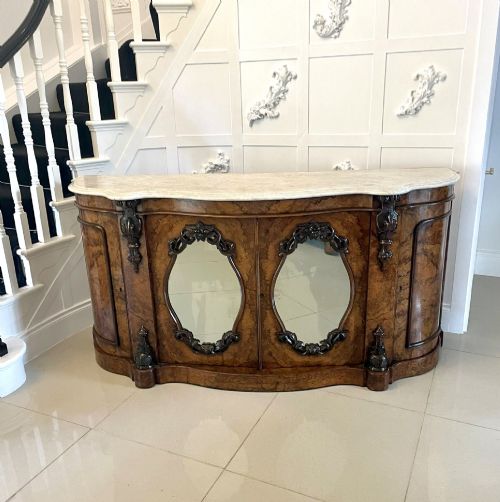
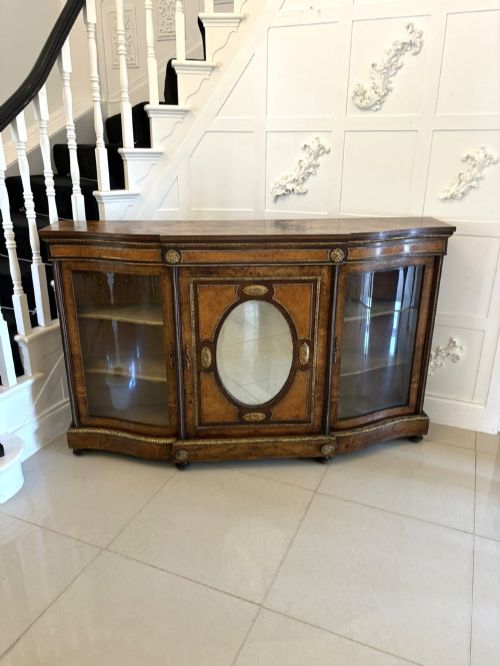
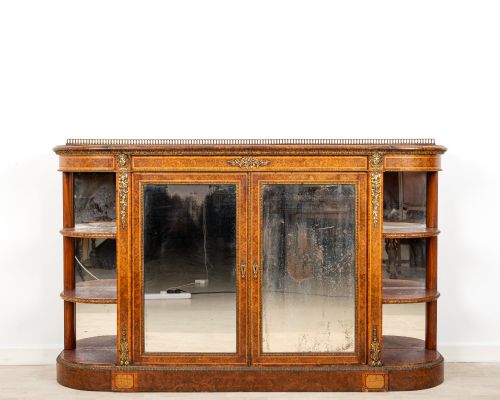
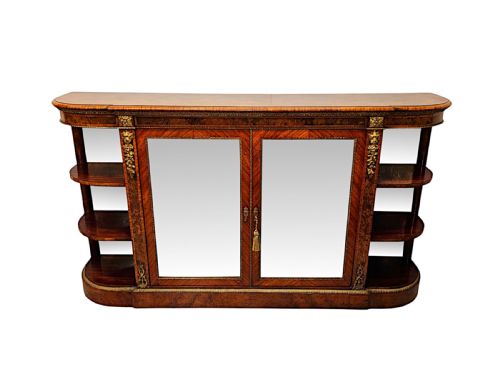
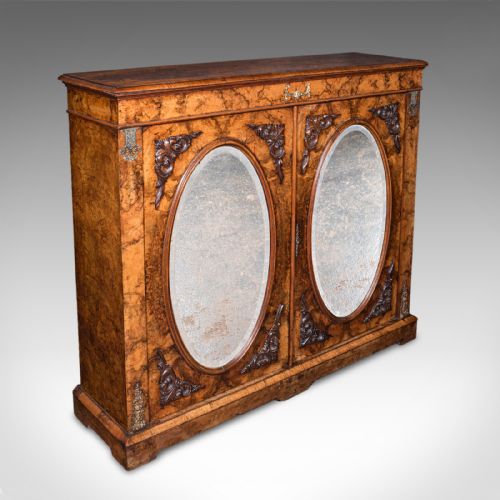
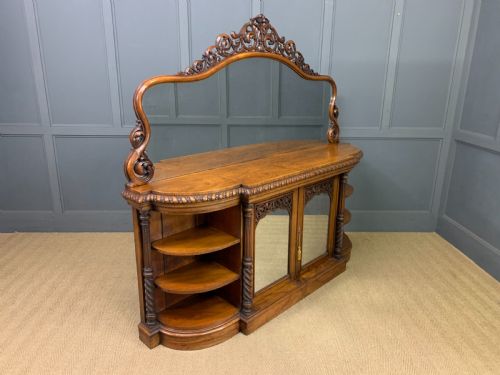


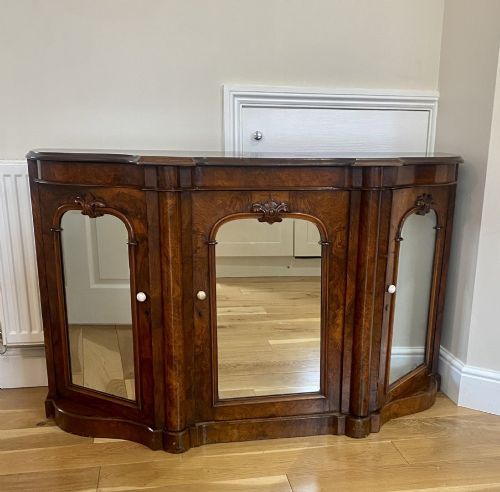
Walnut Mirror Door Credenza
A walnut mirror door credenza brings architectural depth and reflective light to a room through figured timber and central glazed panels.
Walnut Mirror Door Credenza
A walnut mirror door credenza is a substantial low storage cabinet most frequently encountered from the Victorian period, though examples stretch from the Regency era into Edwardian times. These pieces typically combine enclosed cupboard space with central mirrored doors, offering both display capabilities and surface utility.
The selection on this page centres heavily on Victorian burr walnut and figured walnut iterations, often featuring serpentine fronts or marble tops. You will also find related forms such as mirror back chiffoniers and side cabinets sharing the same architectural vocabulary.
Materials and construction methods
Cabinet makers utilised choice cuts of burr and figured walnut veneers applied over solid carcases, prized for their rich, swirling grain patterns. Marquetry inlay in lighter woods frequently punctuates the darker walnut surfaces.
Metalwork played a structural and decorative role, with cast ormolu mounts and brass details framing the doors and corners. Heavy marble slabs often formed the upper surface, whilst bevelled or flat mirror glass was set into the central doors or raised backboards.
Walnut Mirror Door Credenza Retail Price Guide 2026
Typical asking prices for walnut mirror door credenza among the pieces listed under this phrase on Sellingantiques today, from the lower quarter to the upper quarter. They describe what is for sale here now, not the wider market.
Listings feature walnut, burr walnut, and ormolu alongside marble tops across Victorian and Regency periods.
Judging the quality of a credenza
Quality rests upon the selection and matching of the veneer, where symmetrical burr walnut grain signifies a superior workshop. The crispness of carved details and the weight of the cast ormolu mounts further distinguish standard production from exceptional London quality pieces.
Interior fittings and timber choice inside the cupboards reveal the maker's thoroughness. Integrated mirrors, original brass hardware, and sound structural joinery separating the serpentine sections mark the upper tier of surviving examples.
Gillows
The Walnut Mirror Door Credenza Glossary
- Burr walnut
- A figured timber harvested from walnut tree growths, producing intricate, swirling grain patterns highly valued by nineteenth-century cabinet makers. This veneer was typically reserved for the primary display surfaces of high-status furniture.
- Ormolu
- Gilded bronze mounts applied to furniture for decorative enrichment and corner protection. These cast metallic elements caught the candle or gas light in a formal Victorian interior.
- Serpentine front
- A furniture facade curved in a wave shape, presenting a convex central section flanked by concave curves or vice versa. Executing this form required advanced woodworking skill to shape both the timber and the corresponding doors.
- Pier cabinet
- A low freestanding cabinet designed to sit against the wall space between windows. These pieces often matched the materials and proportions of larger credenzas in nineteenth-century drawing rooms.
Walnut Mirror Door Credenza: Frequently Asked Questions
What is a walnut mirror door credenza used for?
These cabinets served primarily in formal nineteenth-century reception rooms and morning rooms to display porcelain and glassware behind glazed or mirrored doors. The low profile allowed the top surface to hold decorative objects or serving items without obstructing wall art.
Today, they function well in dining rooms or living spaces as storage credenzas that double as statement furniture pieces, offering deep interior shelving while reflecting ambient room light through their glass panels.
How do I date a Victorian walnut credenza?
Dating relies on examining stylistic shifts, timber treatments, and construction marks visible across the piece. Mid-nineteenth-century examples often favour heavy burr walnut veneers paired with elaborate ormolu mounts and serpentine fronts.
Later Victorian and Edwardian pieces tend toward lighter framing and simpler mirror back constructions. Stamped maker marks or registration lozenges inside drawers provide the most precise chronological evidence.
Are these credenzas difficult to place in a modern home?
Their substantial proportions require a measured approach to room layout, particularly regarding wall space and traffic flow. Pairing them with neutral walls allows the rich burr walnut grain and metallic mounts to act as focal points.
The inclusion of internal shelving makes them practical for storing tableware or media equipment while maintaining a formal aesthetic.
What is the difference between a credenza and a chiffonier?
A credenza is typically a low, freestanding cabinet featuring doors along its entire front length, sometimes topped with marble. A chiffonier generally includes an upright mirror back structure attached to the upper rear surface.
Both forms utilise similar walnut timbers and marquetry techniques, but the chiffonier leans slightly more toward display shelving above the main surface.