




Walnut Leather Captain Chair
A walnut leather captain chair brings solid timber and dark hides to a study, offering a sturdy seat for long hours at a desk.
Walnut Leather Captain Chair
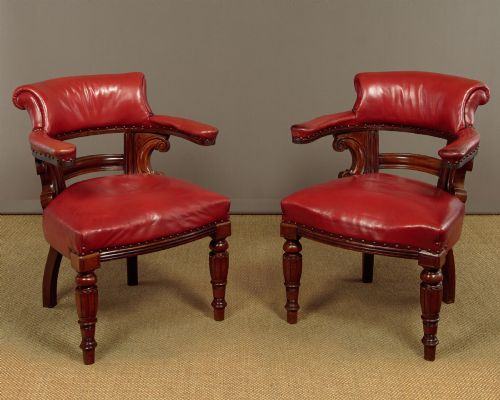
When you search for a walnut leather captain chair, you are looking at practical seating designed for studies, libraries, and offices during the nineteenth and early twentieth centuries. These pieces combine rich timber frames with durable animal hides, serving both domestic and professional spaces across various decades.
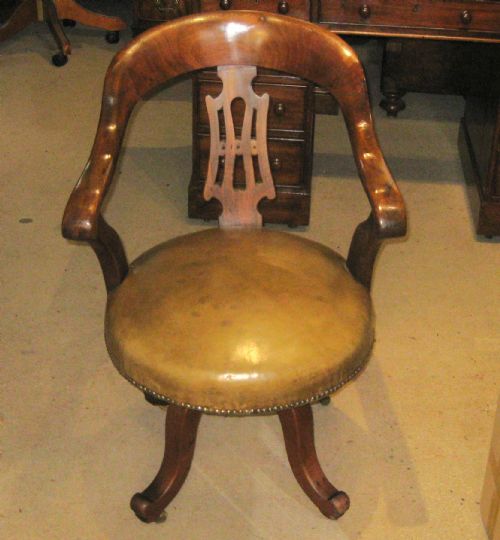
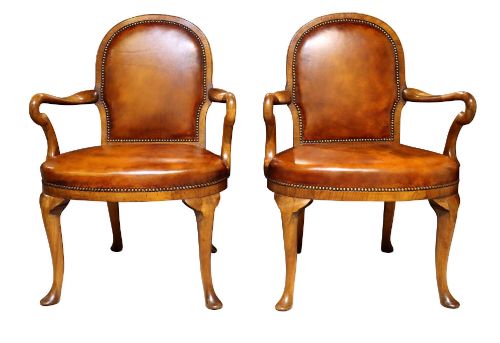
The versions you are most likely to meet on this page date from the Victorian and Edwardian eras, alongside pieces built in revival styles such as Queen Anne and Georgian. They appear as armchairs, desk chairs, and library chairs, often featuring revolving mechanisms or wide bow backs suited to writing desks.
How they were made
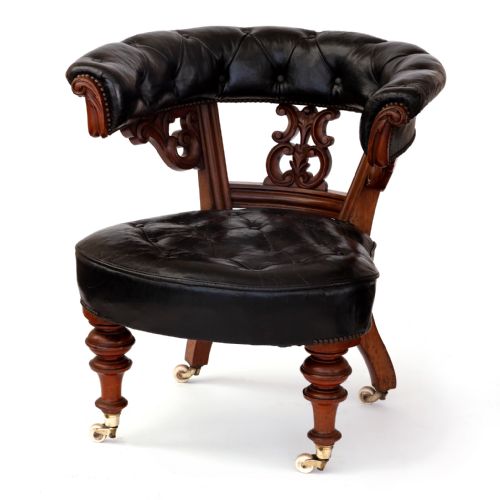
Cabinet makers constructed the foundational frames using solid walnut, sometimes shaping the timber with heavy carving or smooth curved lines depending on the chosen aesthetic. Brass and iron components frequently support the moving parts of revolving desk models.
Upholsterers fitted the seats and backs with leather coverings, securing them to the wooden armature with traditional methods. Cane also appears on select examples, providing lighter textural contrast to the dense timber.
Heavy carving meets swivel action in these sturdy seats, built so nineteenth-century captains of industry could spin while pondering accounts.
What varies in quality
The standard of the timber framing sets the tone for the entire piece, with deeply carved or carefully proportioned frames indicating finer workmanship. Simpler interpretations rely on clean lines and straightforward joinery rather than ornate ornamentation.
The condition and integration of the leather upholstery also dictate the tier of the piece, particularly where original coverings survive. Mechanisms on revolving examples function with varying degrees of smoothness, reflecting the original mechanical ingenuity.
The Walnut Leather Captain Chair Glossary
- Captain chair
- A sturdy timber armchair traditionally used in offices and libraries, often featuring a low back and arms designed to tuck beneath a desk.
- Revolving
- A mechanical feature allowing the seat to turn full circle on a central spindle, commonly found on office and desk chairs from the Victorian period.
- Carver
- An armchair designed to match a set of dining chairs, typically featuring open arms and a wider seat base.
- Bow back
- A curved upper frame shaped to fit the contours of the sitter, providing comfortable support across the shoulders.
- Revival
- A design movement that borrows decorative motifs from earlier eras, such as the Queen Anne or Georgian styles seen in later nineteenth and early twentieth-century seating.
Walnut Leather Captain Chair: Frequently Asked Questions
Are these chairs comfortable for daily desk work?
The supportive timber arms and padded leather seats make these chairs well suited for sitting at a desk for extended periods.
Many examples feature wide proportions and ergonomic curves designed specifically for writing and reading in nineteenth-century studies.
How do I identify a Victorian example?
Victorian pieces often display denser timber framing, revolving metal mechanisms, and traditional leather upholstery styles typical of the mid to late nineteenth century.
Look for structural details like bow backs and heavy carving that distinguish them from plainer twentieth-century revival pieces.
What is the difference between a desk chair and a library chair?
Desk chairs frequently incorporate swivelling bases or compact dimensions to slide easily beneath writing tables and workspace furniture.
Library chairs tend to be heavier armchairs focused on stationary comfort for reading rather than active work at a desk.
Do these chairs require special care?
Leather upholstery benefits from occasional conditioning to keep the hide supple and prevent cracking over time.
Timber frames simply need dusting and protection from direct sunlight or extreme temperature shifts to maintain the finish.