

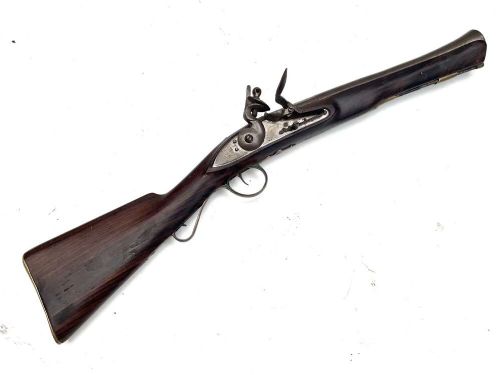
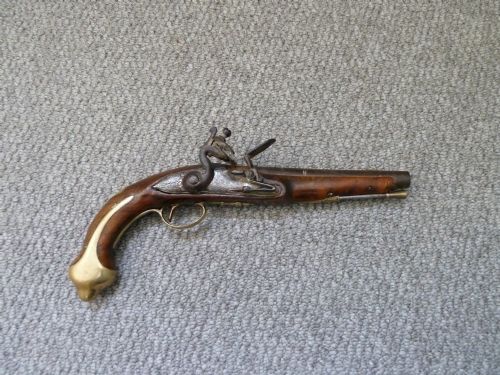
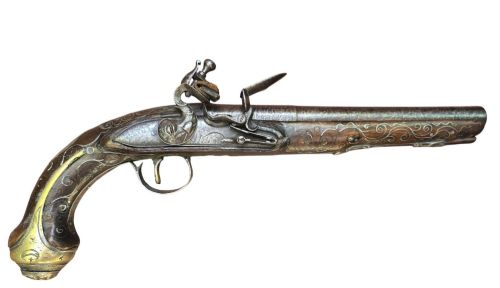
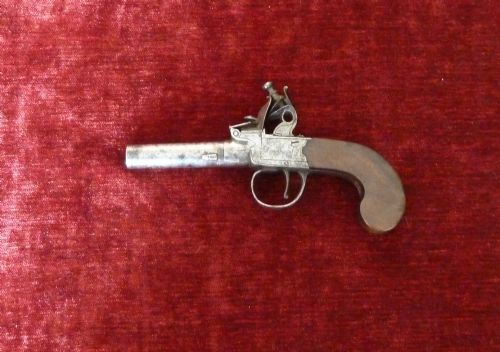
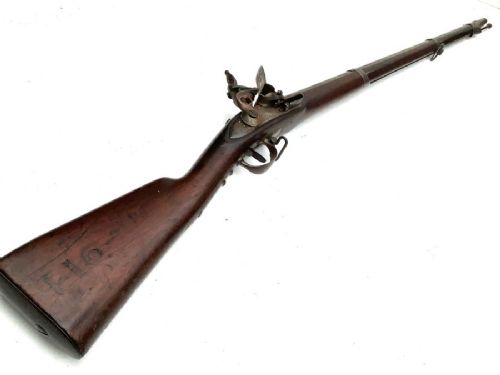
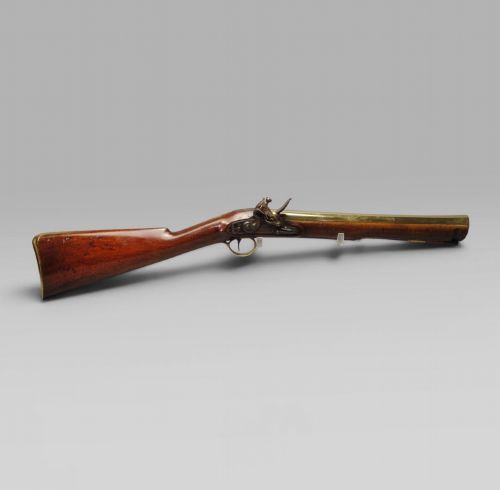
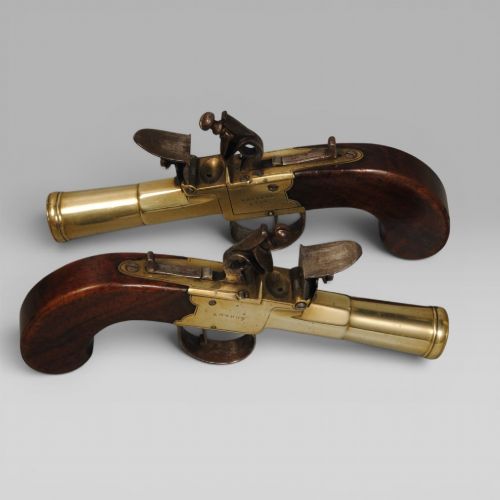


Walnut Flintlock Firearm
When you handle a walnut flintlock firearm, you feel the dense weight of historic military engineering and domestic defence.
Walnut Flintlock Firearm
A walnut flintlock firearm represents a category of antique weaponry encompassing pocket pistols, heavy cavalry holster pieces, and robust muskets spanning the seventeenth through the nineteenth centuries.
Collectors encounter diverse variants on this page, ranging from British military service arms and imposing blunderbusses to ornate European duelling pieces and Ottoman empire holster pistols.
The walnut stock defines the character of these pieces, providing the structural foundation for intricate brass, iron, and silver mountings.
Materials and construction methods
Gunsmiths selected seasoned walnut for stocks due to its grain strength and resistance to splitting under the explosive force of black powder.
Forged steel and iron formed the barrels, lock plates, and internal mechanisms, while brass or cast silver provided structural mounts, trigger guards, and decorative wire inlays.
Walnut Flintlock Firearm Retail Price Guide 2026
Typical asking prices for walnut flintlock firearm among the pieces listed under this phrase on Sellingantiques today, from the lower quarter to the upper quarter. They describe what is for sale here now, not the wider market.
Listings feature walnut stocks paired with steel, brass, and iron across Georgian and Napoleonic military and civilian forms.
Evaluating craftsmanship and condition
Superior examples display crisp barrel signatures, precise engraving on brass or steel lock plates, and intricate silver-wire inlay integrated flush into the wood.
The retention of original factory finishes, smooth action mechanics, and untouched patination distinguish exhibition pieces from heavily restored or service-worn specimens.
T. Potts, London·Twigg, London·La Motte·Sargant & Son, Birmingham·James Barber, London·Timothy Hughes, Cork·H.W. Mortimer & Son, London·R. Willoughby, Birmingham·Thomas Henshaw, London·John Rimes, London·I Parr, London·J. Robinson, Bootle, Liverpool
The Walnut Flintlock Firearm Glossary
- Flintlock
- An ignition mechanism utilising a flint held in a cock to strike a steel frizzen, creating sparks that ignite priming powder. This system dominated European military and civilian arms for over two centuries.
- Blunderbuss
- A muzzle-loading firearm with a flared barrel designed to scatter shot at close range. These weapons saw extensive use among coach guards and naval personnel.
- Turn-off barrel
- A barrel designed to be unscrewed from the breech for easier loading. This configuration appears frequently on eighteenth-century pocket pistols.
- Holster pistol
- A large firearm carried in a saddle holster by cavalry troopers or travellers. These pieces prioritised stopping power over concealment.
- Silver-wire inlay
- A decorative technique where fine silver wire is tapped into hand-carved channels within the walnut stock. Master gunsmiths used this method to create intricate geometric and floral patterns.
Walnut Flintlock Firearm: Frequently Asked Questions
What periods do these firearms cover?
The inventory spans from the seventeenth century through the Napoleonic era and into the nineteenth century. Most examples date from the Georgian period.
Craftsmanship evolved noticeably across these eras, shifting from plain military issue to highly decorated civilian pocket and duelling arms.
How were pocket pistols used historically?
Pocket pistols served as personal defence weapons for merchants, travellers, and inspectors against highwaymen and footpads. Their compact size allowed discreet carriage in overcoats or muffs.
Despite short barrels, their large bore sizes delivered significant stopping power at close quarters.
How do I care for a walnut stock?
Keep the firearm in a stable environment away from direct sunlight and rapid humidity shifts. Apply microcrystalline wax sparingly to preserve the wood and metal surfaces.
Avoid abrasive cleaners and keep all moving mechanical parts lightly oiled to prevent corrosion.
What distinguishes military from civilian pieces?
Military arms feature standardised markings, such as Tower stamps and crown ciphers, built for durability in active service. Civilian pieces often showcase finer finishing, engraved lock plates, and precious metal inlays.
Private makers catered to individual preferences, resulting in greater variation in barrel length and embellishment.