



Walnut Desk Organizer
A walnut desk organizer brings order to correspondence while showing off rich grain and brass mounts.
Walnut Desk Organizer
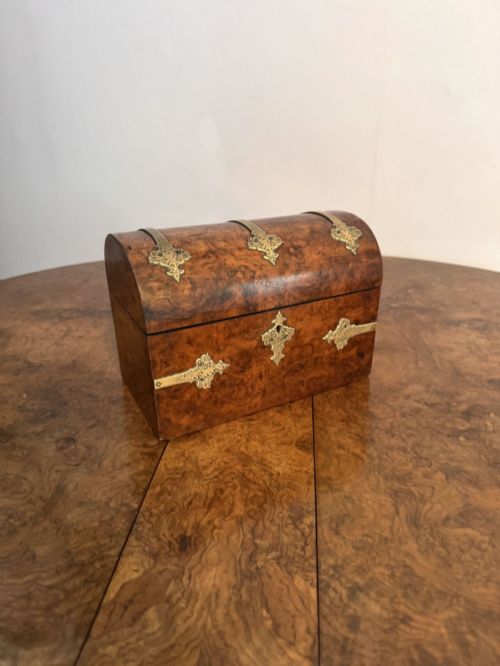
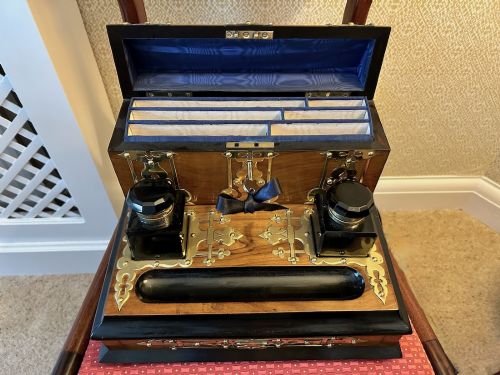
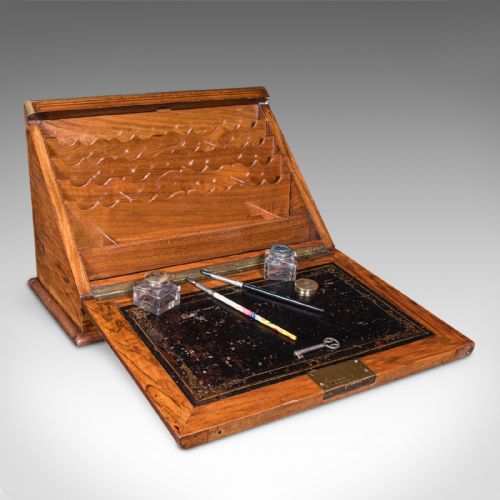
A walnut desk organizer encompasses stationery boxes, correspondence chests, inkstands, and book slides designed to keep a desktop tidy. When searching for a walnut desk organizer, buyers encounter pieces from the Regency, Victorian, and Edwardian eras, spanning the nineteenth and early twentieth centuries. These accessories were essential desk furniture in studies and libraries.
The selections available here rely heavily on figured walnut and burr walnut, often paired with contrasting brass mounts, glass, and leather. Forms range from simple book slides to elaborate stationery cabinets with drop fronts and fitted interiors. Makers utilised various regional styles, including Victorian Gothic Revival, Black Forest carving, and Anglo-Indian design.
Victorian examples dominate the selection, showing how domestic writing habits evolved throughout the nineteenth century. Stationery boxes and correspondence chests provide secure storage for paper and envelopes, whilst inkstands house glass inkwells for daily correspondence. Each item reflects the period's demand for functional yet decorative desk accessories.
How they were made
Cabinet makers constructed these desk accessories primarily using solid walnut and applied veneers of burr walnut to create striking grain patterns on sloping lids and cabinet doors. They reinforced corners and fitted carrying handles using heavy cast or beaten brass, securing components with traditional dovetail joints and brass screws.
Surface decoration involved intricate techniques such as marquetry inlay, Tunbridge ware mosaic work, and hand carving, notably seen in Black Forest animal motifs. Interiors often featured compartments lined with silk or leather, alongside specialised fitments for pens, stamps, and correspondence.
Walnut Desk Organizer Retail Price Guide 2026
Typical asking prices for walnut desk organizer among the pieces listed under this phrase on Sellingantiques today, from the lower quarter to the upper quarter. They describe what is for sale here now, not the wider market.
Carved Black Forest bears peer out from Victorian inkstands, holding glass inkwells in their paws to guard the daily correspondence.
What varies in quality
Quality in a walnut desk organizer depends on the selection of the timber, particularly the symmetry and depth of burr walnut veneers across prominent surfaces. Finer pieces demonstrate superior joinery, such as tightly fitted internal partitions and smoothly operating drop fronts or sliding mechanisms.
The standard of secondary materials and secondary embellishments also sets pieces apart, from substantial gauge brass mounts to finely executed hand carving and specialised patent mechanisms like those by Betjemanns.
Edmund Nye·Betjemanns
The Walnut Desk Organizer Glossary
- Burr walnut
- A prized veneer taken from the wart-like growths on walnut trees, yielding intricate, swirling grain patterns. It was frequently used on the exterior panels of high-end Victorian stationery boxes.
- Stationery cabinet
- A desktop piece with doors or a drop front, housing pigeonholes and shelves for paper and envelopes. These boxes kept correspondence organised before the widespread use of manufactured envelopes.
- Book slide
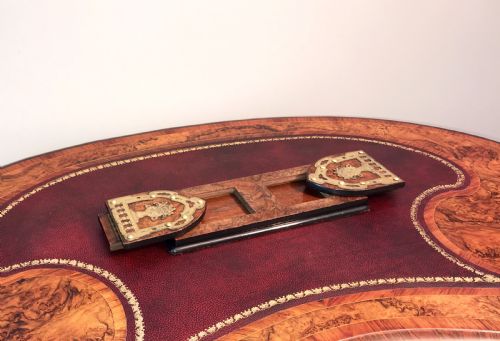
- An expanding desktop rack designed to hold a small row of reference books upright. Many examples feature extending wooden ends connected by a metal mechanism.
- Inkstand
- A desk tray holding one or more inkwells, often accompanied by pen recesses and sanders. They protected desks from ink spills while keeping writing implements close at hand.
- Tunbridge ware
- A form of decorative woodworking utilising tiny coloured wood mosaics to create geometric or pictorial scenes. It appears on nineteenth-century correspondence boxes.
Walnut Desk Organizer: Frequently Asked Questions
What is a walnut desk organizer?
A walnut desk organizer is a desktop accessory made from walnut timber designed to hold writing materials, correspondence, and books. These items include stationery boxes, inkstands, and book slides.
They served practical purposes in nineteenth and early twentieth-century offices and home libraries, keeping writing paper and inkwells neatly arranged.
How do I date a walnut stationery box?
Dating relies on observing construction methods, decorative styles, and hardware conventions of the period. Victorian pieces often display Gothic Revival details or heavy brass mounts, while Edwardian versions frequently incorporate delicate marquetry.
Patent marks and maker signatures also assist in establishing a precise date of manufacture for specific items.
Were these pieces used in offices?
These accessories were standard equipment in private studies, libraries, and commercial offices where written correspondence was managed daily. They provided secure storage for confidential letters and kept necessary writing tools organised.
Wealthy households and business premises utilised different scales of stationery cabinets and inkstands depending on the volume of writing conducted.
How do I care for antique walnut?
Antique walnut benefits from stable room temperatures away from direct sunlight and strong heat sources. Applying traditional wax polish periodically helps maintain the lustre of the wood and protects the finish.
Harsh chemical cleaners should be avoided to preserve the original patina and any delicate brass or veneer work.