

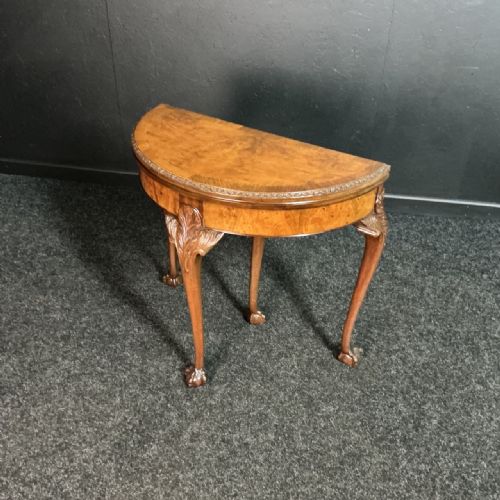


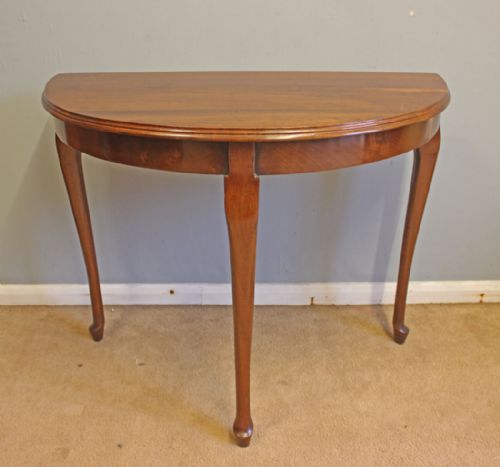


Walnut Demilune Side Table
A walnut demilune side table brings half-circle grace to a hallway, offering rich wood grain and compact form without crowding the room.
Walnut Demilune Side Table
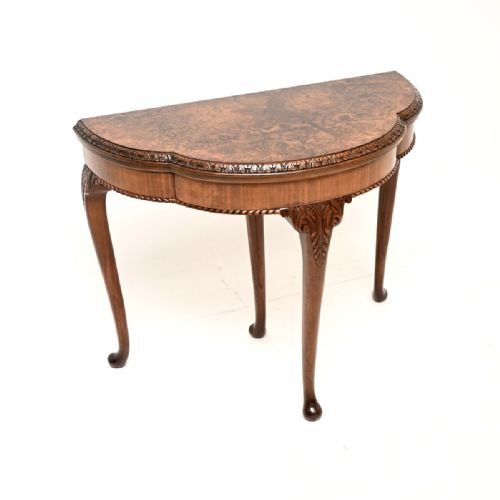
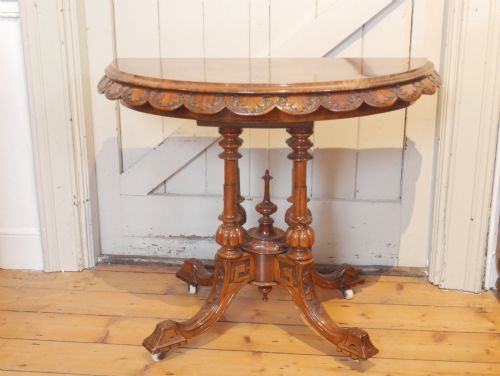
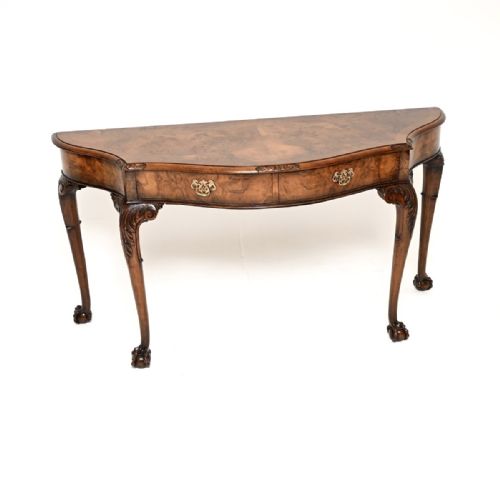
A walnut demilune side table takes a half-moon shape designed to sit flush against a wall, making it practical for narrow spaces. The selection on this page spans from eighteenth-century Georgian and Louis XVI examples to Victorian and later twentieth-century revivals.
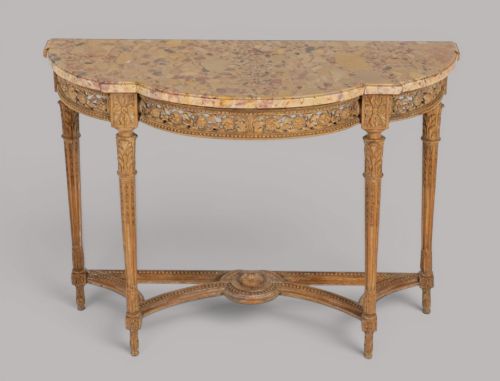
Many of these pieces serve a dual purpose as folding card or games tables, opening up to reveal baize-lined playing surfaces. Others appear as console tables with marble tops or as matching pairs suited for symmetrical placement.
The styles range from plain Queen Anne forms to elaborate Black Forest carved hounds and Louis XVI marquetried surfaces. Walnut remains the unifying material across these diverse periods and functions.
How they were made
Cabinetmakers utilised solid walnut and figured burr walnut veneers applied to secondary woods, creating striking grain patterns across the semicircular tops. Floral marquetry and geometric stringing frequently decorate the main surfaces of Victorian and later pieces.
Marble tops appear on certain continental console variants, requiring heavy stone slabs fitted to wooden frames. Brass hinges and swing-legs support the folding leaves of card tables, while intricate hand-carving defines the legs and skirts of revival pieces.
Walnut Demilune Side Table Retail Price Guide 2026
Typical asking prices for walnut demilune side table among the pieces listed under this phrase on Sellingantiques today, from the lower quarter to the upper quarter. They describe what is for sale here now, not the wider market.
Listings feature periods from the eighteenth century through the Victorian era up to 1930, utilising burr walnut, marble, and brass.
What varies in quality
The choice of walnut veneer dictates much of the visual impact, with symmetrical burr patterns commanding greater presence than plain timber. Finely executed hand-carving on cabriole legs separates standard production from superior workshop output.
The integrity of the folding mechanism and the tightness of the joints determine how well a card table survives daily use. Original marble slabs and intact marquetry inlay preserve the intended character of the piece.
Maurice Adams
The Walnut Demilune Side Table Glossary
- Demilune
- Half-moon shape. This describes furniture with a semicircular front and a flat back designed to stand against a wall.
- Burr walnut
- Wood taken from a walnut tree growth showing swirling knot patterns. Cabinetmakers prize this timber for decorative veneer work.
- Console table
- A table supported by wall brackets or console legs. These pieces traditionally stood against drawing-room walls.
- Marquetry
- Inlaid wood pieces forming decorative patterns. Craftsmen use contrasting veneers to picture flowers, foliage, or geometric designs.
Walnut Demilune Side Table: Frequently Asked Questions
How do I spot burr walnut?
Burr walnut displays swirling, organic grain patterns filled with small knot clusters rather than straight growth lines. It comes from excrescences on the tree where the grain grew in multiple directions.
Cabinetmakers sliced this wood into thin veneers to cover larger surfaces on table tops and cabinet fronts. The resulting figure creates a dramatic, mottled appearance.
Are these tables good for cards?
Many examples on this page are specifically constructed as card and games tables with fold-over tops. They historically provided a stable surface for evening entertainment.
When closed, they occupy minimal space against a wall as side tables. Opening the top reveals a larger surface, often lined with baize or felt for playing.
How do I date a walnut table?
Dating relies on stylistic details, construction methods, and the specific characteristics of the walnut timber used. Georgian and eighteenth-century pieces show different leg profiles and joinery compared to Victorian or Art Deco revivals.
Reference points include Queen Anne cabriole legs, Louis XVI neoclassical details, and later twentieth-century interpretations. Examining the secondary woods underneath also aids identification.