


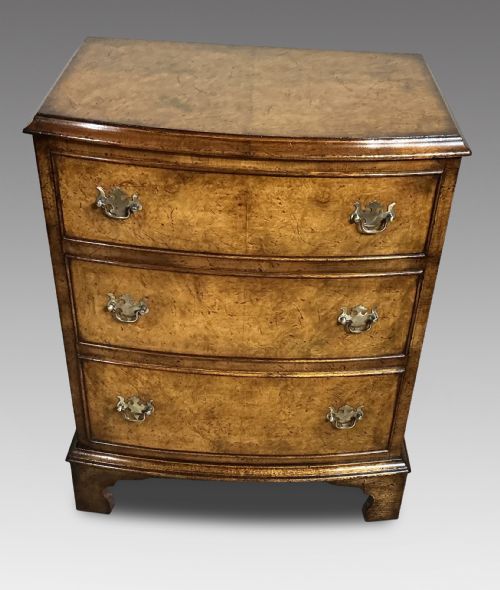


Walnut Bowfront Tallboy
A walnut bowfront tallboy is a commanding bedroom storage piece offering striking curved grain patterns and vertical capacity.
Walnut Bowfront Tallboy
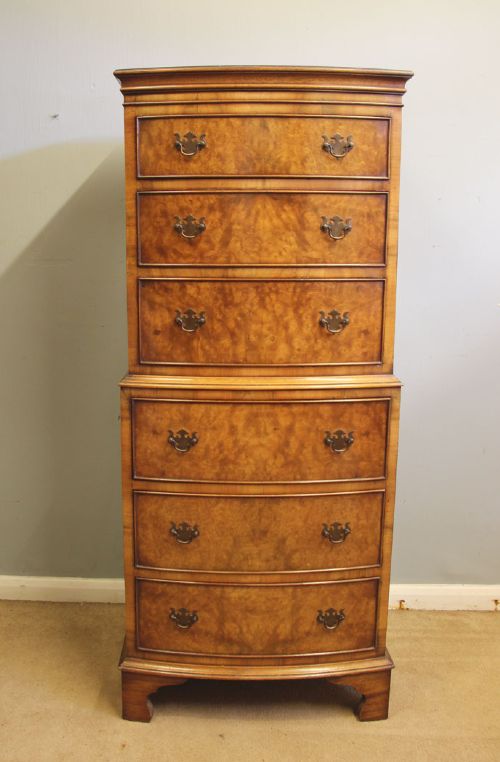
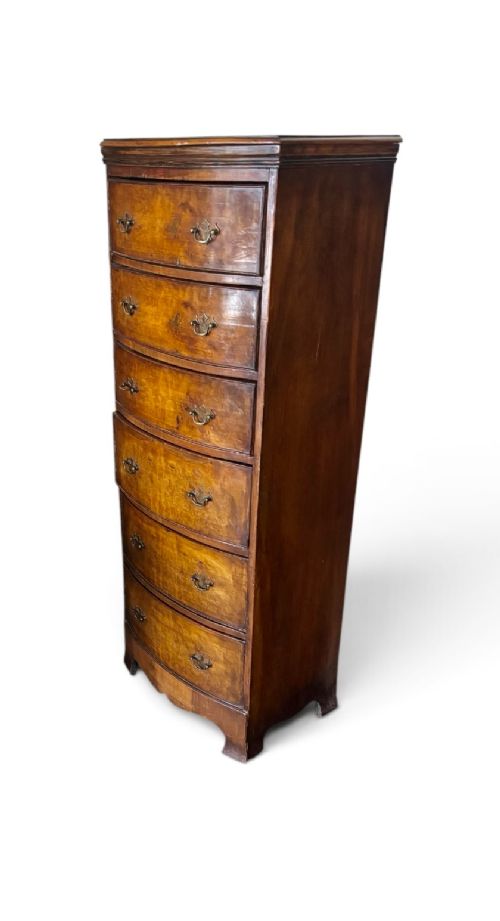
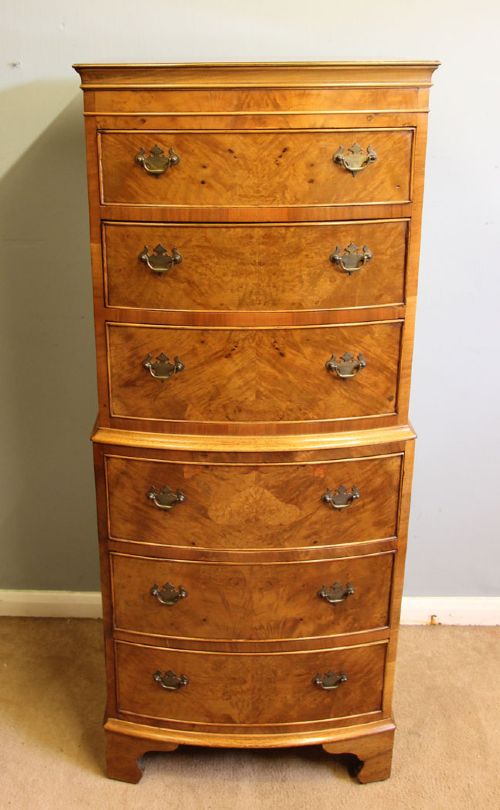
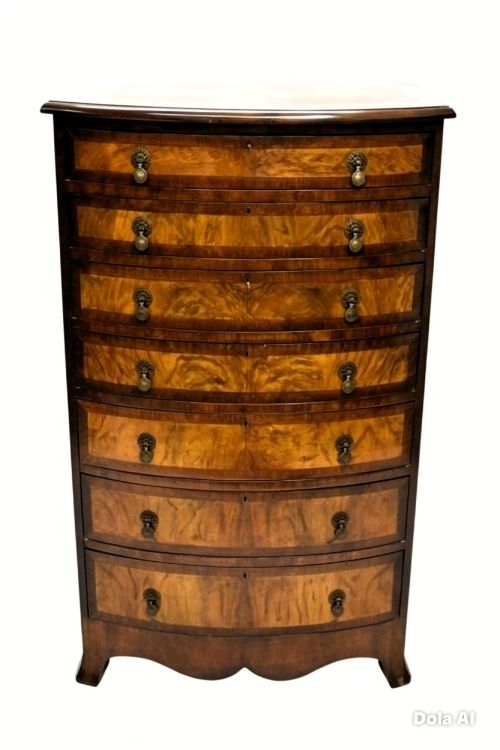
A walnut bowfront tallboy combines the tall, vertical proportions of a chest on chest with a curved front profile that projects outward. Pieces matching this search phrase date from the Edwardian period, 1920, and 1930, capturing Georgian style and Georgian revival movements alongside early twentieth century production.
Makers and workshops of the era utilised timber veneer and figured wood to create these substantial storage items. Forms include chests of drawers, chest on chest configurations, and tallboy designs often associated with firms such as Heal's from the nineteen thirties.
The dominant aesthetic draws heavily on earlier eighteenth century proportions while incorporating the streamlined sensibilities of Art Deco design. Buyers encounter both traditional polished finishes and painted wood variations across these listings.
Materials and construction methods
Cabinet makers constructed these pieces using solid timber frames overlaid with burr walnut veneer, walnut, and figured wood to create striking decorative patterns across the curved drawer fronts. Oak often appears in the internal secondary framing and drawer linings.
Brass hardware, including drop handles and key escutcheons, provides functional contrast to the rich brown tones of the polished timber. Crossbanding techniques frame the drawer margins to highlight the natural figuring of the walnut.
Some nineteenth century chests survived by being sawed horizontally in half to create two modern dressing chests.
Assessing quality in walnut furniture
Quality rests primarily in the selection of the burr walnut veneer and how seamlessly the grain matches across multiple drawer fronts. Superior examples display carefully planned symmetry in the timber patterns that wraps smoothly around the curved bowfront profile.
The precision of the cabinet work distinguishes finer production, particularly in the crisp execution of crossbanding and the tight fit of drawers within their housings. Maker attribution, such as pieces bearing labels from established retailers like Heal's, also elevates the standing of an individual tallboy.
Heal's
The Walnut Bowfront Tallboy Glossary
- Bowfront
- A convex, curved front profile that projects outward from the corners, softening the rectangular mass of a tall chest. This shape requires skilled joinery to bend veneers uniformly.
- Tallboy
- A tall chest of drawers, often constructed as a chest on chest with a smaller upper section resting upon a larger base. It maximises storage while occupying a compact floor footprint.
- Burr walnut
- Timber taken from a growth deformation on a walnut tree, yielding intricate, swirling grain patterns highly prized for decorative veneer work. Cabinet makers select these sections for prime visual impact.
- Crossbanding
- A narrow strip of veneer laid perpendicularly to the surrounding grain around the edge of a drawer front or top. This technique frames the primary wood and adds formal definition.
- Figured wood
- Timber possessing natural patterns and irregularities in the grain that catch the light differently depending on the viewing angle. It marks a deliberate choice by the maker to showcase natural material beauty.
Walnut Bowfront Tallboy: Frequently Asked Questions
What is a tallboy?
A tallboy is a vertical storage unit combining multiple drawers in a single high frame or a chest on chest configuration. It provides generous drawer capacity while maintaining a narrow footprint suited to bedrooms.
Historically designed for clothing storage, these pieces utilise their height to deliver maximum utility without dominating floor space.
How do I date a walnut tallboy?
Dating relies on stylistic clues, construction methods, and materials such as burr walnut veneer or brass hardware. Pieces matching this grouping primarily date from the Edwardian era through the nineteen twenties and nineteen thirties.
Georgian revival and Art Deco influences often overlap in pieces from this timeframe, combining classic proportions with twentieth century manufacturing techniques.
Where should I place a bowfront tallboy?
These pieces suit bedrooms, dressing rooms, or generous hallways where their vertical proportions and curved fronts can be appreciated without obstruction. Ensure adequate clearance for drawer opening and general circulation.
Positioning them away from direct sunlight and heat sources helps preserve the polished walnut surfaces and delicate veneer work over time.
How do I care for walnut veneer?
Maintain walnut furniture by dusting regularly with a soft, dry cloth and avoiding silicone based polishes or harsh chemical cleaners. Consistent indoor humidity levels prevent the underlying timber and veneer from shifting.
Periodic application of appropriate wax feeds the wood and helps protect the finish from drying out or developing minor surface dullness.