


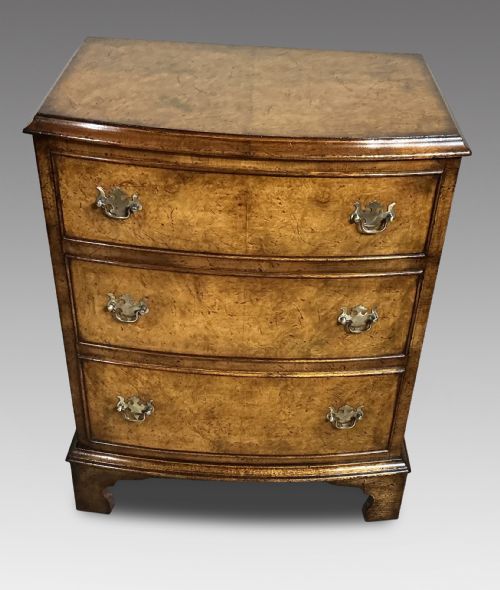


Georgian Walnut Bowfront Chest
These georgian walnut bowfront chest pieces are revival and twentieth-century interpretations of earlier forms, offering rich figuring and deep timber tones for modern interiors.
Georgian Walnut Bowfront Chest
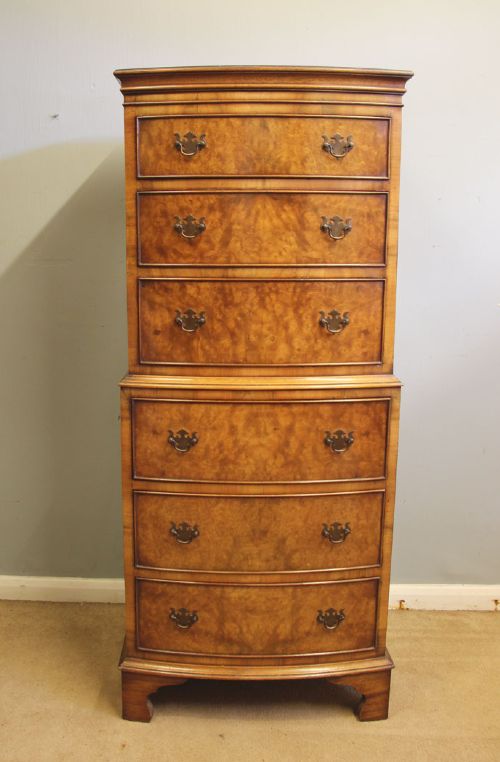
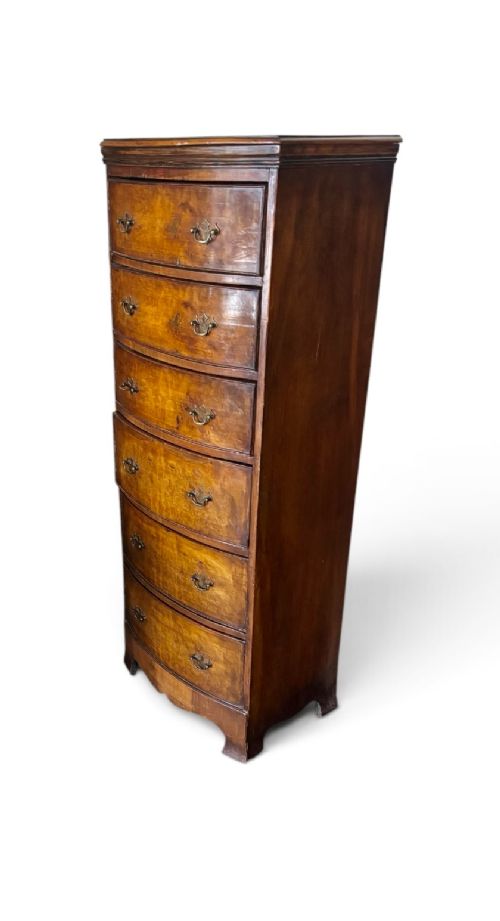
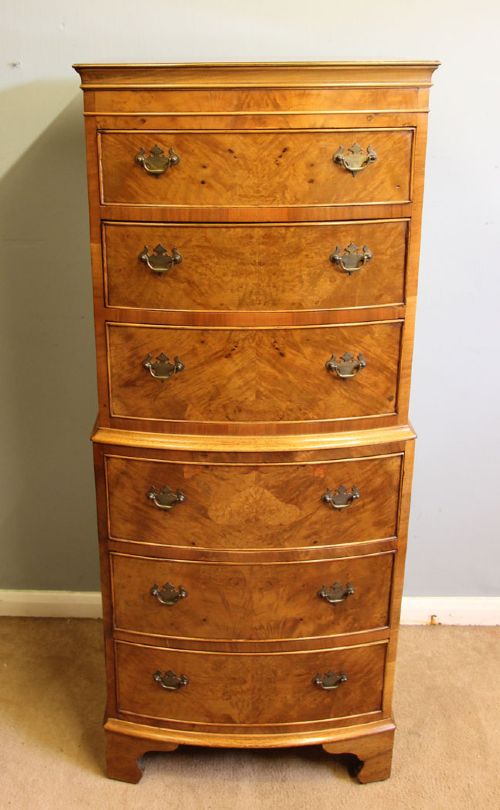
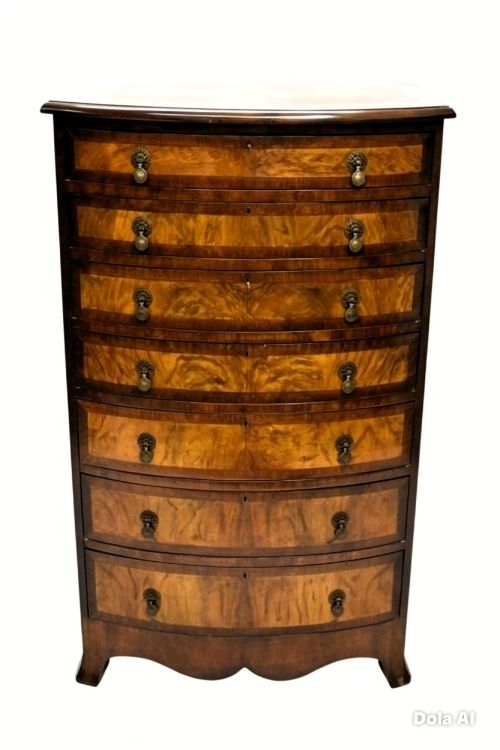
A georgian walnut bowfront chest brings together curved drawer fronts and figured timber surfaces, taking inspiration from eighteenth-century aesthetics while dating primarily from the early twentieth century, including the 1920s and 1930s. Buyers searching this phrase encounter variations such as tallboys, chests on chests, and standard chest of drawers formats.
The prevailing examples on this page reflect Edwardian and 1930s production adhering to Georgian styles and Queen Anne influences. These range from small bow-fronted designs to taller upright pieces incorporating painted wood elements alongside traditional timber construction.
How they were made
Cabinet makers utilised walnut and burr walnut veneer over secondary woods like oak, applying crossbanding to accentuate the curved drawer fronts. Grain patterns were carefully selected and matched across the facade to create visual symmetry.
Brass hardware such as handles and escutcheons were fitted to the drawers, complementing the warm tones of the polished wood surfaces.
Some chests come with painted wood highlights, proving that even traditional cabinet makers enjoyed a brief brush with colour.
What varies in quality
Quality rests in the selection of the burr walnut veneer and the precision of the crossbanding, where finer pieces display continuous, highly figured grain across the curved fronts. The joinery of the drawer linings and the crispness of the bow-front contouring further distinguish better examples from simpler production.
The proportion and scale influence overall desirability, with smaller tallboys and chest-on-chest configurations demonstrating greater intricacy in cabinet work than standard proportions.
The Georgian Walnut Bowfront Chest Glossary
- Bowfront
- A convex, curved front on a piece of furniture that projects outward in an arc. This shape requires specialised joinery to bend wood or shape veneers to the curve.
- Burr walnut
- Wood taken from a walnut tree growth or burl, yielding swirling, knotty grain patterns prized for decorative veneer work. It is typically sliced thin and applied to a stable secondary timber.
- Crossbanding
- A narrow strip of veneer laid perpendicularly to the surrounding grain along the edges of a drawer or top. This technique creates a neat border that frames the primary wood.
- Tallboy
- A tall chest of drawers, often constructed as a chest on chest where a smaller upper section sits upon a larger base. It maximises storage while maintaining a compact footprint on the floor.
Georgian Walnut Bowfront Chest: Frequently Asked Questions
What periods do these chests date from?
The pieces available here primarily date from the early twentieth century, specifically the 1920s, 1930s, and the Edwardian period.
Although they adopt Georgian styles and Queen Anne design motifs, they are later interpretations rather than eighteenth-century originals.
Are these chests made of solid walnut?
Most examples utilise burr walnut veneer applied over a secondary timber such as oak.
This technique allowed cabinet makers to display decorative, figured grain across the curved bowfront surfaces while maintaining structural stability.
What is a chest on chest?
A chest on chest consists of an upper chest of drawers mounted directly onto a slightly larger lower chest.
This tall configuration provides substantial vertical storage capacity within a relatively narrow floor space.
How do bowfront chests differ from straight fronts?
Bowfront chests feature a curved facade that projects outward in the centre, softening the geometric profile of the furniture.
This curved shape demands careful veneering and specialised drawer construction compared to flat-fronted alternatives.