



Walnut Black Forest Clock
A walnut black forest clock brings the vigorous carving and deep tones of the nineteenth-century woodlands straight into a room.
Walnut Black Forest Clock
When you search for a walnut black forest clock, you encounter timepieces rooted in the nineteenth-century tradition of the German and Swiss uplands. These objects combine timekeeping with sculptural woodcraft, taking the form of mantel clocks, wall clocks, bracket clocks, and even aneroid barometers.
The pieces on this page span the Victorian era, with dates stretching from about eighteen fifty to nineteen hundred. You will find wall-hanging cuckoo clocks alongside substantial mantel pieces, some influenced by French Rococo design or German Historicism.
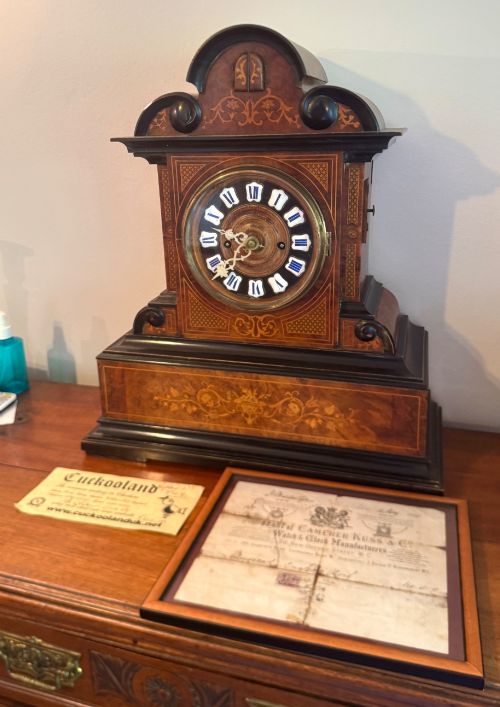
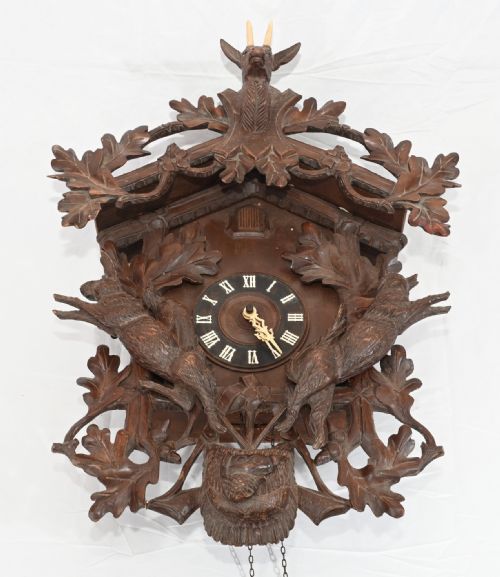
The most common form here is the carved walnut cuckoo clock, often enriched with marquetry or ebonised wood details. Alongside them sit larger architectural bracket clocks and domestic wall clocks driven by brass movements.
How they were made
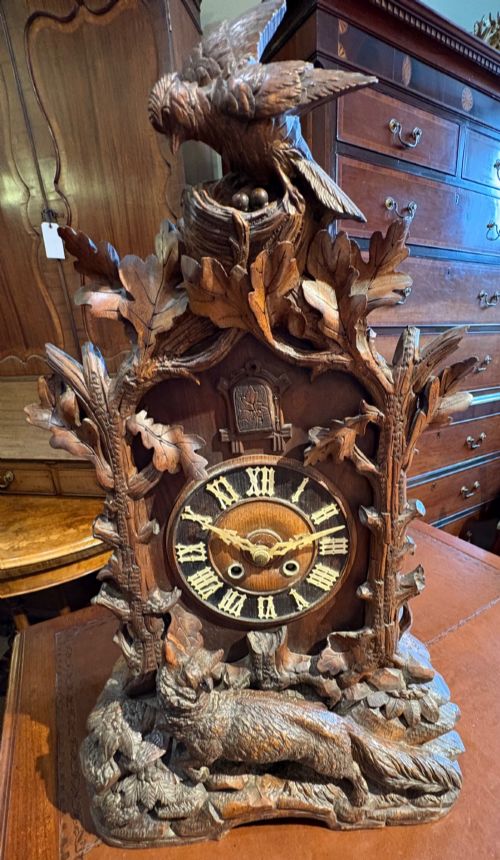
Makers fashioned these cases primarily from walnut, selected for its rich grain, and employed hand-carved wood to build elaborate foliage, birds, and architectural motifs. Ebonised wood often provided stark contrast to the warm brown tones of the carved walnut panels.
Movements relied on brass gear trains, sometimes housed behind glass doors, while dials featured white enamel numerals or ceramic faces with delicate hands. Cast iron components also appeared in the internal weight-driven and spring-driven mechanisms that powered the strikes.
What varies in quality
The distinction between ordinary and exceptional examples rests in the depth and crispness of the carved walnut foliage. Superior pieces display intricate undercut leaves and lifelike birds that emerge dynamically from the timber rather than sitting flat against the surface.
Execution of the movement dictates the standing of a clock, with established makers using refined brass gear trains that endure across generations. Marquetry precision, cabinet proportions, and the integration of enamel or ceramic dials also separate standard production from masterwork output.
Johann Baptist Beha·Lenzkirch
The Walnut Black Forest Clock Glossary
- Black Forest
- A mountainous region in southwest Germany renowned for its domestic wood-carving industry and mechanical clock production during the nineteenth century. This style encompasses both rustic forest motifs and more formal architectural designs.
- Bracket Clock
- A portable clock designed to sit on a bracket or shelf, though many substantial examples stand securely on mantelpieces or tabletops. They typically feature fine woodwork and enclosed mechanical movements.
- Marquetry
- The art of applying small pieces of veneer to a structure to form decorative patterns and pictures. In these pieces, contrasting wood tones create floral or geometric ornamentation on the case.
- Ebonised Wood
- Timber treated with a dark finish to imitate the appearance of ebony. Makers utilised this technique to create sharp visual borders against natural walnut.
- Aneroid Barometer
- A device that measures atmospheric pressure without using liquid mercury, relying instead on a flexible metal box. These instruments were often mounted in carved walnut frames matching the contemporary clock styles.
Walnut Black Forest Clock: Frequently Asked Questions
How do I wind a cuckoo clock?
Most of these clocks operate on weights suspended by chains or gut lines. You pull the chains gently to draw the weights back up to the base of the case.
Avoid pulling too hard or letting the weights drop sharply, as this can strain the internal brass gear train and damage the movement.
Where should I hang a wall clock?
Select an interior wall free from dampness and direct sunlight to protect the walnut veneer and carved details. Ensure the wall structure can support the weight of the timber and brass movement.
Mount the clock firmly at eye level so you can easily reach the side doors or front panel for routine adjustments and winding.
How do I tell an eighteen fifty clock from nineteen hundred?
Mid-nineteenth-century pieces often reflect French Rococo influences with sweeping asymmetrical carvings and softer, rounded outlines. By nineteen hundred, designs grew either more strictly architectural or leaned into heavier German Historicism.
Examine the dial construction and the crispness of the hand-carved walnut foliage, as earlier carving tended towards deep relief while later mass production softened some details.
Can these clocks run on modern time?
Mechanical clocks from the nineteenth century require regular setting and care to keep accurate time. Environmental changes in your home, such as temperature and humidity shifts, will cause the wood and metal to expand or contract.
Allow time for the clock to settle in its new room and make small adjustments to the pendulum bob to regulate the beat over several days.