


Vintage Writing Slope Accessory
These vintage writing slope accessory pieces are the fitted brass, glass and leather furnishings that complete a desk, selected to bring utility and period character to your workspace.
Vintage Writing Slope Accessory
When you search for a vintage writing slope accessory, you are looking at the small, functional implements and fitted containers that accompanied portable writing boxes and domestic desks during the Georgian, Victorian and Edwardian eras. These objects range from heavy inkstands and inkwells to portable writing cases, desk rulers, sealing wax holders and pen wipes designed to keep a writer supplied.
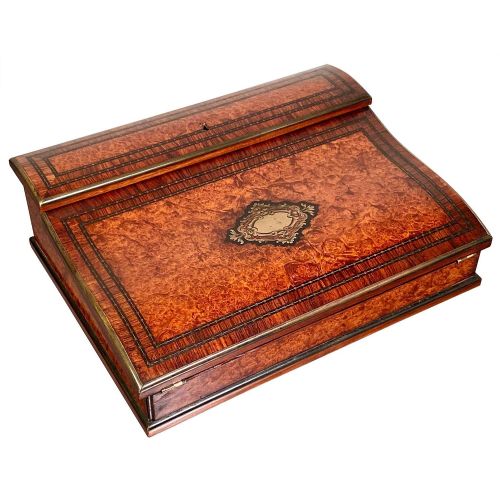
The versions you are most likely to meet on this page span the nineteenth and early twentieth centuries, reflecting the materials and manufacturing methods of the periods from 1800 through to the Edwardian decades. They include campaign writing slopes in burr walnut with brass inlay, solid oak ink stands, and boxed desk sets equipped with intaglio coloured-glass seals.
Makers and manufacturers of the time produced these items in various styles including Empire, Aesthetic Movement and Art Deco, using durable substances suited to daily desk use. Whether you find a French walnut campaign slope or an Edwardian silver sealing wax holder, each piece forms part of the traditional paraphernalia of handwriting.
How they were made
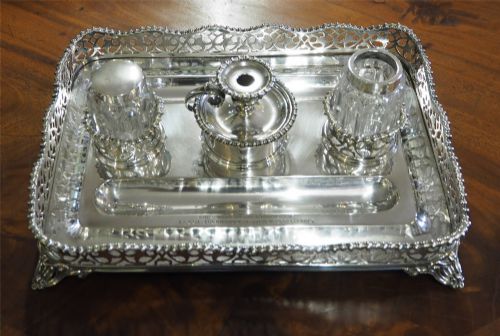
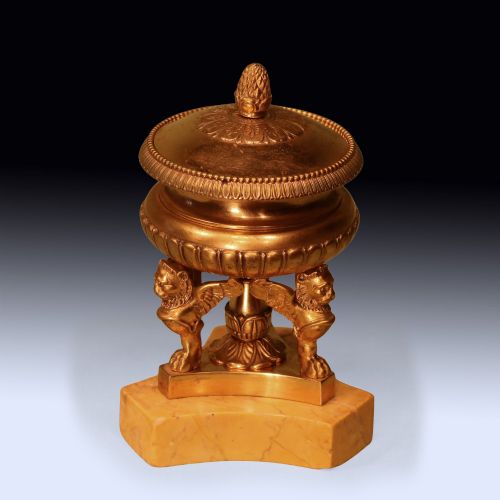
Metalwork forms a primary component in many of these pieces, utilising brass, silver, silver plate and ormolu to create structural mounts, inkwell collars and decorative stands. Craftsmen combined these metals with turned and cut glass for ink reservoirs, or mounted them on bases such as Sienna marble and solid oak.
Woodworking and leathercraft dominate the construction of the larger boxes and cases, employing burr walnut, mahogany and crocodile skin alongside embossed leather. Artisans inlaid brass stringing and escutcheons into the timber surfaces, creating portable writing slopes designed to withstand regular travel and handling.
A surviving Edwardian silver sealing wax holder retains its original, unused sealing wax ready for the next dispatch.
What varies in quality
The standard of execution in the metalwork and mountings dictates the standing of an individual piece, separating standard production items from exhibition grade examples. Crisp chasing on ormolu mounts, heavy gauge silver plate and precision in brass inlay indicate superior workshop output.
Material selection and the preservation of original components also determine the overall merit of an item. Complete sets retaining their original contents, such as unutilised sealing wax or matched intaglio coloured-glass seals within a Georgian box, command greater interest than assembled or altered pieces.
Elkington·Edward Todd And Co New York
The Vintage Writing Slope Accessory Glossary
- Writing slope
- A portable desk featuring a sloping lid that opens to reveal a writing surface and compartments for stationery. These boxes often contain fitted inkwells and pen trays.
- Inkstand
- A desktop stand or tray holding one or more inkwells along with spaces for pens and sealing wax. They are typically made from metals, glass or wood.
- Ormolu
- Gilded bronze used widely in decorative mounts and furniture ornamentation during the nineteenth century. The technique involves applying a gold-mercury amalgam to a bronze base.
- Intaglio
- A design carved into the surface of a material, such as glass or stone, so that the impression sits below the plane. These were frequently used on seals for pressing into hot wax.
- Sealing wax holder
- A small implement designed to hold sticks of sealing wax, often paired with a taper or a seal matrix. They appear in silver and other metals from the Victorian and Edwardian periods.
Vintage Writing Slope Accessory: Frequently Asked Questions
What is an antique inkstand?
An antique inkstand is a desktop tray or stand designed to hold inkwells, pens, and sealing equipment in a central location. These pieces kept writing materials organised and ready for use.
They appear in materials like brass, glass, silver plate and solid oak, reflecting the tastes of the Victorian and Edwardian periods.
How do I use a writing slope?
A writing slope is opened to reveal an inclined writing surface, often lined with leather or velvet, which provides a comfortable angle for handwriting. Compartments inside store paper, envelopes and ink.
Many examples include fitted glass inkwells and secret drawers behind the stationery dividers.
What are intaglio glass seals used for?
Intaglio glass seals are pressed into melted sealing wax to leave a raised impression on letters or documents, serving as a personal signature or closing mark. They were commonly kept in fitted desk sets alongside coloured wax.
The carved glass faces feature various heraldic or decorative motifs.
How do I date a campaign writing slope?
Dating a campaign writing slope involves examining the brass corner mounts, escutcheons, wood types such as burr walnut or mahogany, and construction methods. Pieces from the early nineteenth century often feature flush brass handles designed for travel.
Internal fittings and paper linings also offer clues to the specific decade of manufacture.