


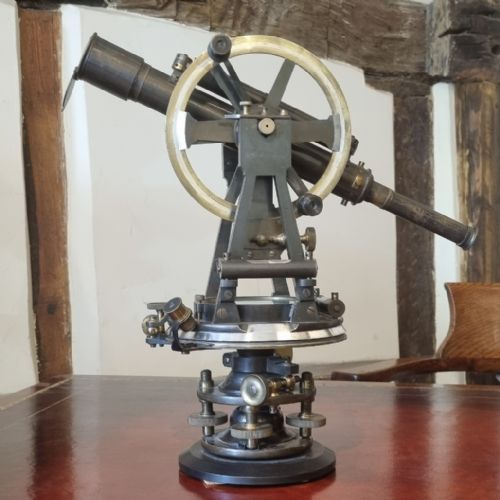

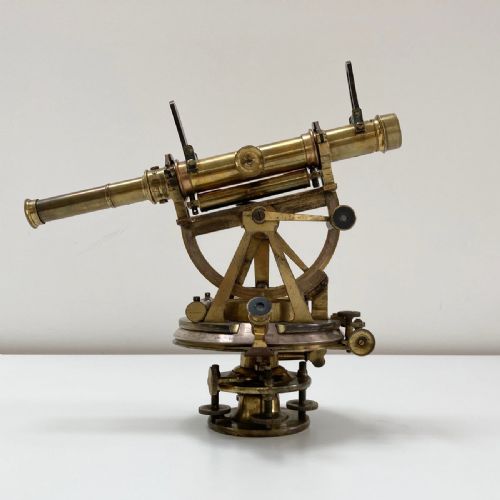

Vintage Transit Instrument
A vintage transit instrument is a piece of precision surveying and navigational equipment built to measure angles, designed for the desk or the field.
Vintage Transit Instrument
When you search for a vintage transit instrument, you encounter specialised surveying and navigational apparatus from the Georgian, Victorian, Edwardian, and First World War military eras. These scientific instruments and related equipment span periods from 1800 through to 1910, reflecting practical field use and scientific enterprise.
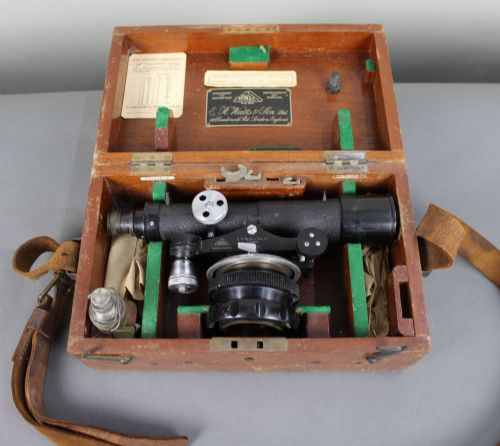
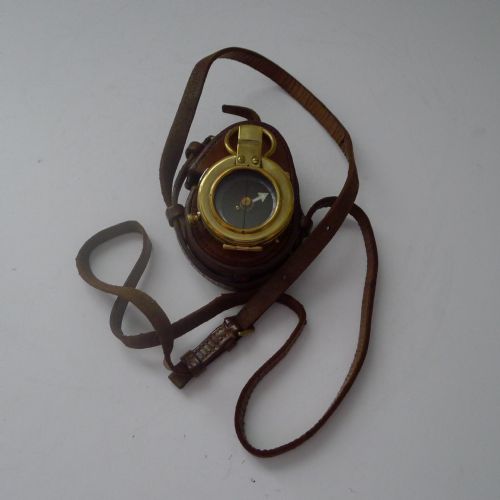
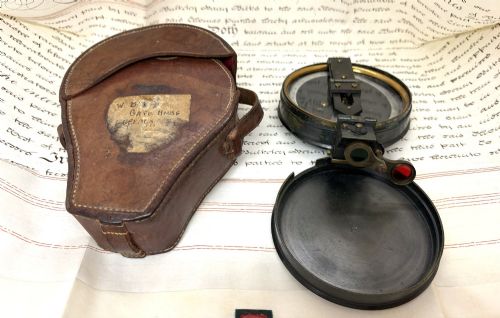
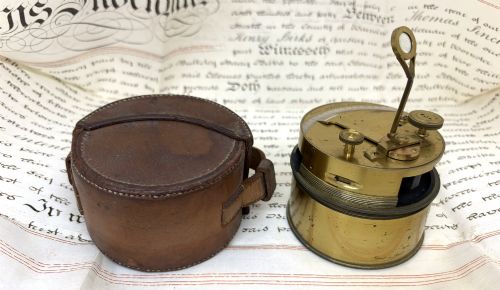
The objects on this page include theodolites, compasses, architects levels, and instrument cases, reflecting the work of makers in London, Edinburgh, Devonport, Madras, and elsewhere. You are most likely to meet brass theodolites and compasses housed in fitted wooden cases.
Surveying and navigation tools from these centuries served practical mapping, military, and engineering needs rather than decorative purposes. Their survival reflects the durable construction standards applied to scientific apparatus during the nineteenth and early twentieth centuries.
Materials and construction
These instruments utilise polished brass and silvered metal for their optical and scale components, paired with glass lenses and dials. The metals are turned, engraved, and fitted to maintain precision under field conditions.
Hhousings and transport boxes are constructed from hardwoods such as mahogany and finished with leather straps and velvet linings to protect delicate internal mechanisms.
Listings feature scientific instruments spanning the Victorian, Edwardian, and First World War military periods, primarily constructed from brass, mahogany, and glass.
Distinctions in quality
Quality in a vintage transit instrument is determined by the precision of the engraving, the clarity of the silvered metal dials, and the smoothness of the mechanical adjustments. Finer examples exhibit meticulous craftsmanship by established instrument makers.
The integrity of the original fitted case, whether mahogany or leather with velvet lining, alongside legible signatures and intact glass, separates standard production from superior examples.
French Ltd.·P. Orr, Madras·Baker, London·W&S Jones·Negretti & Zambra·Elliott Bros. of London·Alexander Adie of Edinburgh·Cox of Devonport·WF Stanley
The Vintage Transit Instrument Glossary
- Theodolite
- A precision instrument for measuring horizontal and vertical angles, mounted on a tripod for surveying and triangulation.
- Prismatic compass
- A pocket-sized navigational tool featuring a prism that allows the user to view the magnetic bearing and the target simultaneously.
- Altazimuth
- An instrument designed to measure both altitude and azimuth coordinates of celestial or terrestrial objects.
- Silvered metal
- A base metal treated with a silver coating to provide a clear, reflective surface for engraved graduation scales.
Vintage Transit Instrument: Frequently Asked Questions
What is a transit instrument?
A transit instrument is a precision optical device used by surveyors and astronomers to measure angles in the vertical and horizontal planes.
These pieces were essential for mapping, construction, and navigation during the nineteenth and early twentieth centuries.
How were these instruments used?
Surveyors, engineers, and military officers used them in the field to establish boundaries, map terrain, and calculate positions.
They were mounted on tripods and carefully calibrated before taking precise measurements through telescopic lenses.
How do I date a piece?
Dating relies on maker signatures, engraved style, patent dates, and the specific materials utilised in the construction.
Makers often inscribed their names and addresses directly onto the silvered metal dials or brass plates.
Are wooden cases original?
Many instruments survive with their fitted mahogany or leather cases, often lined with velvet to protect the brass components.
Original cases frequently bear maker labels or fitted compartments designed specifically for that individual apparatus.