




Vintage Tapestry Pillow
These vintage tapestry pillow examples bring together centuries of woven textile fragments and decorative borders into everyday interiors.
Vintage Tapestry Pillow
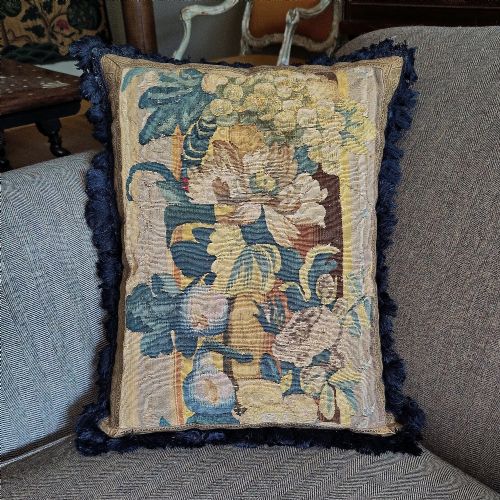
A vintage tapestry pillow repurposes historic woven textiles, fragments, and borders into functional cushions for domestic interiors. These pieces draw on traditional textile crafts from various regions and centuries, adapted into cushion covers and cushions.
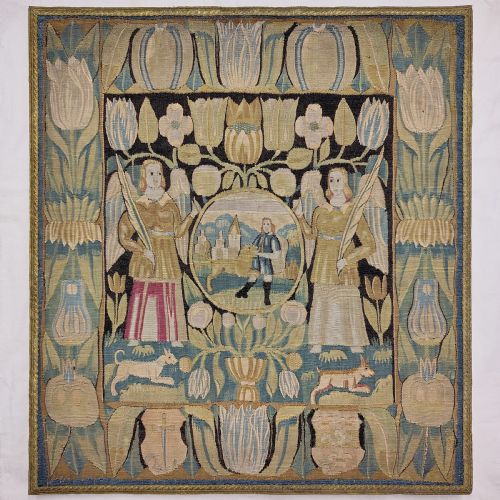
The selections encountered here most frequently include French Aubusson examples alongside Anatolian and Turkmen tribal flatweaves. Pieces range from seventeenth-century Flemish tapestry borders to nineteenth-century French and tribal formats.
Buyers look for these items to introduce texture, historic pattern, and colour into modern or traditional rooms. The forms span simple cushion covers to stuffed cushions trimmed with passementerie.
Materials and construction
Construction relies on historic textiles woven from wool, silk, cotton, and linen. These foundational fibres were worked using traditional weaving techniques to create dense pictorial or geometric surfaces.
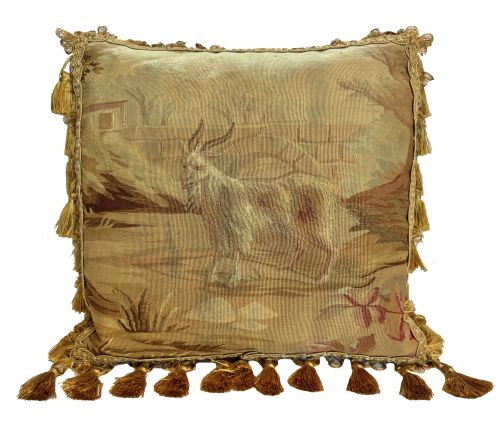
Many examples incorporate passementerie or passementerie trim to finish the edges of the textile panels. The resulting panels are then backed and assembled into cushions and cushion covers.
A nomadic storage bag gets a second life as a sofa cushion.
Assessing quality
Quality rests upon the fineness of the original weave and the complexity of the design rendered in wool and silk. Tightly woven early fragments demonstrate superior structural integrity compared to later or simpler iterations.
The integrity and preservation of the historic textile surface dictate the overall standing of the piece. Well-preserved borders and Aubusson panels maintain clearer pictorial detail and more harmonious colour retention across the face of the cushion.
The Vintage Tapestry Pillow Glossary
- Aubusson
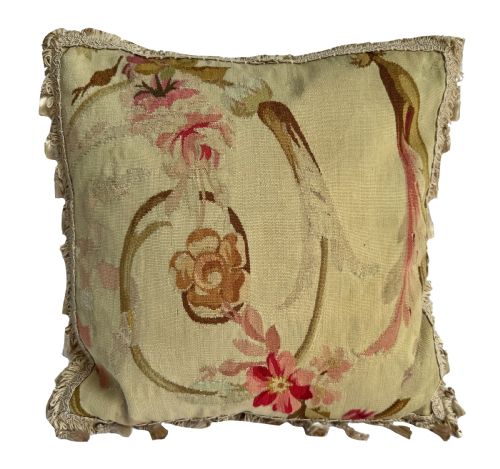
- A style of tapestry originating from the French town of Aubusson, known for floral and architectural motifs. These woven panels are frequently repurposed into decorative cushion covers.
- Kilim
- A flatwoven carpet or rug produced in regions including Anatolia, utilised here in cushion form. The technique yields a smooth surface without a pile.
- Passementerie
- Decorative edgings, braids, or fringes applied to the borders of textiles. This trimmings work frames the tapestry face of the cushion.
- Chuval
- A large tribal bag face produced by Turkmen weavers, often featuring traditional guls. These flatwoven pieces are sometimes converted into cushions.
- Flemish tapestry
- Woven wall hangings produced in the Flanders region during periods such as the seventeenth century. Border fragments from these works appear on cushions.
Vintage Tapestry Pillow: Frequently Asked Questions
What is a vintage tapestry pillow?
A vintage tapestry pillow is a decorative cushion constructed from historic woven textiles, such as Aubusson panels, Flemish tapestry borders, or tribal flatweaves.
These pieces repurpose older fragments into functional home accessories while retaining their original material composition of wool, silk, linen, and cotton.
How do I care for antique cushions?
Care involves protecting the delicate historic fibres from direct sunlight and excessive friction. Gentle handling preserves the wool and silk threads of the vintage textile.
Professional textile cleaning is recommended when maintenance is required, avoiding harsh washing methods that damage the weave.
Where were Aubusson cushions made?
Aubusson cushions originate from France, specifically the historic weaving centre of Aubusson. The workshops there produced renowned pictorial tapestries.
Fragments from these French weaves are subsequently fashioned into cushion covers and decorative pillows.
What is the difference between a Kilim and an Aubusson?
Kilims are flatwoven tribal textiles featuring geometric patterns, often originating from Anatolia or Turkmen regions. They present a different aesthetic to French Aubusson pieces.
Aubusson works utilise pictorial, floral, and classical motifs woven in softer colour palettes using wool and silk.