



Vintage Sidearm
These vintage sidearm pieces are historical firearms and military hardware that collectors prize for their functional heritage and period design.
Vintage Sidearm
When you search for a vintage sidearm, you are looking at historical firearms and military hardware originating from the eighteenth and nineteenth centuries. These objects include flintlock pistols, percussion cap sidearms, and rimfire or pinfire revolvers associated with military service and civilian defence.
The versions you are most likely to meet on this page belong to the nineteenth century, including Victorian military issues, American Civil War era revolvers, and British officer sidearms. Scottish silver flintlock pocket pistols and eighteenth century duelling pieces also appear among these listings.
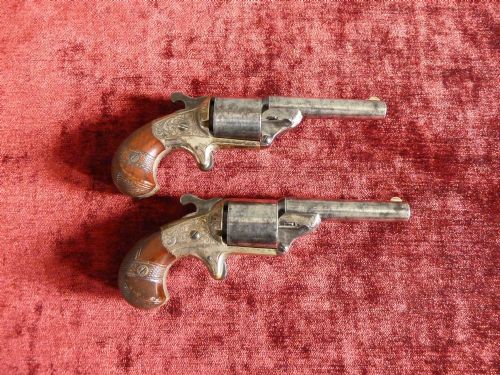
Forms span cavalry pistols, double barrel designs featuring foldaway bayonets, and matched pairs of revolvers. Their origins bridge British, American, and Scottish workshops, reflecting the practical sidearm requirements of officers and soldiers during periods of active conflict.
How they were made
Makers constructed these sidearm pieces using robust metals such as steel, iron, and brass for barrels, locks, and furniture. These components were forged and machined to withstand the mechanical stresses of black powder ignition and mechanical recoil.
Stocks and grips utilise hardwoods, notably walnut, shaped to fit the hand and pinned or fastened to the metal frame. Precious metals like silver appear on select Scottish pocket pistols for decorative mounts and sideplates.
Vintage Sidearm Retail Price Guide 2026
Typical asking prices for vintage sidearm among the pieces listed under this phrase on Sellingantiques today, from the lower quarter to the upper quarter. They describe what is for sale here now, not the wider market.
Some nineteenth-century travellers clearly valued dual-purpose engineering, carrying a pocket pistol that doubled as a foldaway bayonet.
What varies in quality
The distinction between standard military issue and finer officer pieces lies in the precision of the lock mechanism and the finish of the metalwork. London makers and notable firms applied higher standards of engraving and fitting compared to utilitarian martial arms.
The preservation of original matching components, such as serial numbers on revolvers and maker signatures on locks, elevates the standing of a piece. Finer examples retain crisp metal markings and sound wood grips without extensive replacement parts.
Meyer and Mortimer·Barber of Newark·Colt
The Vintage Sidearm Glossary
- Flintlock
- An ignition mechanism utilising a piece of flint held in a cock to strike a steel frizzen, creating sparks to ignite priming powder. This system predates percussion caps.
- Percussion
- A lock type using a small priming cap placed on a nipple, struck by the hammer to fire the main charge. It replaced the flintlock system in the nineteenth century.
- Smoothbore
- A barrel lacking internal rifling grooves, designed to fire lead balls without imparting spin. Many early military pistols feature this bore type.
- Rimfire
- A metallic cartridge type where the priming compound is located within the hollow folded rim of the casing. The firing pin strikes the edge to ignite the round.
- Pinfire
- An early self-contained cartridge featuring a small internal pin projecting radially from the base of the cartridge case. The hammer strikes this pin to ignite the priming mixture.
Vintage Sidearm: Frequently Asked Questions
What periods do these sidearms come from?
The pieces span the eighteenth and nineteenth centuries, capturing key eras of military history. You will find items from Georgian times alongside Victorian military issues and the American Civil War period.
Dates range from specific years like eighteen-fifty and eighteen-sixty through to broader nineteenth-century designations. Each period reflects distinct technological shifts in firearm ignition and military doctrine.
How were these pistols used historically?
These sidearms served military officers, cavalry troopers, and civilians for personal defence and combat. Cavalry units relied on single-shot percussion or multi-shot revolvers at close range.
Officers purchased private-purchase pieces like flintlock duelling pistols or London-made percussion arms for personal service. Pocket pistols provided discreet protection for civilian travellers during the eighteenth and nineteenth centuries.
What materials are typical for these pieces?
Construction relies heavily on ferrous and non-ferrous metals, with steel and iron forming barrels and lock mechanisms. Brass appears frequently in trigger guards, backstraps, and frame components.
Stocks utilise dense hardwoods, predominantly walnut, chosen for durability under field conditions. Select pieces incorporate silver mounts for decorative enhancement.
How do flintlock and percussion pistols differ?
Flintlock pistols use a piece of flint striking a steel plate to generate sparks that ignite loose gunpowder in an external pan. This mechanical system was standard through the eighteenth and early nineteenth centuries.
Pistols use an enclosed percussion cap placed on a nipple, struck directly by the hammer to fire the charge. This later system offered greater reliability in damp weather and faster reload times.