


Vintage Sailing Ship Diorama
These vintage sailing ship diorama pieces bring the sea indoors, offering miniature maritime scenes constructed with remarkable detail inside glass cases and bottles.
Vintage Sailing Ship Diorama
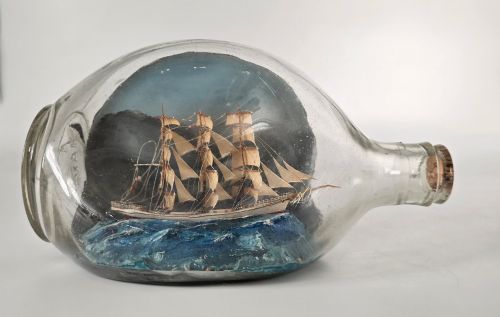
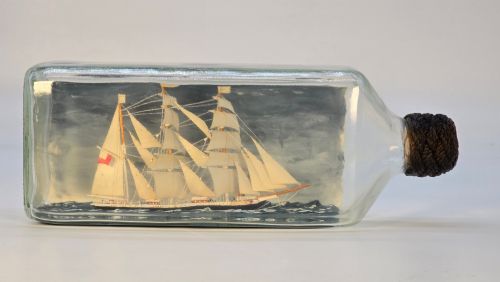
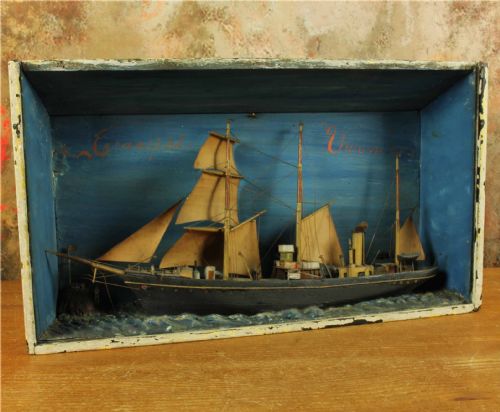
A vintage sailing ship diorama captures maritime history in three dimensions, presenting vessels like clippers, barques, and racing ships set against painted seascapes. Buyers searching for a vintage sailing ship diorama encounter shadow box displays, cased wall art, and intricate ship models enclosed within glass bottles.
The pieces on this page span the Victorian era into the early twentieth century, drawing heavily on British and French folk art traditions. Many examples record specific vessels, such as the named ships Glynllifon and Queen Anne, or capture dramatic scenes of two vessels racing at sea.
Makers ranged from professional marine craftsmen to folk artists working with readily available materials. These creations function primarily as maritime folk art, offering a glimpse into nineteenth-century and early twentieth-century naval craftsmanship.
Materials and construction methods
Makers constructed these dioramas using wood for the hulls and plinths, canvas and thread for the sails and rigging, and rope for maritime details. Plaster and cork frequently built up the dimensional sea waves and coastal landforms, which were then finished with paint.
Enclosure was a vital technique, sealing the delicate models inside glass bottles or wooden shadow boxes to protect the canvas and thread components from dust and damage. Scratch-built wooden components required immense patience, particularly when fitting completed models through narrow bottle necks.
Object types seen on this page include maritime dioramas, shadow box dioramas, ship in a bottle models, and wall art.
Judging quality in maritime dioramas
Quality rests in the precision of the rigging and the naturalism of the painted backdrop, where finer pieces achieve a convincing sense of depth and motion. The complexity of the vessel, such as a clipper in full sail or two ships racing, distinguishes standard examples from more ambitious works.
The preservation of original materials like canvas sails, painted plaster, and glass housing dictates the overall integrity of the piece. Well-maintained wooden plinths and intact bottle seals indicate how carefully a diorama has survived over the decades.
The Vintage Sailing Ship Diorama Glossary
- Diorama
- A three-dimensional scene representing a historical event or physical setting. In this context, it houses a model ship within a framed box or glass enclosure.
- Clipper
- A very fast nineteenth-century sailing ship with three masts and square sails. These vessels appear frequently in Victorian maritime art.
- Barque
- A sailing ship with three or more masts, having the fore and mainmasts square-rigged and the mizzenmast fore-and-aft rigged. They formed the backbone of merchant fleets.
- Shadow Box
- A deep, glass-fronted picture frame designed to display objects in relief. It protects miniature maritime models while allowing clear viewing from the front.
- Scratch-built
- A model built completely from raw materials rather than from a commercial kit. Makers used wood, thread, and canvas to construct these pieces by hand.
Vintage Sailing Ship Diorama: Frequently Asked Questions
What is a vintage sailing ship diorama?
It is a three-dimensional maritime display featuring a handmade ship model housed inside a glass bottle, shadow box, or wooden case.
These pieces combine carved wood, painted backdrops, and textile rigging to recreate historical vessels and sailing scenes.
How were ships placed inside bottles?
Makers constructed the masts and rigging with clever hinges and folding threads so the vessel could pass through the narrow bottle neck.
Once inside, pull-strings raised the masts and secured the rigging into the painted plaster sea floor.
Where should I display my diorama?
These pieces suit sideboards, bookshelves, or walls where adequate lighting highlights the depth of the painted seascapes.
Keep them away from direct sunlight and high humidity to protect the delicate canvas sails and wooden components.
How do I date an antique diorama?
Dating relies on the style of the ship rigging, the construction of the wooden box, and the type of glass used in the case.
Named ships and written inscriptions on the plinth or bottle often provide a direct link to a specific nineteenth or early twentieth-century period.