


Vintage Purple Amethyst Ring
A vintage purple amethyst ring brings deep violet quartz into gold and platinum settings, offering bold colour and historic character for daily wear.
Vintage Purple Amethyst Ring
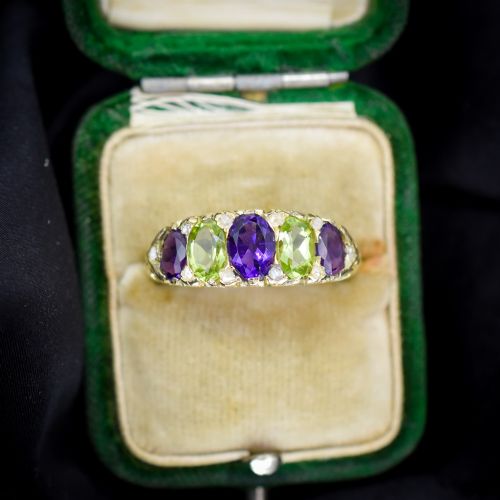
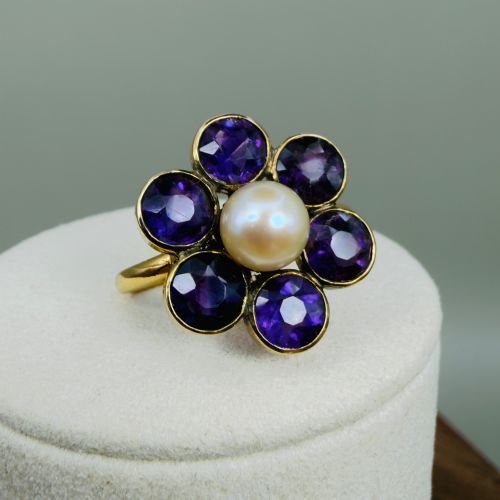
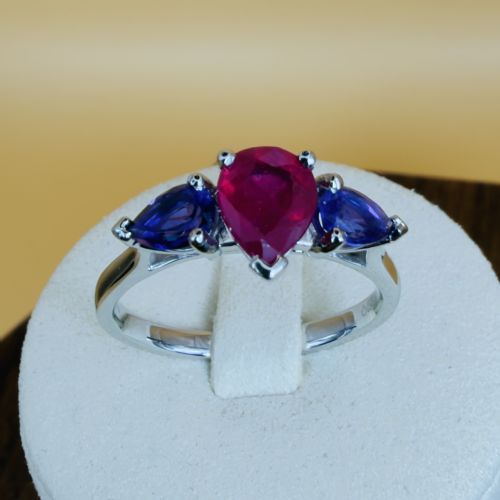
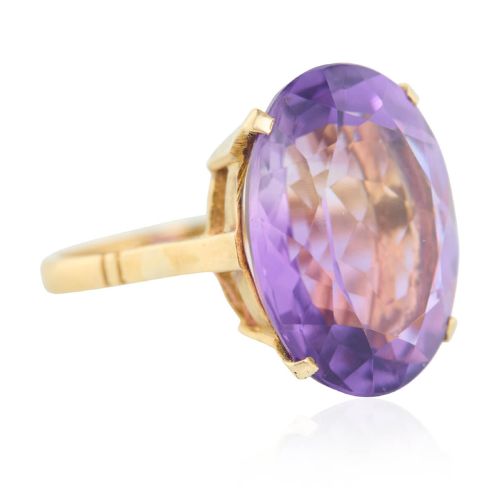
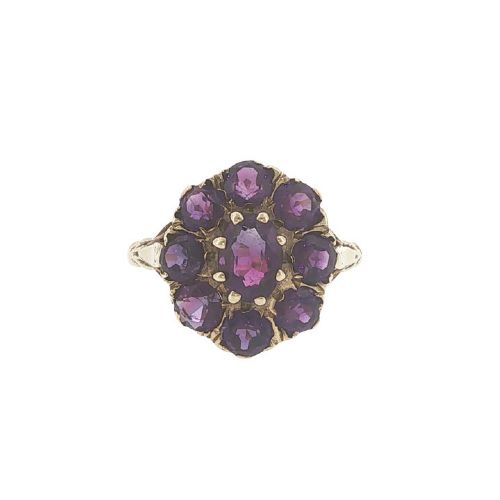
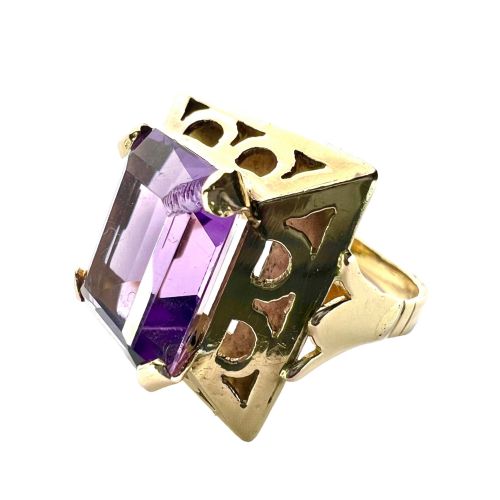
A vintage purple amethyst ring spans Georgian, Victorian, Edwardian, Art Deco, and mid-century periods, showcasing how jewellers set large purple quartz across two centuries. Buyers searching for a vintage purple amethyst ring encounter diverse forms, from delicate clusters surrounded by pearls to substantial cocktail rings weighing over twenty carats.
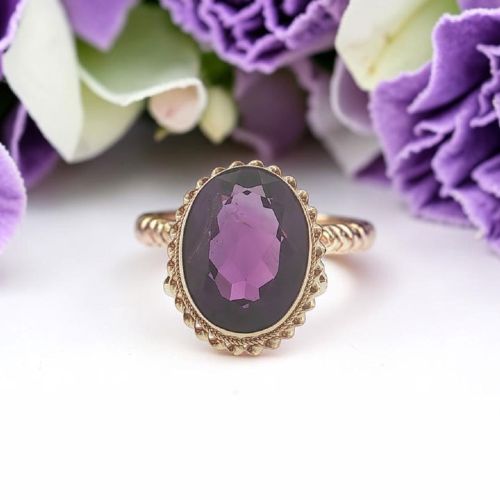
The pieces on this page lean heavily towards mid-century productions alongside significant antique examples from the nineteenth century and the Art Deco era. Solitaires, multi-stone settings, and halo designs dominate the selection, often pairing the purple stones with diamonds, pearls, or peridots.
How they were made
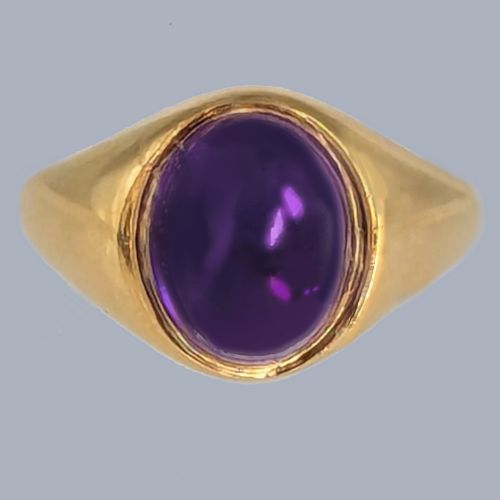
Goldsmiths worked primarily in 9ct and 18ct yellow and rose gold, platinum, and occasionally silver, casting and forging mountings to securely hold substantial faceted or cabochon stones. Stones received various cuts including emerald, cushion, pear, heart, and round profiles, tailored to maximise the depth of the purple hue.
Settings frequently incorporate claw mounts, bezels, and cluster arrangements where smaller diamonds or seed pearls frame the central purple amethyst. Hallmarks punched into the metal bands record the assay town and year of production, anchoring the construction in a specific decade.
Listings feature periods spanning from Georgian and Victorian eras through to the 1970s.
What varies in quality
The calibre of a ring depends upon the saturation and clarity of the purple quartz, the weight of the precious metal used in the shank, and the precision of the stone cutting. Superior examples balance massive carat weights with clean internal facets and robust, hallmarked settings that have withstood decades of wear.
The Vintage Purple Amethyst Ring Glossary
- Cluster ring
- A design featuring a central gemstone surrounded by a ring of smaller accent stones, such as diamonds or pearls.
- Cocktail ring
- A large, statement ring designed to draw attention, frequently set with an oversized gemstone during the mid-century and Art Deco periods.
- Cabochon
- A gemstone shaped and polished with a smooth, rounded surface rather than faceted edges.
- Hallmark
- Official marks stamped into precious metal to indicate purity, origin, and the year of testing.
- Solitaire
- A ring mounting holding a single gemstone without additional accent stones.
Vintage Purple Amethyst Ring: Frequently Asked Questions
How do I clean my amethyst ring?
Wash the ring gently using warm soapy water and a soft brush to remove everyday oils from the stone and setting. Avoid harsh chemical cleaners or ultrasonic machines which can damage softer surrounding pearls.
Dry the piece thoroughly with a lint-free cloth before storing it away from direct sunlight to preserve the purple colour of the quartz.
Are amethyst rings durable enough for daily wear?
Amethyst rates a seven on the Mohs hardness scale, making it reasonably resilient for regular use if treated with care. Rings set in robust gold or platinum bezels offer better protection against knocks than high prong settings.
Removing the jewellery during heavy physical tasks prevents unnecessary scratching to both the purple stone and the metal band.
What is a suffragette ring?
A suffragette ring typically combines green peridot, white pearls or diamonds, and purple amethyst to represent the colours of the women's social and political union. These pieces date predominantly from the Edwardian era and early twentieth century.
They carry distinct historical significance alongside their decorative gemstone arrangement.
How can I date my vintage ring?
Examine the inner band for stamped hallmarks that indicate the assay office, metal purity, and a date letter corresponding to specific years. The overall style, cut of the amethyst, and manufacturing techniques also point towards periods like Art Deco or mid-century design.
Comparing these details with known historical benchmarks helps narrow down the decade of creation.