
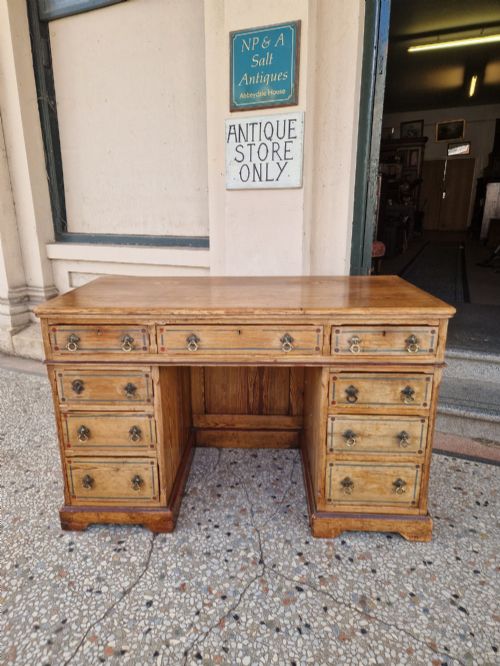
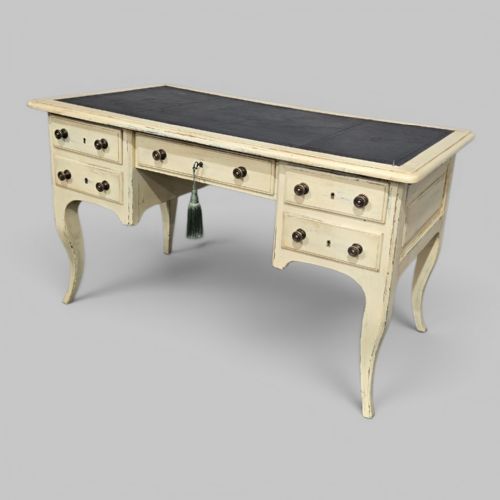
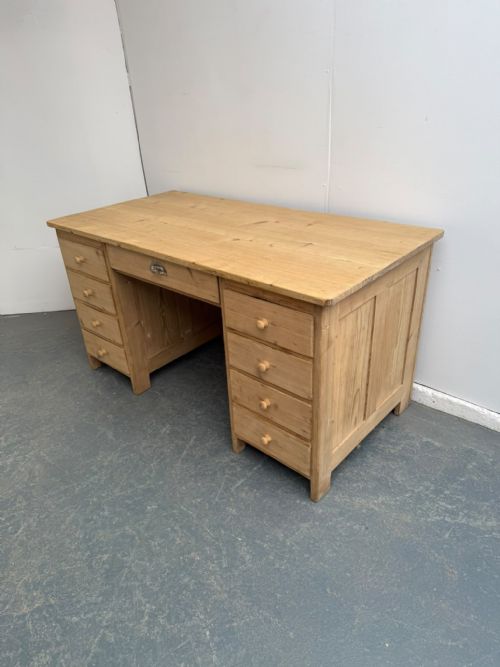


Vintage Painted Kneehole Desk
These vintage painted kneehole desk pieces bring together working surfaces and fitted drawers beneath decorated timber.
Vintage Painted Kneehole Desk
A vintage painted kneehole desk offers a central recess for the sitter flanked by pedestals of drawers, finished with surface paint rather than bare grain. The selection here spans simpler country pine pieces alongside more formal dressing tables and writing desks from the nineteenth century into the nineteen-twenties.
The styles range from English country and Victorian to French provincial, Swedish Gustavian, and Sheraton revival. Buyers encounter both dedicated desks and versatile dressing tables adapted for writing use, often sharing the same recessed pedestal proportions.
Materials and construction
Makers built these pieces primarily using pine, pitch pine, and assorted wood substrates finished with decorative paintwork or lacquer. Brass fittings such as handles and key escutcheons appear across the construction, while specific variants incorporate mirror glass.
Surfaces received layers of paint, sometimes simulating finer timbers like satinwood or pine, or featuring decorative schemes such as Chinoiserie motifs. Cabinetmakers constructed the carcase to house multiple drawers around the central kneehole space, relying on traditional joinery.
One listed item combines nineteenth-century utility with canine architecture, designated simply as a dog kennel dresser.
Judging quality and finish
Quality rests primarily in the survival of original decorative paintwork and the crispness of the applied decoration, whether intricate Chinoiserie lacquer or simple country brushwork. Better pieces retain their early painted surfaces without clumsy later overpainting masking the timber beneath.
Construction integrity defines the upper tier, seen in smooth-running drawers, stable carcases, and well-fitted brass hardware. Proportion and style execution also separate utilitarian workshop items from refined examples in Gustavian, Regency, or Arts and Crafts idioms.
The Vintage Painted Kneehole Desk Glossary
- Kneehole desk
- A writing table featuring a central recessed space for the legs, flanked on both sides by stacks of drawers. This layout allows the user to sit directly facing the centre of the furniture.
- Chinoiserie
- European decorative style imitating Chinese artistic traditions, frequently employing gold motifs on lacquered backgrounds. It appears on desks and dressing tables from the early twentieth century.
- Pitch pine
- A durable softwood with prominent grain patterns frequently utilised in nineteenth-century cabinetmaking. Craftsmen valued it for structural strength and distinctive figuring.
- Gustavian
- The Swedish interpretation of neoclassical design, known for pale painted finishes and restrained classical ornamentation. Pieces from this tradition often feature soft grey, cream, or white paintwork.
- Serpentine
- A curved furniture front characterised by a convex centre flanked by concave ends. This contour adds visual movement to the piece.
Vintage Painted Kneehole Desk: Frequently Asked Questions
What is a kneehole desk?
A kneehole desk is a piece of furniture designed for writing, featuring a central void for the user's legs with pedestals of drawers on either side. This layout provides ample storage while allowing a comfortable seated position.
Such configurations appear across various nineteenth-century and early twentieth-century styles, from simple pine country pieces to formal painted dressing tables.
How do I date a painted desk?
Dating relies on examining the construction methods, timber types, and the composition of the paint layers. Earlier nineteenth-century examples often utilise solid pine or pitch pine with hand-cut joints.
Stylistic cues such as Regency or Arts and Crafts details further narrow the period of manufacture. Paint analysis helps distinguish original decorative schemes from later refurbishments.
Are dressing tables usable as desks?
Many dressing tables share the same kneehole configuration and dimensions as writing desks, making them practical for modern workspace use. Historic pieces often served multiple domestic functions depending on the room.
Buyers simply need to check that the kneehole height and clearance accommodate a standard chair comfortably.
How do I care for painted wood?
Painted wooden furniture requires gentle cleaning with a soft, dry cloth to remove dust without abrasive action. Avoiding direct sunlight and excessive moisture protects the decorative surface from fading or flaking.
Preserving the finish maintains the historical character of the piece.