






Vintage Oriental Room Divider
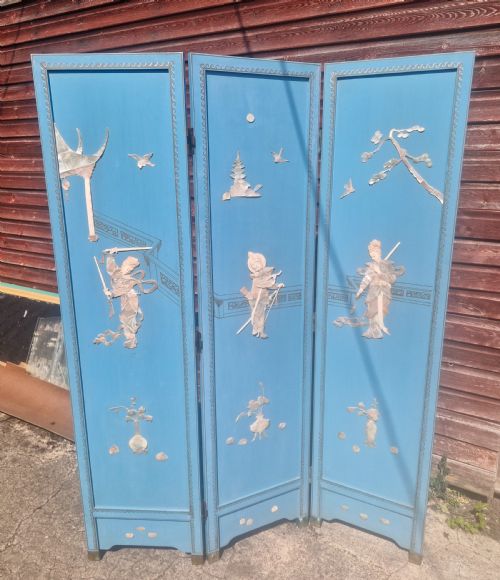
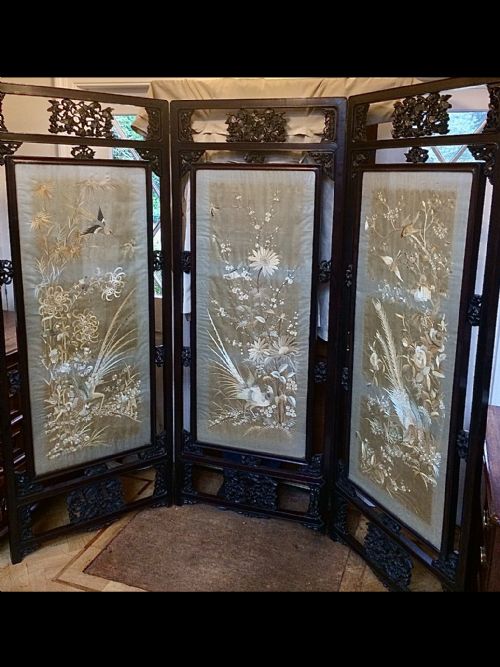
These vintage oriental room divider pieces are folding screens that partition a space with painted lacquer, carved wood and intricate textile panels.
Vintage Oriental Room Divider
A vintage oriental room divider typically takes the form of a multi-panel folding screen constructed to partition interior spaces or create intimate corners within a room. Buyers searching for a vintage oriental room divider will encounter various configurations ranging from three-fold dressing screens to grand eight-fold panels. The pieces recorded here span from the late nineteenth century through to the mid-twentieth century, showing diverse regional influences including Chinese, Japanese, Burmese and Anglo-Indian traditions.
Most examples function primarily as freestanding architectural screens, though some smaller variants serve as dressing screens or decorative wall panels. The forms vary from traditional Chinese lacquered screens featuring hardstone inlay to intricately carved wooden panels from India and Burma. Textile panels also appear, notably in Japanese works that utilise woven fabrics rather than painted surfaces.
Materials and construction methods
Wood serves as the foundational structure for these folding screens, with dense hardwoods, teak and lighter timber frames providing the necessary support for multi-panel hinges. Lacquer finishes feature extensively, applied in multiple coats to create deep black or coloured grounds that accept gold leaf detailing and painted motifs. Skilled artisans built up decorative surfaces by embedding hardstone, mother-of-pearl or carved bone directly into the lacquered wood.
Alternative traditions rely heavily on intricate fretwork and deep carving rather than surface painting, particularly in examples originating from Burma and India. Textile screens employ stretched silk within wooden frames, whilst other pieces incorporate painted paper panels backed by sturdy wooden armatures. Brass and metal hinges connect the individual leaves together, allowing the screens to fold in both directions.
Vintage Oriental Room Divider Retail Price Guide 2026
Typical asking prices for vintage oriental room divider among the pieces listed under this phrase on Sellingantiques today, from the lower quarter to the upper quarter. They describe what is for sale here now, not the wider market.
WILLIAM MORRIS made a room divider, proving that even Victorian textile royalty occasionally fancied a bit of oriental folding scenery.
Assessing quality in folding screens
The sophistication of the surface decoration and the depth of the carving dictate the distinction between standard production pieces and finer works. Superior examples exhibit meticulous hand-painting, precise gold leaf application and securely mounted hardstones that sit flush within the lacquer. Lesser works may rely on simpler printed or stencilled motifs rather than hand-applied artistry.
Structural integrity also separates the grades, visible in the weight of the timber and the quality of the joinery connecting the individual panels. Finer screens utilise robust wooden frames that prevent warping across multiple folds, whereas simpler items employ lighter woods that are more susceptible to movement over time.
The Vintage Oriental Room Divider Glossary
- Chinoiserie
- European artistic interpretation and imitation of Chinese and East Asian artistic traditions, popular in furniture and decorative screens. This style often incorporates fantastical landscapes and pavilion architecture.
- Hardstone
- Naturally occurring decorative stones such as jade, agate or soapstone cut and polished for inlay work. These stones add dimension and colour variation to lacquered screen panels.
- Lacquer
- A durable resin finish derived from trees that hardens into a smooth, glossy coating. It provides a protective base for intricate painting and gold leaf enrichment.
- Fretwork
- Ornamental perforated woodwork created by cutting patterns through thin boards. This technique appears frequently in carved screens from South and Southeast Asia.
- Meiji
- A historical period in Japan lasting from 1868 to 1912, known for exceptional decorative arts and export folding screens. Pieces from this era often showcase detailed textile work and painted decoration.
Vintage Oriental Room Divider: Frequently Asked Questions
How do I use a room divider in a modern home?
A folding screen works effectively to zone open-plan living areas, creating private study corners or dressing spaces without building permanent walls.
Position the panels at an angle to ensure stability and allow the decorated surface to catch the ambient light of the room.
What is the difference between Chinese and Japanese screens?
Chinese screens often feature heavy lacquer, carved wooden reliefs and inlaid hardstones that create a tactile, three-dimensional surface.
Japanese examples more commonly emphasise painted textiles, delicate brushwork and textile panels framed within lighter wooden structures.
How many panels do these screens usually have?
The pieces recorded here most frequently feature fourfold or sixfold configurations, though three-fold dressing screens and larger eight-fold variants also appear.
More panels provide greater width and stability when arranged in a zig-zag configuration across a floor.
How should I clean a lacquered screen?
Dust the wooden framework and panels gently with a dry, soft microfiber cloth to prevent surface scratching.
Avoid using chemical polishes, water or abrasive cleaners that can damage delicate lacquer finishes, gold leaf and inlaid hardstone.