
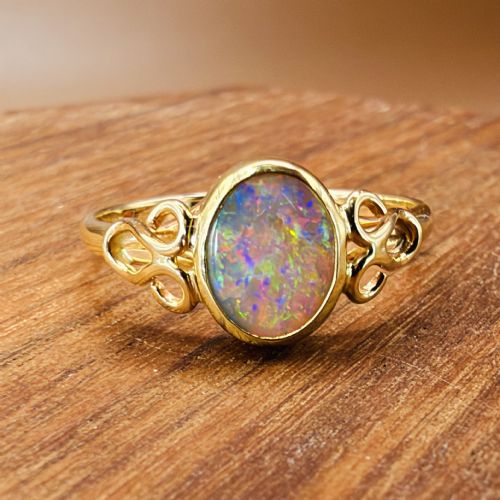
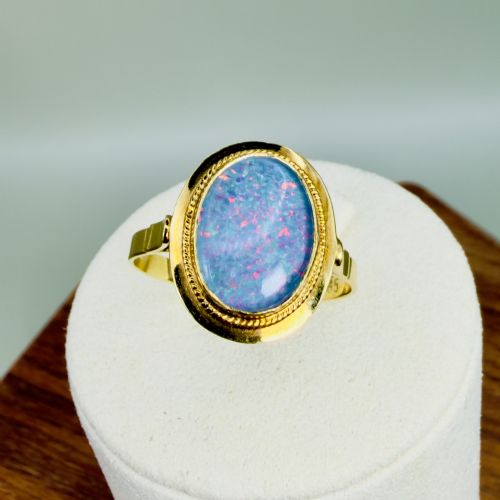


Vintage Opal Statement Ring
A vintage opal statement ring catches the light with shifting play-of-colour, offering bold presence on the hand through varied golden settings.
Vintage Opal Statement Ring
A vintage opal statement ring brings together substantial central stones and decorative mountings from eras such as the Victorian period, Art Deco, and the mid-century decades. These pieces function primarily as dress or cocktail rings designed to draw the eye through sheer scale and optical variety.
You are most likely to encounter gold and platinum settings housing single large cabochons or clusters flanked by diamonds, sapphires, or emeralds. The forms range from traditional solitaire mounts to elaborate multi-gem arrangements originating across the nineteenth and twentieth centuries.
How they were made
Goldsmiths utilised metals including 9ct and 18ct gold, white gold, and platinum to fabricate secure settings for fragile silica stones. Bezel and cluster constructions protect the softer edges of the opal while maximising the exposure of the stone to light.
Gem-setters integrated supporting diamonds, garnets, and emeralds around the central opals using precision claw and flush techniques. These methods ensured durable mounts capable of holding significant carat weights firmly in place during daily wear.
Periods represented span from the 19th century and Victorian era through the 1930s, 1940s, 1950s, and 1960s.
What varies in quality
The intensity and spectral range of the play-of-colour within the opal dictate the visual standing of the ring. Stones displaying vibrant flashes of red, green, and blue across the entire surface command greater appreciation than those with muted or patchy colour distribution.
The structural integrity of the metalwork and the harmonious integration of supporting gemstones influence the overall calibre of the piece. Substantial platinum or high-carat gold mounts paired with well-matched diamonds elevate the sophistication of the design.
The Vintage Opal Statement Ring Glossary
- Cabochon
- A gemstone shaped and polished with a smooth rounded surface rather than faceted. This style preserves the internal play-of-colour characteristic of opals.
- Play-of-colour
- The optical phenomenon where spectral colours shift and flash across the stone as the angle of light changes. This visual property forms the primary appeal of every opal.
- Solitaire
- A ring featuring a single prominent gemstone set centrally on the band. In these selections, such stones often present substantial carat weights.
- Cluster ring
- A design featuring a central gemstone surrounded by a ring of smaller stones, frequently diamonds. This arrangement maximises surface area and visual impact on the hand.
- Bezel set
- A method where a thin metal collar wraps entirely around the edge of the gemstone to hold it securely. This technique offers robust protection for softer stones.
Vintage Opal Statement Ring: Frequently Asked Questions
How do I care for my opal ring?
Opals possess a lower hardness than diamonds and contain water within their structure, requiring gentle treatment during daily wear. Avoid exposing them to harsh chemicals, ultrasonic cleaners, or sudden temperature extremes.
Store the ring separately in a fabric-lined box to prevent scratching from harder jewellery pieces. Clean the stone simply with a soft, damp cloth without soaking it in water for extended periods.
Can I wear a vintage opal ring every day?
These rings tolerate regular wear provided you exercise mindfulness regarding impact and abrasion. Choosing a protective bezel setting helps shield the stone edges from accidental knocks.
Removing the ring during manual labour, gardening, or exercising ensures the gold or platinum mount and the central opal remain secure and undamaged over time.
What periods do these rings come from?
The pieces span from the nineteenth century and the Victorian era through the Art Deco period of the 1930s into mid-century designs from the 1950s and 1960s. Each era brings distinct metal choices and mounting styles to the jewellery.
Victorian and Edwardian examples often feature intricate cluster work, while mid-century creations lean towards bolder cocktail proportions and clean lines.
What is a boulder opal?
A boulder opal forms naturally within an ironstone matrix, leaving the host rock attached to the back of the precious opal layer. This natural backing adds structural strength and often enhances the depth of the colour.
Such stones provide a distinctive appearance compared to solid crystal opals, making them popular choices for substantial statement rings.